
Cayman Cima Sib Mutual Private Funds
Cayman CIMA SIB Act, SPC Ring-Fencing, Mutual & Private Funds: Institutional Statute Guide
Under Cayman CIMA supervision, over 12,800 open-ended mutual funds and 16,900 closed-ended private funds operate alongside SIB Act dealers and Registered Persons subject to CI$1,000,000 administrative fine powers.
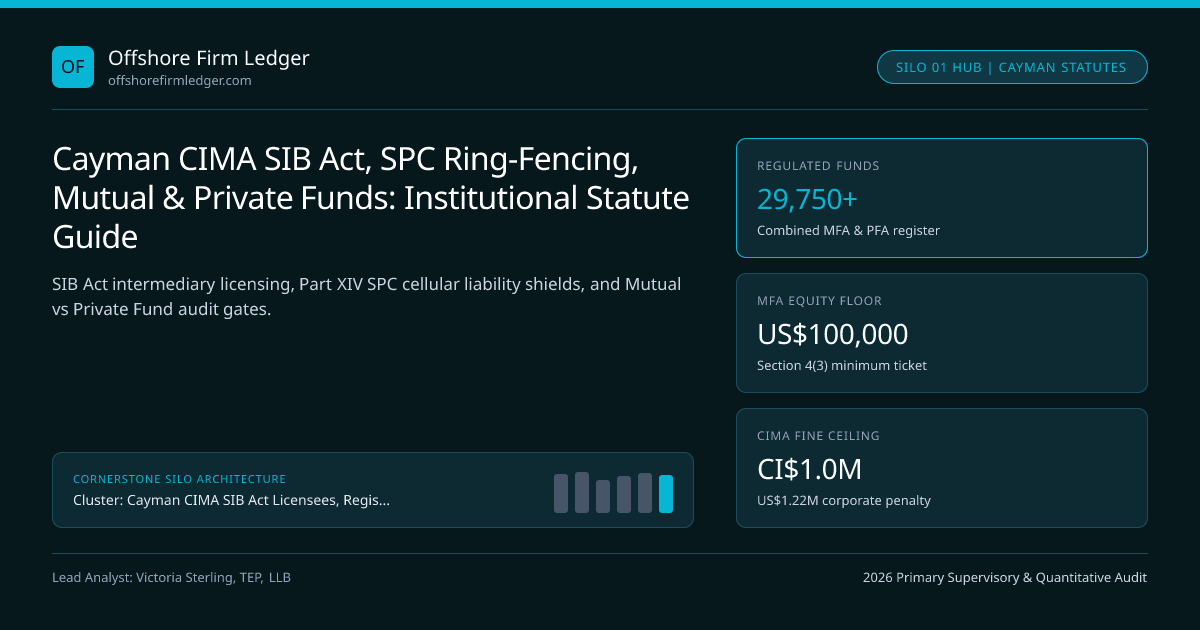
More than 29,700 regulated investment funds—spanning approximately 12,850 open-ended vehicles under the Mutual Funds Act (2025 Revision) and 16,900 closed-ended partnerships and corporate vehicles under the Private Funds Act (2025 Revision)—anchor the global alternative asset ecosystem supervised by the Cayman Islands Monetary Authority in George Town. Institutional allocators, prime brokers, and sovereign wealth committees evaluating a Cayman Islands counterparty must distinguish sharply between fund-level registration, discretionary manager authorization under the Cayman Islands Securities Investment Business Act, and corporate cellular liability shields erected under Part XIV of the Companies Act. Across the Cayman CIMA SIB Act & Fund Governance cluster, statutory reforms enacted between 2020 and 2026 replaced legacy light-touch exemptions with binding governance rules, local audit sign-offs, and standalone administrative fines reaching CI$1,000,000 (US$1,219,512) for entities and CI$100,000 for natural-person directors.
Architecture of Cayman Statutory Charters Across Funds and Securities Dealers#
Grand Cayman operates a bifurcated statutory perimeter separating collective investment vehicles from the investment managers, broker-dealers, and market makers executing trades on their behalf. Open-ended hedge funds that grant investors redemption rights at their own option fall under the Mutual Funds Act, where Section 4(3) Registered Funds require a minimum initial equity subscription of CI$80,000 (customarily documented at US$100,000) per investor unless listed on a CIMA-recognized stock exchange. Conversely, closed-ended private equity, venture capital, infrastructure, and private credit vehicles that do not offer unilateral investor redemptions fall under the Private Funds Act, triggering mandatory CIMA registration within 21 days of accepting capital commitments and prohibiting any drawdowns of investor capital prior to certificate issuance.
Intermediaries dealing in securities, arranging deals, managing discretionary portfolios, or advising institutional clients from or within the islands are governed separately by the Securities Investment Business Act (SIB Act). Following the abolition of the historic "Excluded Person" regime under CFATF mutual-evaluation pressure, former Schedule 4 entities had to requalify as SIB Act Registered Persons or Full Licensees, submitting every director and senior officer to CIMA fitness-and-propriety screening and annual economic substance filings under the OECD FHTP Substance Standard. Digital asset exchanges and token custodians face parallel oversight under Phase 2 of the Cayman VASP Act, while protocol treasuries frequently utilize memberless corporate wrappers under the Cayman Foundation Companies Act.
SIB Act Full Licensing Versus Schedule 4 Registered Persons#
Discretionary asset managers, multi-family offices, and broker-dealers incorporated in Cayman overwhelmingly elect Schedule 4 Registered Person status when serving exclusively "Sophisticated Persons" (US$100,000+ per trade) or "High Net Worth Persons" (CI$800,000 / US$1,000,000 individual net worth or CI$4,000,000 / US$5,000,000 entity assets). Retail-facing brokerages—unlike dealers under BVI FSC or Bahamas SCB charters—cannot use Registered Person status to solicit retail margin clients; they must obtain a full Section 5 SIB Act Licence, maintain net liquid capital, and segregate client money.
Where a brokerage group lists a Cayman entity alongside affiliates such as Aspen Digital or Ascotprime, due diligence teams must check the CIMA online entity search to confirm whether the certificate is a Full Broker-Dealer Licence or a non-retail Registered Person registration. Misrepresenting Registered Person status as a retail licence triggers CIMA controllers and Grand Court winding-up petitions.
Segregated Portfolio Companies and Statutory Cellular Ring-Fencing#
Under Part XIV (Sections 212–228) of the Companies Act, a Cayman exempted company may register as a Segregated Portfolio Company (SPC) creating statutory cells within one legal person. Unlike Incorporated Cell Companies under Channel Islands Fund Regimes, Cayman cells lack separate corporate personality; Section 216 cellular ring-fencing mandates that cell assets answer solely for cell liabilities, shielding general assets and sibling cells.
Execution errors can erode this shield. As analyzed in our review of Grand Court SPC cross-cell contamination and receivership jurisprudence, directors who sign prime brokerage ISDA schedules or margin guarantees without naming the contracting portfolio under Section 218 expose general assets and personal director indemnity, while foreign courts may test unsegregated onshore custody cash under local law.
| Cayman Statutory Regime | Governing Statute & Section | Investor / Client Threshold | CIMA Capital / Audit Mandate | Key Governance & Substance Anchor |
|---|---|---|---|---|
| SIB Act Full Licensee (Broker-Dealer / Market Maker) | SIB Act s.5 & Financial Requirements Regs | Retail or institutional counterparties | Risk-based net liquid capital (min CI$80k–CI$1M+) + 6-month IFRS audit | Binding Rule on Corporate Governance & CIMA-approved MLRO |
| SIB Act Registered Person | SIB Act s.5(4) & Schedule 4 | Sophisticated (US$100k/trade) or HNW (US$1M ind. / US$5M corp.) | No statutory capital floor; annual CIMA declaration by Jan 15 | Minimum 2 natural-person directors (DRLA) + Economic Substance CIGA |
| Section 4(3) Registered Mutual Fund | Mutual Funds Act s.4(3) | Min US$100,000 initial equity (or listed exchange) | Local CIMA-approved auditor sign-off + FAR within 6 months | Independent board oversight + Redemption gate governance |
| Administered / Retail Licensed Mutual Fund | Mutual Funds Act s.4(1)(b) / s.4(1)(a) | No statutory minimum ticket (licensed Cayman administrator provides office) | Full CIMA prospectus vetting (s.4(1)(a)) + local audit | Cayman-licensed Mutual Fund Administrator principal office |
| Registered Private Fund | Private Funds Act s.7, s.16–s.18 | Closed-ended capital commitments (non-redeemable) | Local CIMA audit + s.16 valuation, s.17 title, s.18 cash | Zero capital drawdown permitted prior to CIMA registration |
Binding CIMA Corporate Governance, Internal Controls, and Audit Sign-Offs#
In 2023, CIMA enacted two binding instruments: the CIMA Rule on Corporate Governance for Regulated Entities and the CIMA Rule and Statement of Guidance on Internal Controls. The Governance Rule binds operators (corporate boards, general partners of Exempted Limited Partnerships, and unit-trust trustees) of every Section 4(3) Mutual Fund and registered Private Fund to convene at least annually, maintain a signed conflicts register, and minute vendor KPI oversight.
Quantitative Regulatory Cost and Capital Drag Model for Cayman Structures#
Sponsors launching a Cayman-Delaware Master-Feeder structure or multi-cell SPC model annual statutory drag—CIMA fees, local auditor FAR sign-off, DRLA independent directors, and natural-person AML officer appointments—against subscribed AUM:
- Worked Example (US$45,000,000 Master-Feeder — 1 Cayman Feeder + 1 Cayman Master):
- F_CIMA = US$4,482 (Feeder) + US$3,262 (Master) + US$732 (2x FAR filings) = US$8,476
- FAuditLocal = US$42,000 (master-feeder audit + CIMA local partner sign-off)
- FBoardDRLA = US$36,000 (2 independent Cayman directors incl. DRLA US$854/director)
- FAMLTrio = US$14,500 (outsourced natural-person AMLCO / MLRO / DMLRO suite)
- FROBOTA = US$11,200 (registered office, govt return, BOTA & CRS/FATCA)
- TotalAnnual = US$112,176 -> AnnualStatutoryDragbps = (112,176 / 45,000,000) * 10000 = 24.93 bps
At US$45M net assets, fixed Cayman infrastructure consumes 24.93 bps annually—highly efficient above US$50M, whereas sub-US$15M managers often incubate in BVI before continuing into Grand Cayman.
Cluster Dossier Synthesis: Specialized Statutory & Litigation Audits#
Allocators and fund counsel conducting granular due diligence across Cayman structures should pair this foundational guide with our specialized statutory deep-dives covering Economic Substance CIGA outsourcing for discretionary fund managers and the Beneficial Ownership Transparency Act (BOTA) legitimate-interest register. On the operational assurance front, Closed-Ended LP committees must audit compliance with Private Funds Act Section 16 hard-to-value asset governance, Section 17 title verification, and Section 18 daily cash monitoring, while open-ended allocators should verify Section 4(3) vs Administered Mutual Fund structures alongside cross-registry checks on the license verification portal before wiring subscription proceeds.
Frequently asked questions
What determines whether a Cayman investment vehicle registers under the Mutual Funds Act or the Private Funds Act?
Investor redemption entitlement is the decisive statutory boundary. Vehicles issuing equity interests redeemable at the option of the investor fall under the Mutual Funds Act (2025 Revision), whereas closed-ended funds offering no investor-initiated redemption rights fall under the Private Funds Act and must register within 21 days of capital acceptance.
Can a Cayman SIB Act Registered Person legally onboard retail forex or CFD margin clients?
No. SIB Act Schedule 4 Registered Person status is restricted strictly to Sophisticated Persons, High Net Worth Persons (minimum CI$800k / US$1M individual net worth or CI$4M / US$5M entity assets), or entities whose investors all meet those thresholds. Retail brokerage requires a full Section 5 SIB Act Licence.
Do individual cells of a Cayman Segregated Portfolio Company possess separate legal personality?
No. Under Part XIV of the Cayman Companies Act, a Segregated Portfolio Company is a single corporate legal entity. Each segregated portfolio represents a statutorily ring-fenced pool of assets and liabilities rather than a separate subsidiary, requiring explicit portfolio attribution under Section 218 on every contract.
Does the 2023 CIMA Rule on Corporate Governance apply to Section 4(3) Registered Mutual Funds and Private Funds?
Yes. Unlike historic non-binding guidance, the CIMA Rule on Corporate Governance for Regulated Entities applies directly to all CIMA-regulated Mutual Funds and Private Funds, mandating documented annual governance meetings, written conflicts-of-interest policies, and active oversight of outsourced service providers.
Publication record
- Published
- 14 November 2026
- Updated
- 14 November 2026
- Author
- Victoria Sterling, TEP, LLB
- Review
- Review not recorded
- Automated fact check
- Passed in the stored pipeline record
- Source URLs
- 4 recorded
AI assistance recorded: anthropic/claude-opus-4.6. This field does not establish human review or source verification.
Academic & Institutional Attribution
Cite This Research & Embed Live Data Card
Standard academic & institutional research paper citation format.
Victoria Sterling, TEP, LLB. (2026, November 14). Cayman CIMA SIB Act, SPC Ring-Fencing, Mutual & Private Funds: Institutional Statute Guide. Offshore Firm Ledger. https://offshorefirmledger.com/dossiers/cayman-cima-sib-act-spc-mutual-private-funds-statute-guideRegulatory Directory Cross-Reference
Referenced Institutions & Regulatory Registries
Top Regulated Institutions in This Coverage Slice
Related Cayman Cima Sib Mutual Private Funds & Institutional Briefings
Explore Cayman Cima Sib Mutual Private Funds Hub (20) →Cayman Cima Sib Mutual Private Funds
Cayman SIB Act Full Licensee vs Schedule 4 Registered Person: Capital & Perimeter AuditCayman Cima Sib Mutual Private Funds
Cayman Segregated Portfolio Company (SPC) Ring-Fencing Under Companies Act Part XIVCayman Cima Sib Mutual Private Funds
Cayman SPC Cross-Cell Contamination & Section 224 Receivership Case Law AuditCayman Cima Sib Mutual Private Funds
CIMA Rule on Corporate Governance for Regulated Entities: Fund Board & Fine AuditCayman Cima Sib Mutual Private Funds
CIMA Rule on Internal Controls: Five COSO Components & Outsourcing AuditsCayman Cima Sib Mutual Private Funds
Cayman Private Funds Act Section 16 Asset Valuation: Level 3 & Manager FirewallsCayman Cima Sib Mutual Private Funds
Cayman Private Funds Act Section 17 Safekeeping & Title Verification AuditCayman Cima Sib Mutual Private Funds
Cayman Private Funds Act Section 18 Cash Monitoring & Bank ReconciliationBvi Fsc Siba Approved Manager Statutes
BVI FSC SIBA Categories 1–6, Approved Managers & VASP Supervision: Statute GuideMauritius Fsc Seychelles Fsa Dealers
Mauritius FSC Investment Dealers vs Seychelles FSA Securities Dealers: Statute GuideBahamas Scb Sia Dare Labuan Lfsa
Bahamas SCB, Bermuda BMA, Labuan LFSA & Vanuatu VFSC Statutes: 2026 Prudential ArchitectureMulti Entity Group Onboarding Arbitrage
Multi-Entity Brokerage Groups: Offshore Contracting Entities, Risk Routing & Client Recourse
Offshore Firm Ledger Data, Benchmarks & Contributor Records
CC BY 4.0 Open Data
Open Institutional Datasets (CSV / JSON) →
Download desk-compiled quantitative series & schemas.
2026 Reference Matrix
2026 Institutional Benchmarks & Thresholds →
Statutory capital, clearing, margin & rate conventions.
Editorial Records
Authors & Review Records →
View named contributors where those records are available.
Complete Index
Master Research & Dossier Archive →
Browse all published briefings by topic pillar & date.