
Cayman Cima Sib Mutual Private Funds
CIMA Rule on Corporate Governance for Regulated Entities: Fund Board & Fine Audit
Effective October 2023, the CIMA Rule on Corporate Governance converted voluntary fund board guidance into binding Cayman law backed by CI$1,000,000 corporate administrative fines across all Mutual and Private Funds.
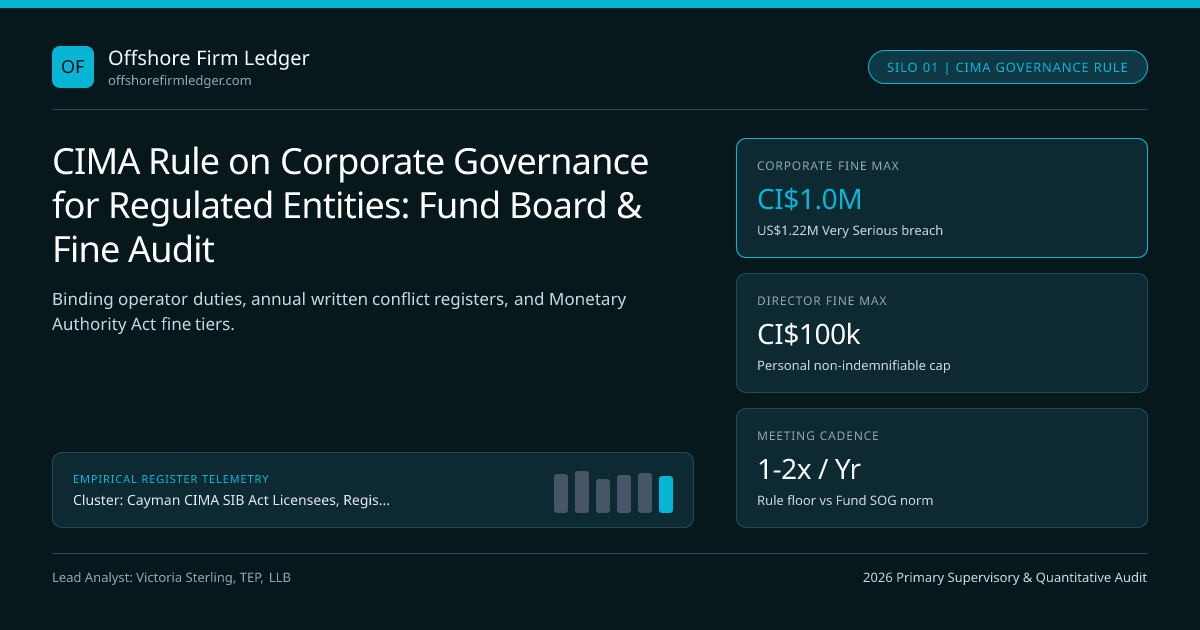
Enforced across all regulated entities since October 14, 2023, the CIMA Rule on Corporate Governance for Regulated Entities abolished the two-tier governance divide that previously exempted closed-ended Private Funds and Section 4(3) Mutual Funds from binding statutory board rules. Under Section 34 of the Monetary Authority Act, breaching a CIMA Rule—unlike departing from a non-binding Statement of Guidance (SOG)—constitutes an immediate regulatory violation empowering the Cayman Islands Monetary Authority to impose administrative fines up to CI$1,000,000 (US$1,219,512) for "very serious" corporate breaches without prior judicial conviction. As detailed in our Cayman CIMA SIB Act & Fund Governance hub, this reform fundamentally reshaped board minutes, General Partner governance committees, and service-provider oversight across nearly 30,000 Cayman funds.
Expanded Statutory Scope: Operators of Corporate Funds, ELPs, and Unit Trusts#
Prior to October 2023, binding CIMA corporate governance rules applied only to full licensees such as banks, insurers, trust companies under the TCSP Regulatory Standard, and retail licensed funds, while Section 4(3) hedge funds followed only the 2013 Statement of Guidance for Regulated Mutual Funds—and Private Funds had no bespoke governance code whatsoever. The 2023 Rule unified the entire regulatory perimeter inside the Cayman CIMA topic cluster, capturing SIB Act Full Licensees, VASP licensees, Section 4(3) and Administered Mutual Funds, and all registered Private Funds.
Crucially, because Cayman investment funds take diverse legal forms, the Rule defines the "Governing Body" functionally as the Operators of the fund: the board of directors of an exempted company or Segregated Portfolio Company, the General Partner (or board of the corporate GP) of an Exempted Limited Partnership, the manager of a Cayman LLC, or the trustee of a unit trust. Private equity sponsors accustomed to executing GP written consents without formal board deliberations must now convene documented annual governance sessions of the GP's governing body.
Seven Mandatory Pillars of the CIMA Governance Framework#
Paragraphs 7 through 18 of the Corporate Governance Rule compel every Governing Body to adopt, implement, and document a written governance framework proportional to the size, complexity, structure, nature of business, and risk profile of its operations. Seven concrete evidentiary artifacts are inspected during CIMA desk-based and onsite reviews:
- Objectives, Strategy & Risk Appetite: Documented alignment between the fund's offering memorandum / LPA investment restrictions, leverage ceilings, and real-time portfolio risk metrics.
- Structure, Independence & Time Commitment: Demonstration that directors (including DRLA-registered independent directors) possess collective financial-markets competence and sufficient capacity—directly targeting "jumbo board" directors holding excessive appointments without analytical support.
- Annual Written Conflicts-of-Interest Declarations: Every operator must submit a signed conflict declaration at least annually, updating it immediately upon material changes (such as cross-trades between a flagship private credit fund and a continuation vehicle, GP-led secondaries, or affiliated broker-dealer execution).
- Remuneration Alignment: For SIB Act licensees and management companies, compensation policies must avoid incentivizing excessive short-term risk-taking or breaches of client fiduciary mandates.
- Outsourced Service-Provider Accountability: Operators retain ultimate statutory responsibility for tasks delegated to third-party administrators, investment managers, custodians, and AML officers, requiring formal board-pack reporting and exception tracking.
- Code of Conduct & Succession Planning: Written ethical standards and continuity protocols for key-person departures.
- Granular Board Minutes: Boilerplate two-paragraph minutes rubber-stamping financial statements fail CIMA scrutiny; minutes must record dissenting questions, valuation challenges, liquidity stress outcomes, and action-item owners.
Comparative Matrix: Pre-2023 Guidance vs Binding CIMA Governance Rule#
| Governance Requirement | Pre-2023 Mutual Fund SOG | Pre-2023 Private Funds | Current Binding CIMA Rule + Fund SOG | Administrative Enforcement Tier |
|---|---|---|---|---|
| Legal Enforceability | Non-binding Statement of Guidance | Uncodified common-law fiduciary duty | Binding Statutory Rule (Monetary Authority Act s.34) | Minor / Serious / Very Serious fines |
| Minimum Meeting Cadence | Semi-annual recommended | Unspecified | Min 1x/year mandatory by Rule; 2x/year expected per Fund SOG | Serious breach if zero annual meeting |
| Conflicts of Interest | General disclosure expected | LPA LPAC provisions only | Mandatory written annual register + ongoing updates | Serious to Very Serious (up to CI$1M) |
| Private Equity GP Coverage | Excluded | Excluded | Expressly binds corporate GP boards / ELP operators | Direct GP & fund-level inspection |
| Internal Control Integration | Ad hoc | Ad hoc | Paired with binding Rule on Internal Controls | Concurrent breach aggregation risk |
Quantitative Director Capacity & Governance Audit Scoring Model#
Institutional ODD (Operational Due Diligence) teams at pension funds and sovereign allocators audit Cayman fund boards using a quantitative time-capacity and governance-pack completeness equation before approving allocations—contrasting sharply with opaque offshore broker boards seen in unregulated domiciles like 4P Capital or AAFX.
- Where:
- AvailableExecutiveHours = 1,920 hours/year (48 weeks * 40 hrs) - 240 hrs (CPE, DRLA regulatory & admin) = 1,680 net hours
- NMasterFeeder_Groups = Number of active CIMA-regulated fund groups served by the independent director
- NPassiveSPVs = Number of non-trading blocker / holding SPVs
- Worked Capacity & Penalty Risk Audit (Independent Cayman Professional Director):
- Scenario A (Boutique Governance Firm): 28 active fund groups + 20 blockers
- Effective_Load = 28 + (0.35 * 20) = 35.0 weighted relationships
- HoursPerFund = 1,680 / 35.0 = 48.0 hours/year (12.0 hours per quarterly board cycle — Institutional Pass)
- Scenario B (Overextended Legacy Director): 115 active fund groups + 60 blockers
- Effective_Load = 115 + (0.35 * 60) = 136.0 weighted relationships
- HoursPerFund = 1,680 / 136.0 = 12.35 hours/year (3.1 hours/quarter — High CIMA Rule Para 10 Capacity Risk)
When a director's effective time budget drops toward 12 hours per fund per year, CIMA examiners scrutinize board attendance timestamps and late board-pack distribution logs, treating rubber-stamped valuation sign-offs during NAV restatements as Serious or Very Serious governance violations. Importantly, under Cayman administrative-fine rules, personal fines levied on an individual director for bad-faith or reckless governance breaches cannot be indemnified out of fund investor assets.
Practical Remediation for General Partners and Multi-Fund Boards#
General Partners of Cayman closed-ended funds who historically relied solely on Delaware investment-committee minutes should adopt a dedicated Cayman Operator Governance Charter, schedule an annual Cayman GP Operator meeting alongside the Section 16–18 Private Funds Act review, maintain a standalone signed Conflicts Register, and cross-check every board member's DRLA serial status on the license verification portal.
Frequently asked questions
What is the legal difference between a CIMA Rule and a CIMA Statement of Guidance (SOG)?
A CIMA Rule creates binding legal obligations whose breach directly triggers administrative fines and enforcement actions under Section 34 of the Monetary Authority Act. A Statement of Guidance sets out CIMA supervisory expectations used to measure whether an entity is conducting business in a sound and prudent manner.
How often must the governing body of a Cayman Private Fund or Mutual Fund meet under the 2023 Rule?
The binding Corporate Governance Rule requires the Governing Body of every regulated entity to meet at least once per year. However, the companion Statement of Guidance for Regulated Mutual Funds and Private Funds states CIMA expects at least two meetings per year where strategy and risk complexity warrant.
Does delegating fund administration or portfolio management relieve Cayman fund directors of liability under the Rule?
No. Paragraph 15 of the Rule explicitly stipulates that while a Governing Body may delegate operational functions to investment managers, administrators, or AML officers, ultimate statutory responsibility cannot be outsourced and requires documented ongoing performance monitoring.
Does CIMA impose a hard numerical cap on how many directorships one independent Cayman director can hold?
CIMA does not fix a rigid statutory cap on directorship count, though holding 20 or more covered directorships triggers Professional Director licensing under the DRLA. Instead, the Governance Rule requires demonstrable time capacity commensurate with each entity size and complexity.
Publication record
- Published
- 14 November 2026
- Updated
- 14 November 2026
- Author
- Victoria Sterling, TEP, LLB
- Review
- Review not recorded
- Automated fact check
- Passed in the stored pipeline record
- Source URLs
- 3 recorded
AI assistance recorded: anthropic/claude-opus-4.6. This field does not establish human review or source verification.
Academic & Institutional Attribution
Cite This Research & Embed Live Data Card
Standard academic & institutional research paper citation format.
Victoria Sterling, TEP, LLB. (2026, November 14). CIMA Rule on Corporate Governance for Regulated Entities: Fund Board & Fine Audit. Offshore Firm Ledger. https://offshorefirmledger.com/dossiers/cima-rule-corporate-governance-regulated-entities-2023-auditRegulatory Directory Cross-Reference
Referenced Institutions & Regulatory Registries
Top Regulated Institutions in This Coverage Slice
Referenced Supervisory Authorities
Related Cayman Cima Sib Mutual Private Funds & Institutional Briefings
Explore Cayman Cima Sib Mutual Private Funds Hub (20) →Cayman Cima Sib Mutual Private Funds
Cayman CIMA SIB Act, SPC Ring-Fencing, Mutual & Private Funds: Institutional Statute GuideCayman Cima Sib Mutual Private Funds
CIMA Rule on Internal Controls: Five COSO Components & Outsourcing AuditsCayman Cima Sib Mutual Private Funds
Cayman Private Funds Act Section 16 Asset Valuation: Level 3 & Manager FirewallsCayman Cima Sib Mutual Private Funds
Cayman Private Funds Act Section 17 Safekeeping & Title Verification AuditCayman Cima Sib Mutual Private Funds
Cayman Private Funds Act Section 18 Cash Monitoring & Bank ReconciliationCayman Cima Sib Mutual Private Funds
Cayman Mutual Funds Act Section 4(3) Registered vs Administered & Licensed FundsCayman Cima Sib Mutual Private Funds
Cayman-Delaware Master-Feeder & UBTI Blocker Structure: Form 8832 Tax & CIMA AuditCayman Cima Sib Mutual Private Funds
CIMA Directors Registration and Licensing Act (DRLA): Covered Entities & Insurance RulesBvi Fsc Siba Approved Manager Statutes
BVI Approved Manager Regime: US$400M Open-Ended & US$1B Closed-Ended AUM CapsBvi Fsc Siba Approved Manager Statutes
BVI Incubator Fund (20/20/20 Test) vs Approved Fund (US$100M Cap): Audit & ConversionBvi Fsc Siba Approved Manager Statutes
BVI Professional Fund, Private Fund & Public Fund Recognition vs Registration TiersBvi Fsc Siba Approved Manager Statutes
BVI Private Investment Funds (PIF) Under SIBA Part IIIA: Three Appointed Persons Audit
Offshore Firm Ledger Data, Benchmarks & Contributor Records
CC BY 4.0 Open Data
Open Institutional Datasets (CSV / JSON) →
Download desk-compiled quantitative series & schemas.
2026 Reference Matrix
2026 Institutional Benchmarks & Thresholds →
Statutory capital, clearing, margin & rate conventions.
Editorial Records
Authors & Review Records →
View named contributors where those records are available.
Complete Index
Master Research & Dossier Archive →
Browse all published briefings by topic pillar & date.