
Cayman Cima Sib Mutual Private Funds
Cayman-Delaware Master-Feeder & UBTI Blocker Structure: Form 8832 Tax & CIMA Audit
Global hedge fund and private credit managers pair a Delaware LP onshore feeder with a Cayman Exempted Company offshore feeder and Form 8832 partnership Master Fund to block US UBTI and ECI tax leakage.
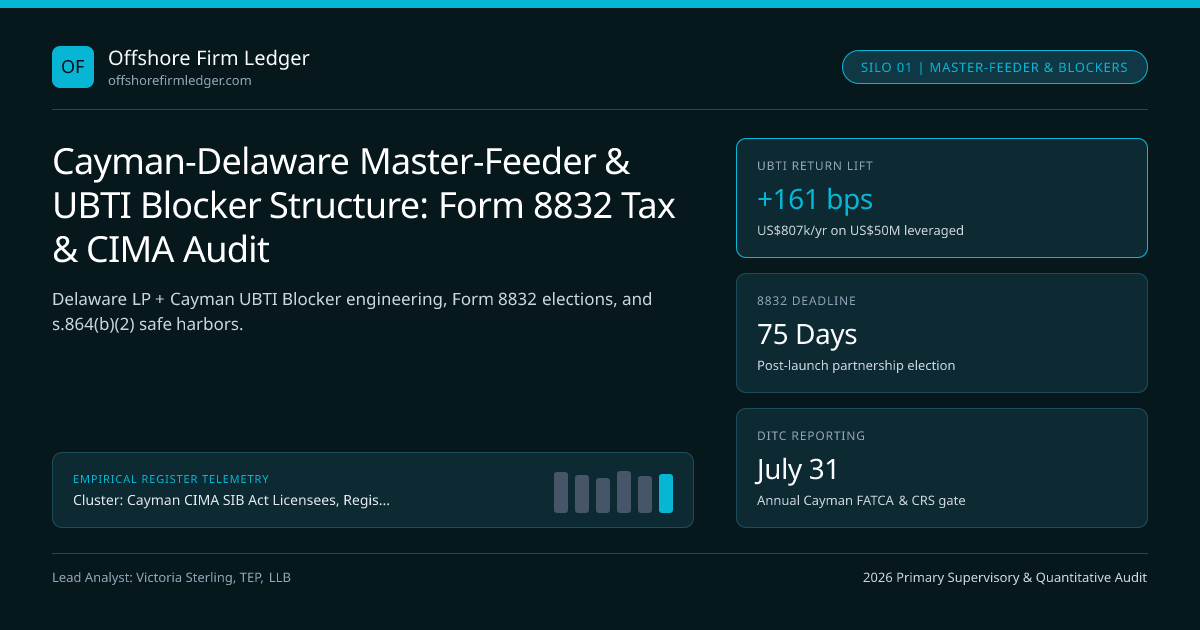
Over 80% of multi-billion-dollar institutional hedge funds managed out of New York, Greenwich, London, and Hong Kong—including vehicles allocating capital from US tax-exempt pension plans, university endowments, and sovereign wealth funds—deploy a two-tier Cayman-Delaware Master-Feeder architecture supervised by CIMA. Under this structure, US taxable investors subscribe into a Delaware Limited Partnership (Onshore Feeder), while non-US investors and US tax-exempt institutions (ERISA pensions, 501(c)(3) foundations, endowments) subscribe into a Cayman Islands Exempted Company (Offshore Feeder). Both feeders invest 100% of their investable cash into a Cayman Master Fund (incorporated as an Exempted Company that files IRS Form 8832 to "check the box" to be treated as a flow-through partnership for US federal income tax purposes, or formed directly as a Cayman Exempted Limited Partnership). Within our Cayman CIMA SIB Act & Fund Governance hub, getting the US tax-classification election and CIMA master-registration mechanics right prevents catastrophic 21%–37% tax drag.
Why US Tax-Exempt Pensions Invest Offshore: Blocking Leveraged UBTI#
Without a corporate offshore feeder, a US pension fund or university endowment investing directly into a leveraged partnership trading on prime-brokerage margin incurs Unrelated Business Taxable Income (UBTI) under Internal Revenue Code Sections 512 and 514 ("debt-financed property"). Any income or capital gain attributable to prime-broker margin borrowing flows straight onto the tax-exempt institution's IRS Form 990-T, taxed at ordinary US corporate/trust rates (21% corporate or up to 37% trust rates).
Interposing a Cayman Islands Exempted Company taxed as a foreign corporation (per se or default association taxable as a corporation under Treas. Reg. § 301.7701-3) acts as an airtight UBTI Blocker inside the Cayman SIB & Fund Governance cluster. Because Cayman levies 0% corporate income, capital gains, or dividend withholding tax—backed by a 20-to-30-year Governor-in-Cabinet Tax Undertaking Certificate under Section 6 of the Tax Concessions Act—margin-financed trading gains realized inside the Master Fund are absorbed by the Cayman corporate feeder and distributed or redeemed to the US pension plan as tax-free corporate dividends or capital redemptions, free of UBTI (and outperforming the Passive Foreign Investment Company [PFIC] problem because tax-exempt entities are generally exempt from PFIC punitive interest rules under Treas. Reg. § 1.1291-1(e)).
Trading Safe Harbor (IRC § 864(b)(2)) vs Private Credit Loan-Origination ECI#
For global macro, equity long/short, and quantitative hedge funds trading stocks, securities, and commodities for their own account, Internal Revenue Code Section 864(b)(2) (the "Trading Safe Harbor") shields the Cayman Master Fund and Offshore Feeder from being treated as engaged in a US Trade or Business (USTB), even when discretionary portfolio managers sit in Manhattan—eliminating Effectively Connected Income (ECI) tax (21% corporate + 30% Branch Profits Tax = 44.7% combined drag).
Direct-lending private credit funds, however, cannot rely on the Section 864(b)(2) trading safe harbor when originating loans directly to US borrowers on a regular basis. To prevent non-US sovereign and institutional LPs from suffering ECI and mandatory US tax-return filings, private credit sponsors pair Cayman Private Fund feeders with Season-and-Sell, Treaty-Eligible Luxembourg/Irish Note Issuers, or Leveraged Delaware Corporate Blockers capitalized with portfolio-interest-exempt shareholder debt, alongside strict compliance with the OECD CRS / AEOI Framework and Cayman US Model 1B FATCA IGA reporting via the DITC portal.
Comparative Matrix: Cayman-Delaware Master-Feeder & Mini-Master Vehicles#
| Vehicle Component | Legal Form & Domicile | US Tax Classification | CIMA Registration Status | Primary Investor Cohort Served |
|---|---|---|---|---|
| Onshore Feeder | Delaware Limited Partnership | Partnership (Schedule K-1 pass-through; preserves 60/40 § 1256 & LTCG) | Outside CIMA scope (SEC Reg D 3(c)(7) / 3(c)(1)) | US High-Net-Worth individuals, family offices & taxable trusts |
| Offshore Feeder | Cayman Exempted Company | Corporation (Default Foreign Corp; UBTI Blocker) | MFA s.4(3) Registered Fund (CI$3,675/yr) | Non-US institutions, sovereign funds & US ERISA/501(c)(3) pensions |
| Master Fund (Corporate) | Cayman Exempted Company | Partnership via IRS Form 8832 election within 75 days | MFA s.4(3)(a)(iii) Master Fund (CI$2,675/yr) | Holds 100% of Onshore + Offshore Feeder investable capital |
| Master Fund (Partnership) | Cayman Exempted Limited Partnership | Partnership (via Form 8832 if GP has limited liability) | MFA Registered Master Fund (or PFA if closed-ended) | Preferred when avoiding corporate share-capital redemption mechanics |
| Performance Allocation Vehicle | Cayman ELP ("Mini-Master" / GP Vehicle) | Partnership (preserves carried-interest character under IRC § 1061) | Exempt GP / Mini-Master structure | Crystallizes incentive allocation (vs ordinary-income fee) for US GPs |
Quantitative Model: UBTI Tax Savings of a Cayman Corporate Blocker for a US Endowment#
Consider a US$50,000,000 university endowment ticket allocated to a relative-value credit/equity hedge fund generating a 14.0% net pre-tax return while utilizing prime-brokerage margin debt equal to 150% of NAV (so 60.0% of total gross assets are acquisition-indebtedness financed under IRC § 514):
- DebtFinancedRatio = AverageAcquisitionDebt / AverageGrossAdjusted_Basis = 1.50 / (1.00 + 1.50) = 0.60 (60.0%)
- Worked Comparison (US$50,000,000 Endowment Ticket; 14.0% Net Return = US$7,000,000 Annual Gain):
- Case 1 (Direct Subscription into Unblocked Delaware LP):
- DebtFinancedUBTI_Income = US$7,000,000 * 0.60 = US$4,200,000 taxable on Form 990-T
- FederalCorporateUBTI_Tax (@ 21.0%) = US$4,200,000 * 0.21 = US$882,000 / year tax drag (-176.4 bps return loss)
- Case 2 (Subscription via Cayman Exempted Company Offshore Feeder into Form 8832 Master Fund):
- CaymanCorporateTax = US$0 (0.0%)
- USFDAPDividend_Leakage = US$75,000 (30% withholding on 0.50% US cash-equity dividend yield; 0% on swaps/capital gains)
- NetAnnualBlocker_Benefit = US$882,000 - US$75,000 = +US$807,000 / year (+161.4 bps net return preservation)
Even after accounting for minor Section 871(m) / FDAP dividend withholding on physical US dividend-paying shares, routing the endowment through the Cayman Offshore Feeder preserves US$807,000 per year—more than 7× the entire Cayman Master-Feeder statutory governance cost!
Critical Operational Pitfall: The 75-Day IRS Form 8832 Filing Deadline#
Because a Cayman Exempted Company (and a Cayman ELP whose GP has limited liability) defaults to foreign corporate status under US Treasury regulations whenever all members enjoy limited liability, the Cayman Master Fund must file IRS Form 8832 electing partnership status effective on Day 1 of launch (within 75 days after the desired effective date, or via Rev. Proc. 2009-41 late-election relief). Missing Form 8832 turns the Master Fund into a PFIC for every US taxable investor in the Delaware Onshore Feeder, destroying long-term capital-gains character. Fund launch counsel should verify Form 8832 certified-mail receipts alongside CIMA Master/Feeder registration certificates and GIIN numbers on the license verification portal (contrast single-tier offshore broker IBCs in the offshore domiciles register like Alpha Exchange International).
Frequently asked questions
Why must a Cayman Exempted Company Master Fund file IRS Form 8832 to check the box as a partnership?
Under US Treasury Regulation 301.7701-3, a foreign entity in which no member has personal unlimited liability defaults to an association taxable as a corporation. Without filing Form 8832 to elect partnership treatment, US taxable LPs in the Delaware feeder would face punitive PFIC taxation instead of pass-through K-1 capital gains.
Why do US hedge fund managers use a "Mini-Master" ELP between the Offshore Feeder and the Master Fund?
Since Internal Revenue Code Section 457A ended tax-deferred offshore incentive fees in 2009, routing the Cayman Offshore Feeder through a partnership vehicle allows the US GP to receive a partnership "incentive allocation" preserving long-term capital-gains tax character (subject to the 3-year IRC Section 1061 holding rule) rather than ordinary fee income.
Does a Cayman Master Fund have to register separately with CIMA if the Cayman Feeder is already registered?
Yes. Under Mutual Funds Act Section 4(3)(a)(iii), any Cayman Master Fund issuing redeemable equity interests that has at least one CIMA-regulated feeder fund must separately register with CIMA, pay the CI$2,675 annual Master Fund fee, and submit an audited Fund Annual Return.
Do Cayman Master and Feeder funds report investor accounts under FATCA and the OECD Common Reporting Standard?
Yes. Both Cayman entities classify as Reporting Cayman Islands Financial Institutions, requiring registration for an IRS GIIN and portal registration with the Cayman Department for International Tax Cooperation (DITC) to file annual US FATCA and CRS returns by July 31.
Publication record
- Published
- 14 November 2026
- Updated
- 14 November 2026
- Author
- Victoria Sterling, TEP, LLB
- Review
- Review not recorded
- Automated fact check
- Passed in the stored pipeline record
- Source URLs
- 3 recorded
AI assistance recorded: anthropic/claude-opus-4.6. This field does not establish human review or source verification.
Academic & Institutional Attribution
Cite This Research & Embed Live Data Card
Standard academic & institutional research paper citation format.
Victoria Sterling, TEP, LLB. (2026, November 14). Cayman-Delaware Master-Feeder & UBTI Blocker Structure: Form 8832 Tax & CIMA Audit. Offshore Firm Ledger. https://offshorefirmledger.com/dossiers/cayman-master-feeder-blocker-delaware-lp-exempted-structureRegulatory Directory Cross-Reference
Referenced Institutions & Regulatory Registries
Top Regulated Institutions in This Coverage Slice
Referenced Supervisory Authorities
Related Cayman Cima Sib Mutual Private Funds & Institutional Briefings
Explore Cayman Cima Sib Mutual Private Funds Hub (20) →Cayman Cima Sib Mutual Private Funds
Cayman CIMA SIB Act, SPC Ring-Fencing, Mutual & Private Funds: Institutional Statute GuideCayman Cima Sib Mutual Private Funds
CIMA Directors Registration and Licensing Act (DRLA): Covered Entities & Insurance RulesCayman Cima Sib Mutual Private Funds
Cayman VASP Act Phase 2 Licensing: Custody Segregation, Exchanges & SIB Act OverlapCayman Cima Sib Mutual Private Funds
Cayman Foundation Companies Act (2017): Orphan SPVs, DAO Treasuries & Supervisor LawCayman Cima Sib Mutual Private Funds
Cayman Economic Substance Act: Fund Management CIGA, Investment Fund Carve-Out & DITC FinesCayman Cima Sib Mutual Private Funds
Cayman AMLCO, MLRO & DMLRO Rules: Natural-Person Independence & CIMA FinesCayman Cima Sib Mutual Private Funds
Cayman Exempted Limited Partnership Act (ELPA): LP Safe Harbors, Clawbacks & Side LettersCayman Cima Sib Mutual Private Funds
CIMA Local Auditor Sign-Off & REEFs Fund Annual Return (FAR): Deadlines & WaiversBvi Fsc Siba Approved Manager Statutes
BVI Strike-Off & Immediate Dissolution Reform: Bona Vacantia & 5-Year RestorationBvi Fsc Siba Approved Manager Statutes
BVI Regulatory Code Part IV Client Assets: Statutory Trust, Reconciliations & TTCA TrapsBvi Fsc Siba Approved Manager Statutes
BVI Economic Substance Act & BOSS Filings: Pure Equity Holding vs Fund Management CIGABvi Fsc Siba Approved Manager Statutes
BVI Commercial Court Section 24A Black Swan Orders & Worldwide Freezing Injunctions
Offshore Firm Ledger Data, Benchmarks & Contributor Records
CC BY 4.0 Open Data
Open Institutional Datasets (CSV / JSON) →
Download desk-compiled quantitative series & schemas.
2026 Reference Matrix
2026 Institutional Benchmarks & Thresholds →
Statutory capital, clearing, margin & rate conventions.
Editorial Records
Authors & Review Records →
View named contributors where those records are available.
Complete Index
Master Research & Dossier Archive →
Browse all published briefings by topic pillar & date.