
Cayman Cima Sib Mutual Private Funds
CIMA Local Auditor Sign-Off & REEFs Fund Annual Return (FAR): Deadlines & Waivers
Every Cayman Mutual Fund and registered Private Fund must have its annual financial statements signed off by a CIMA-approved local Cayman audit office and submitted with a Fund Annual Return within 6 months of year-end.
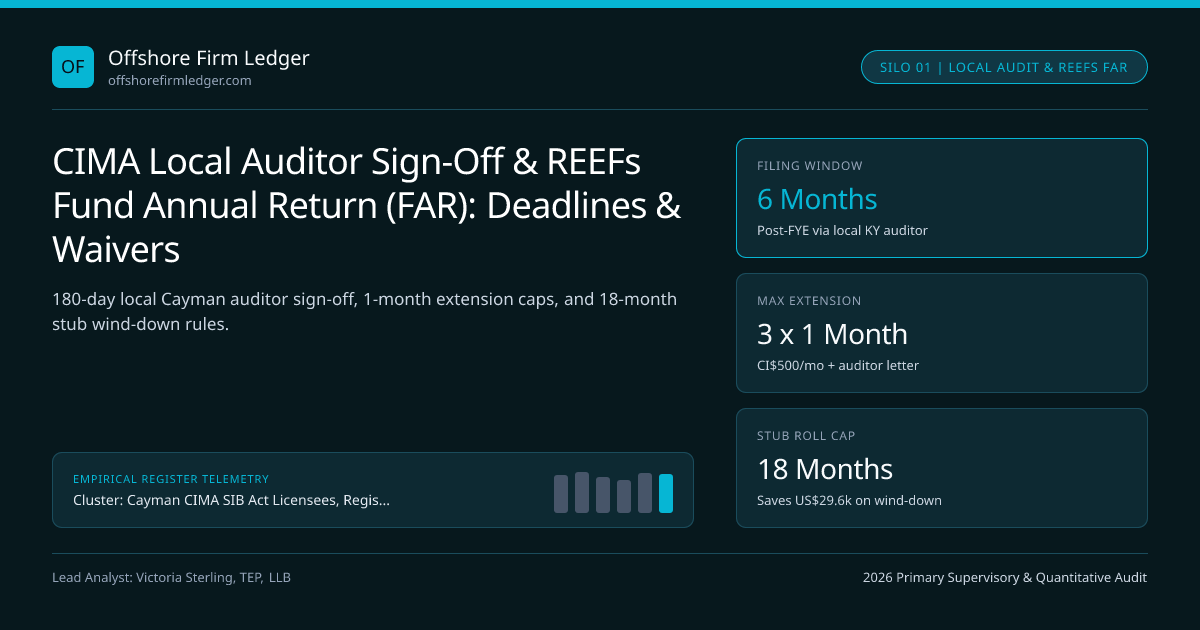
Under Section 8 of the Mutual Funds Act and Section 13 of the Private Funds Act, every regulated Cayman investment fund must have its accounts audited annually and transmitted electronically—together with an itemized Fund Annual Return (FAR) and Operator Declaration—within 6 months of the end of each financial year via CIMA's Regulatory Enhanced Electronic Forms Submission (REEFs) portal. Crucially, onshore New York, London, or Hong Kong audit firms cannot upload or sign off a Cayman statutory filing directly: CIMA's Local Audit Sign-Off Policy mandates that the audit opinion be issued by, and electronically uploaded through REEFs by, one of roughly 45 CIMA-Approved Local Cayman Islands Audit Firms physically licensed on Grand Cayman. Within our Cayman CIMA SIB Act & Fund Governance hub, understanding how onshore audit fieldwork interfaces with Grand Cayman partner sign-off, strict extension caps, and narrow audit-waiver grounds prevents license-deregistration traps.
How Dual-Office Audit Fieldwork & Local Cayman Sign-Off Operate#
When a US or European manager engages PwC, Deloitte, EY, KPMG, Grant Thornton, BDO, EisnerAmper, or RSM in New York or Dublin, the fund does not undergo two duplicative audits. Instead, the Cayman Islands member firm of that audit network is formally appointed as the statutory auditor on CIMA's REEFs record (delivering the required Auditor's Letter of Consent upon fund launch), sub-contracting substantive portfolio testing and valuation fieldwork to its onshore specialist team while the Grand Cayman audit partner reviews Cayman statutory disclosures (PFA Sections 16–18, Segregated Portfolio cell schedules, related-party notes), signs the audit opinion in the name of the Cayman firm, and executes the final REEFs cryptographic upload.
Alongside the audited IFRS or US/UK GAAP financial statements, the fund's administrator prepares the FAR Excel/XML data pack (together with the Related Fund Entity Form [RFE] for Private Funds), reporting exact gross/net assets, leverage ratios, geographic investor domicile breakdowns, subscription/redemption flows, management/performance fee totals, and whether any qualified opinion or NAV suspension occurred during the year inside the Cayman SIB & Fund Governance cluster.
Strict 1-Month Extension Tranches & Narrow CIMA Audit Waiver Policy#
Managers investing in underlying fund-of-funds or delayed K-1 partnerships cannot assume automatic audit extensions past June 30. Under CIMA's Regulatory Policy – Exemption from Audit Requirement, extensions are granted strictly in one-month increments up to a maximum cumulative cap of three months (September 30 for a December 31 year-end):
- First 1-Month Extension: Must be submitted via REEFs before the original 6-month deadline expires, accompanied by the CI$500 (US$610) application fee and a written explanation.
- Second & Third 1-Month Extensions: Require a signed supporting letter from the CIMA-approved local auditor substantiating the specific external bottleneck (e.g., delayed underlying third-party fund audits) and confirming an exact completion schedule.
Full Audit Waivers (exempting a fiscal year from audit altogether) are extraordinarily narrow under CIMA policy and never granted merely to save audit expenses on a small AUM fund! CIMA considers waivers solely in enumerated lifecycle edge cases: (a) a newly registered fund that has not launched (zero investor capital accepted), where operators file a sworn non-launch declaration within 45 days of year-end; (b) a stub first or final liquidation period of 6 months or less that can be rolled into an adjacent <= 18-month single audited period; or (c) terminal third-party bankruptcy/liquidation where no realizable assets exist to fund an audit. By contrast, unverified offshore brokers in the offshore domiciles register such as Bcs Markets or Best One Markets Ltd frequently operate without public local auditor REEFs gates.
Voluntary Deregistration Trap: You Cannot Exit CIMA Without a Final Terminal Audit!#
Sponsors shutting down an underperforming Cayman fund cannot simply wire out 100% of cash without reserving for a Final Stub Audit. Under CIMA's Deregistration Procedure, CIMA keeps the fund in fee-accruing status until every historical and final stub-period audit + FAR (down to zero investor equity) is uploaded by the local Cayman auditor or formally waived!
| Audit / Deregistration Scenario | Statutory / CIMA Rule | Fee & Timing Requirement | Required Supporting Evidence | Consequence of Missing Deadline |
|---|---|---|---|---|
| Standard Annual Audit + FAR | MFA s.8 / PFA s.13 | Within 6 months of FYE; CI$300 FAR fee | Signed Cayman audit opinion + FAR Excel + Operator Declaration | Late breach flag on public CIMA search + fine escalation |
Stub Launch Period (<= 6 months) | Extended Accounting Period (<= 18 mos max) | Notice prior to initial 6-mo audit deadline | Amended PPM/LPA reflecting <=18-month initial period | Defaults to mandatory standalone stub audit |
| Unlaunched Registered Fund | Non-Launch Audit Waiver | Sworn Operator Affidavit | Bank confirmation showing US$0 subscriptions received | Full CIMA annual fee + audit required if late |
| Voluntary Wind-Down (LUT Status) | Deregistration Procedure | Submit core docs by Dec 31 to avoid full next-yr fee | Board resolution, zero-investor payout proof & Final Stub Audit + FAR | Full next-year CI$3,675 fee + involuntary revocation |
| Auditor Resignation / Dismissal | MFA s.21 / PFA s.14 | Immediate notice to CIMA | Outgoing auditor must explain any fraud, dispute, or qualification | CIMA inquiry + suspension until replacement consents |
Quantitative Model: Terminal Wind-Down Cost Savings of the 18-Month Extended Audit Rule#
Suppose a US$25M Cayman hedge fund decides in October of Year 3 to liquidate, returning 95% of cash by December 15, Year 3, and distributing the final 5% holdback on February 28, Year 4 (2 months into Year 4):
- Where:
- Path 1 (Separate Year 3 12-Mo Audit + Separate Year 4 2-Mo Stub Audit + Late Post-Dec-31 Notice):
- TwoSeparateLocal_Audits = US$34,000 (Yr 3) + US$24,500 (2-mo stub audit + 2x FAR) = US$58,500
- FullYear4Statutory_Stack = US$4,482 (CIMA) + US$1,098 (Govt) + US$1,708 (DRLA) + US$8,500 (RO/AML) = US$15,788
- TotalPath1 = US$74,288
- Path 2 (Pre-Approved 14-Month Extended Final Audit [Jan 1 Yr 3 – Feb 28 Yr 4] + Pre-Dec-31 LUT Filing):
- Single14MoTerminal_Audit = US$37,500 (1 audit opinion + 1 final FAR)
- ReducedLUTStatutory_Cost = US$2,241 (50% LUT CIMA fee) + US$732 (deregistration fee) + US$4,200 (stub RO) = US$7,173
- TotalPath2 = US$44,673
- WindDownTerminalSavings = US$74,288 - US$44,673 = US$29,615 saved (39.87% terminal cost reduction)
Consolidating the final two-month liquidation tail into a single 14-month terminal audit and filing LUT documents before December 31 saves US$29,615—preserving nearly 12 bps of closing NAV for redeeming LPs!
Mandatory Statutory Whistleblowing Duty of Cayman Auditors#
Allocators derive extraordinary comfort from Section 21 of the Mutual Funds Act and Section 14 of the Private Funds Act: if a CIMA-approved local auditor, during its audit, obtains information or suspects that a fund is unable to meet its obligations as they fall due, is carrying on business in breach of Cayman statutes or CIMA Corporate Governance Rules, or has radically incomplete accounting records, the auditor is statutorily compelled to report immediately in writing to CIMA—enjoying absolute statutory immunity from breach-of-confidentiality suits. Always confirm active audit standing via the license verification portal.
Frequently asked questions
Can a US PCAOB-registered accounting firm upload audited financials directly to CIMA REEFs without a Cayman firm?
No. Under CIMA Local Audit Sign-Off Policy, only an audit firm physically established in the Cayman Islands and listed on CIMA Approved Local Auditors roll possesses REEFs portal submission credentials and legal authority to issue the statutory audit sign-off.
Can a small US$5 million Cayman Private Fund obtain a CIMA audit waiver because the audit fee is high?
No. CIMA explicitly rejects small AUM, negative performance, or audit cost burden as valid grounds for an audit exemption. Waivers are restricted to unlaunched zero-capital vehicles, short stub periods consolidated into an <=18-month audit, or court-supervised insolvent liquidations.
What is the Private Fund Related Fund Entity (RFE) form submitted alongside the FAR?
Introduced by CIMA for registered Private Funds, the RFE form captures linked parallel funds, alternative investment vehicles (AIVs), and co-investment entities connected to the registered Cayman Private Fund, must be filed even if zero related entities exist, and accompanies the annual FAR.
What must a Cayman local auditor do if it discovers a fund cannot pay redemptions or has material valuation fraud?
Under Mutual Funds Act Section 21 and Private Funds Act Section 14, the auditor has a mandatory statutory whistleblowing duty to give CIMA immediate written notice of suspected insolvency, fraud, or regulatory breach, overriding client confidentiality.
Publication record
- Published
- 14 November 2026
- Updated
- 14 November 2026
- Author
- Victoria Sterling, TEP, LLB
- Review
- Review not recorded
- Automated fact check
- Passed in the stored pipeline record
- Source URLs
- 3 recorded
AI assistance recorded: anthropic/claude-opus-4.6. This field does not establish human review or source verification.
Academic & Institutional Attribution
Cite This Research & Embed Live Data Card
Standard academic & institutional research paper citation format.
Victoria Sterling, TEP, LLB. (2026, November 14). CIMA Local Auditor Sign-Off & REEFs Fund Annual Return (FAR): Deadlines & Waivers. Offshore Firm Ledger. https://offshorefirmledger.com/dossiers/cima-local-auditor-sign-off-far-filing-waiver-suspensionsRegulatory Directory Cross-Reference
Referenced Institutions & Regulatory Registries
Top Regulated Institutions in This Coverage Slice
Referenced Supervisory Authorities
Related Cayman Cima Sib Mutual Private Funds & Institutional Briefings
Explore Cayman Cima Sib Mutual Private Funds Hub (20) →Cayman Cima Sib Mutual Private Funds
Cayman CIMA SIB Act, SPC Ring-Fencing, Mutual & Private Funds: Institutional Statute GuideCayman Cima Sib Mutual Private Funds
Cayman Beneficial Ownership Transparency Act (BOTA): ELP Scope, Fund Route & Access RulesCayman Cima Sib Mutual Private Funds
Cayman Hedge Fund Redemption Gates, NAV Suspensions & Side-Pocket Case Law AuditCayman Cima Sib Mutual Private Funds
Cayman SIB Act Full Licensee vs Schedule 4 Registered Person: Capital & Perimeter AuditCayman Cima Sib Mutual Private Funds
Cayman Segregated Portfolio Company (SPC) Ring-Fencing Under Companies Act Part XIVCayman Cima Sib Mutual Private Funds
Cayman SPC Cross-Cell Contamination & Section 224 Receivership Case Law AuditCayman Cima Sib Mutual Private Funds
CIMA Rule on Corporate Governance for Regulated Entities: Fund Board & Fine AuditCayman Cima Sib Mutual Private Funds
CIMA Rule on Internal Controls: Five COSO Components & Outsourcing AuditsBvi Fsc Siba Approved Manager Statutes
BVI Limited Partnership Act 2017: Optional Legal Personality, GP Safe Harbors & SecurityBvi Fsc Siba Approved Manager Statutes
BVI International Arbitration Centre (BVI IAC): 2021 Rules, New York Convention & JoinderMauritius Fsc Seychelles Fsa Dealers
Mauritius FSC Full Service Investment Dealer: Including vs Excluding Underwriting (MUR 10M vs 1M)Mauritius Fsc Seychelles Fsa Dealers
Mauritius FSC Investment Dealer (Broker vs Discount Broker vs Currency/Derivatives): Scope Audit
Offshore Firm Ledger Data, Benchmarks & Contributor Records
CC BY 4.0 Open Data
Open Institutional Datasets (CSV / JSON) →
Download desk-compiled quantitative series & schemas.
2026 Reference Matrix
2026 Institutional Benchmarks & Thresholds →
Statutory capital, clearing, margin & rate conventions.
Editorial Records
Authors & Review Records →
View named contributors where those records are available.
Complete Index
Master Research & Dossier Archive →
Browse all published briefings by topic pillar & date.