
Cayman Cima Sib Mutual Private Funds
Cayman Segregated Portfolio Company (SPC) Ring-Fencing Under Companies Act Part XIV
Part XIV of the Cayman Companies Act enables a single Segregated Portfolio Company to launch statutorily ring-fenced hedge fund or private credit cells under Section 216 without forming separate corporate entities.
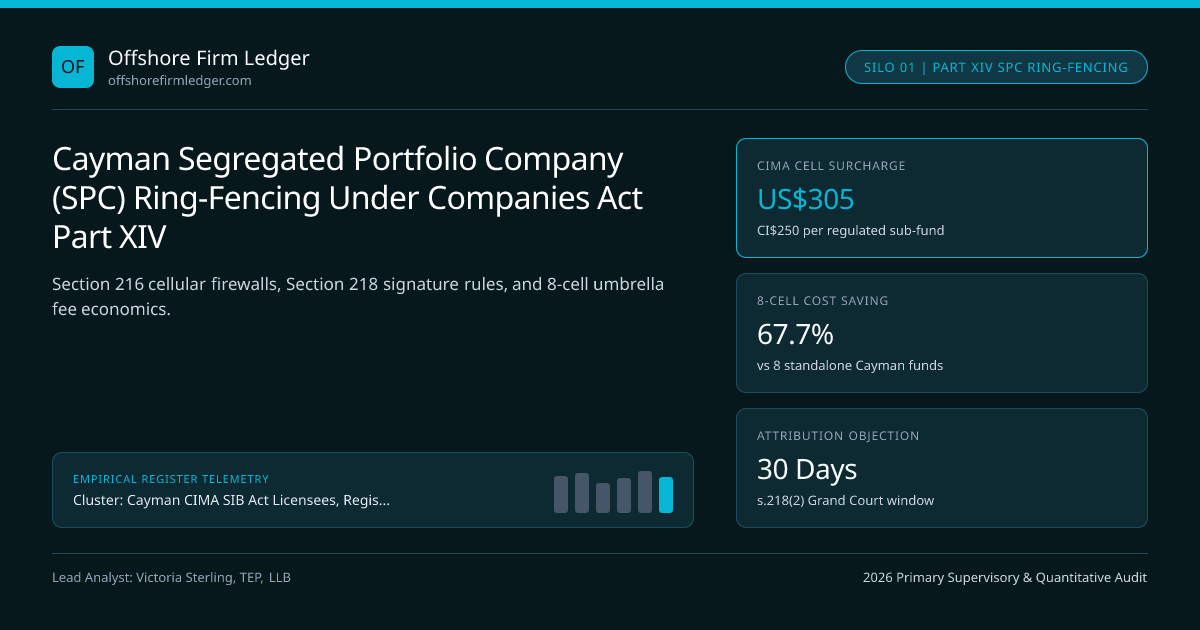
Sections 212 through 228 (Part XIV) of the Cayman Islands Companies Act empower an exempted company to register as a Segregated Portfolio Company (SPC), establishing statutory firewalls between individual "segregated portfolios" (cells) and the company's own "general assets" without incorporating separate subsidiary legal entities. Multi-strategy hedge fund platforms, emerging-manager umbrella incubators, and private credit securitization conduits supervised by CIMA deploy SPCs to launch sub-portfolios in 7 to 14 days at a fraction of standalone incorporation cost. Within our Cayman CIMA statutory guide, Part XIV cellular architecture stands out as one of the sharpest structural contrasts between unitary-entity statutory cells and incorporated-cell structures found in Channel Islands Fund Regimes.
Unitary Legal Personality and Section 216 Statutory Asset Attribution#
A Cayman SPC constitutes a single body corporate bearing the mandatory corporate suffix "SPC" or "Segregated Portfolio Company" under Section 213. Individual segregated portfolios—typically styled "Alpha Macro SPC – acting solely for and on behalf of Segregated Portfolio A"—cannot sue, be sued, or hold legal title in isolation from the SPC itself. Instead, Section 216 imposes two statutory duties on the directors: first, to keep segregated portfolio assets separately identifiable and segregated from general assets and from every other segregated portfolio's assets; second, to attribute every asset and liability strictly to a designated cell or to general corporate operations.
Section 219 and Section 220 codify the creditor waterfall that makes SPCs attractive inside the Cayman SIB & Fund Governance topic hub. Where a liability arises from a matter attributable to Segregated Portfolio A, the counterparty's recourse extends first to the segregated portfolio assets of Cell A and—unless explicitly excluded in the governing contract—secondarily to the SPC's general assets to the extent Cell A's assets prove insufficient, but zero recourse ever attaches to the segregated portfolio assets of Cell B, Cell C, or any other sibling portfolio. Practically, institutional ISDA and prime brokerage agreements routinely include a "non-recourse to general assets" waiver, confining creditor recovery 100% to the named cell's net assets.
Section 218 Execution Formalities and the Director Indemnity Penalty#
Statutory ring-fencing is not automatic on defective contracts. Section 218(1) mandates that every deed, ISDA Master Agreement, prime-brokerage facility, or subscription contract executed for a cell state unequivocally that execution is on behalf of that named segregated portfolio.
When a signatory signs solely as "Apex Horizon SPC" without naming the cell, Section 218(2) compels directors upon discovery to make a formal attribution, notify all counterparties, and allow 30 days for Grand Court re-attribution applications. Incurring misattributed liabilities against general assets without reasonable grounds exposes directors to personal indemnity claims, as detailed in our review of Grand Court SPC cross-cell contamination and receivership litigation.
Inter-Cell Asset Transfers and CIMA Mutual vs Private Fund SPC Rules#
Directors cannot casually lend cash or transfer illiquid positions from Cell A to rescue a margin call in Cell B. Section 216(6)(c) permits asset transfers between segregated portfolios, or between a segregated portfolio and general assets, solely at full value. Below-market transfers, uncollateralized intra-SPC liquidity sweeps, or cross-collateralized prime brokerage accounts spanning multiple cells violate Part XIV fiduciary duties and expose the SPC's CIMA registration to suspension.
From a regulatory licensing standpoint, an open-ended SPC registered as a Section 4(3) Mutual Fund pays a single base CIMA annual fee (CI$3,675 / US$4,482) plus a modest CI$250 (US$305) per additional segregated portfolio up to 25 cells, though CIMA requires separate Private Fund registrations or sub-fund schedules under the Mutual Funds (Annual Returns) Regulations so each cell's NAV, investor count, and liquidity mismatch are reported distinctly via REEFs. By contrast, offshore retail brokerages attempting to use unapproved SPC cells in lower-cost jurisdictions like BVI or Belize—where firms such as Banex Capital or Aurum Markets appear in offshore corporate cross-checks—cannot replicate Cayman SPC fund economics without explicit regulator cell sign-off.
| Structural Feature | Cayman SPC (Companies Act Part XIV) | Jersey ICC (Companies Law Part 18D) | Cayman Standalone Umbrella (Separate Cos) | BVI SPC (BCA Part VII) |
|---|---|---|---|---|
| Legal Personality of Cells | No — single unitary corporate entity | Yes — each Incorporated Cell is a separate company | Yes — independent exempted companies | No — single BVI Business Company |
| Inter-Cell Contracting | Cannot contract directly with self under common law (requires statutory/trust deed care) | Cells can enter into binding bilateral contracts with each other | Unrestricted arm's-length bilateral contracts | Same unitary-entity common-law constraint |
| Regulatory Prior Approval | Unregulated SPCs allowed; CIMA approval if Mutual/Private Fund or Insurer | JFSC consent required for regulated funds | Per-company CIMA registration | Strictly restricted to BVI FSC funds, insurers, or approved classes |
| Annual Govt Cell Surcharge | CI$2,000 SPC fee + CI$300/cell (capped at CI$1,500) | Per-cell JFSC annual registry fee | Full CI$850–CI$2,560 govt fee per company | US$550–US$1,350 base + FSC per-cell fee |
| Prime Broker ISDA Setup | Single LEI or sub-account LEI + s.218 SP Schedule Annex | Separate LEI and standalone ISDA per cell | Separate LEI and standalone ISDA per company | Single corporate entity + SP attribution annex |
Multi-Cell Platform Cost-Efficiency Model (SPC vs Standalone Exempted Companies)#
Umbrella sponsors hosting emerging quant and credit pods model the break-even cell count comparing a single 8-cell Cayman Mutual Fund SPC against 8 standalone Cayman Exempted Company Section 4(3) funds.
- Where:
- N = Number of distinct sub-fund strategies (N = 8)
- CostStandaloneFund = US$4,482 (CIMA) + US$1,098 (Govt) + US$28,000 (DRLA Board) + US$9,500 (AML/RO) + US$26,000 (Audit) = US$69,080
- CostSPCCore = US$4,482 (Base CIMA) + US$3,537 (Govt + CI$2,000 SPC) + US$36,000 (SPC Board) + US$13,500 (SPC AML/RO) + US$14,000 (Core Audit) = US$71,519
- CostIncrementalCell = US$305 (CIMA CI$250 cell) + US$229 (pro-rata capped CI$1,500 govt fee / 8) + US$366 (FAR per cell) + US$12,500 (Cell Audit Schedule) = US$13,400
- Worked 8-Strategy Umbrella Comparison:
- 8x Standalone Total = 8 * US$69,080 = US$552,640 / year
- 8-Cell SPC Total = US$71,519 + (8 * US$13,400) = US$71,519 + US$107,200 = US$178,719 / year
- AnnualSPCSavings = US$552,640 - US$178,719 = US$373,921 / year (67.66% structural overhead reduction)
Even after budgeting separate audit testing schedules for each of the eight portfolios, consolidating under Part XIV cuts fixed platform overhead by US$373,921 per year—reducing annual fixed drag on an 8 × US$10 million emerging-manager platform from 69.1 bps to 22.3 bps.
Institutional Counterparty Safeguards When Facing a Cayman SPC#
Before extending leverage or subscribing into a Cayman SPC cell, prime brokers and LP counsel must verify four items: (1) an explicit general-assets non-recourse clause paired with a cross-default carve-out so insolvency in Cell B cannot trigger ISDA Section 5(a)(vii) Bankruptcy Events of Default against solvent Cell A; (2) separate bank and prime custody account numbers per cell with zero cross-margining; (3) confirmation that no foreign real estate or unhedged onshore assets sit in jurisdictions hostile to non-corporate statutory cells; and (4) verification of the SPC's active CIMA registration and local auditor FAR standing on the license verification portal.
Frequently asked questions
Can a creditor of an insolvent Cayman SPC cell seize assets belonging to another cell in the same SPC?
No, under Cayman domestic law. Section 220(b) of the Companies Act strictly prohibits a creditor of one segregated portfolio from attaching or levying execution against the segregated portfolio assets of any other cell. If general-asset recourse is not contractually waived, only general corporate assets serve as secondary backup.
What happens if a director signs a prime brokerage agreement in the name of the SPC without naming the cell?
Under Section 218(2) of the Companies Act, the directors must immediately attribute the liability upon discovering the omission and notify all counterparties in writing. Counterparties have 30 days to petition the Grand Court to object, and careless directors risk personal indemnity liability.
Can two segregated portfolios within the same Cayman SPC sign a binding loan contract with each other?
Because a Cayman SPC is a single legal person and common law holds that a person cannot contract with itself, bilateral inter-cell loans face enforceability challenges unless structured via external trustees/SPVs or strictly documented as full-value Section 216(6)(c) board-resolved asset transfers.
How does CIMA charge annual regulatory fees for a multi-cell Mutual Fund SPC?
CIMA charges one base annual Mutual Fund registration fee of CI$3,675 (US$4,482) for the SPC plus an incremental CI$250 (US$305) per regulated segregated portfolio up to 25 cells, alongside per-sub-fund Fund Annual Return (FAR) filing fees via the REEFs portal.
Publication record
- Published
- 14 November 2026
- Updated
- 14 November 2026
- Author
- Victoria Sterling, TEP, LLB
- Review
- Review not recorded
- Automated fact check
- Passed in the stored pipeline record
- Source URLs
- 3 recorded
AI assistance recorded: anthropic/claude-opus-4.6. This field does not establish human review or source verification.
Academic & Institutional Attribution
Cite This Research & Embed Live Data Card
Standard academic & institutional research paper citation format.
Victoria Sterling, TEP, LLB. (2026, November 14). Cayman Segregated Portfolio Company (SPC) Ring-Fencing Under Companies Act Part XIV. Offshore Firm Ledger. https://offshorefirmledger.com/dossiers/cayman-segregated-portfolio-company-spc-cellular-ring-fencingRegulatory Directory Cross-Reference
Referenced Institutions & Regulatory Registries
Top Regulated Institutions in This Coverage Slice
Referenced Supervisory Authorities
Related Cayman Cima Sib Mutual Private Funds & Institutional Briefings
Explore Cayman Cima Sib Mutual Private Funds Hub (20) →Cayman Cima Sib Mutual Private Funds
Cayman CIMA SIB Act, SPC Ring-Fencing, Mutual & Private Funds: Institutional Statute GuideCayman Cima Sib Mutual Private Funds
Cayman SPC Cross-Cell Contamination & Section 224 Receivership Case Law AuditCayman Cima Sib Mutual Private Funds
CIMA Rule on Corporate Governance for Regulated Entities: Fund Board & Fine AuditCayman Cima Sib Mutual Private Funds
CIMA Rule on Internal Controls: Five COSO Components & Outsourcing AuditsCayman Cima Sib Mutual Private Funds
Cayman Private Funds Act Section 16 Asset Valuation: Level 3 & Manager FirewallsCayman Cima Sib Mutual Private Funds
Cayman Private Funds Act Section 17 Safekeeping & Title Verification AuditCayman Cima Sib Mutual Private Funds
Cayman Private Funds Act Section 18 Cash Monitoring & Bank ReconciliationCayman Cima Sib Mutual Private Funds
Cayman Mutual Funds Act Section 4(3) Registered vs Administered & Licensed FundsBvi Fsc Siba Approved Manager Statutes
BVI SIBA Category 3 Investment Management (Sub-Categories A–E): Capital & CIGA AuditBvi Fsc Siba Approved Manager Statutes
BVI SIBA Categories 4, 5 & 6: Investment Advice, Custody & Fund AdministrationBvi Fsc Siba Approved Manager Statutes
BVI Approved Manager Regime: US$400M Open-Ended & US$1B Closed-Ended AUM CapsBvi Fsc Siba Approved Manager Statutes
BVI Incubator Fund (20/20/20 Test) vs Approved Fund (US$100M Cap): Audit & Conversion
Offshore Firm Ledger Data, Benchmarks & Contributor Records
CC BY 4.0 Open Data
Open Institutional Datasets (CSV / JSON) →
Download desk-compiled quantitative series & schemas.
2026 Reference Matrix
2026 Institutional Benchmarks & Thresholds →
Statutory capital, clearing, margin & rate conventions.
Editorial Records
Authors & Review Records →
View named contributors where those records are available.
Complete Index
Master Research & Dossier Archive →
Browse all published briefings by topic pillar & date.