
Cayman Cima Sib Mutual Private Funds
Cayman SIB Act Full Licensee vs Schedule 4 Registered Person: Capital & Perimeter Audit
Cayman SIB Act Schedule 4 Registered Persons restrict client onboarding to US$1M High Net Worth individuals or US$5M corporate entities, whereas retail dealing requires a full Section 5 offshore license.
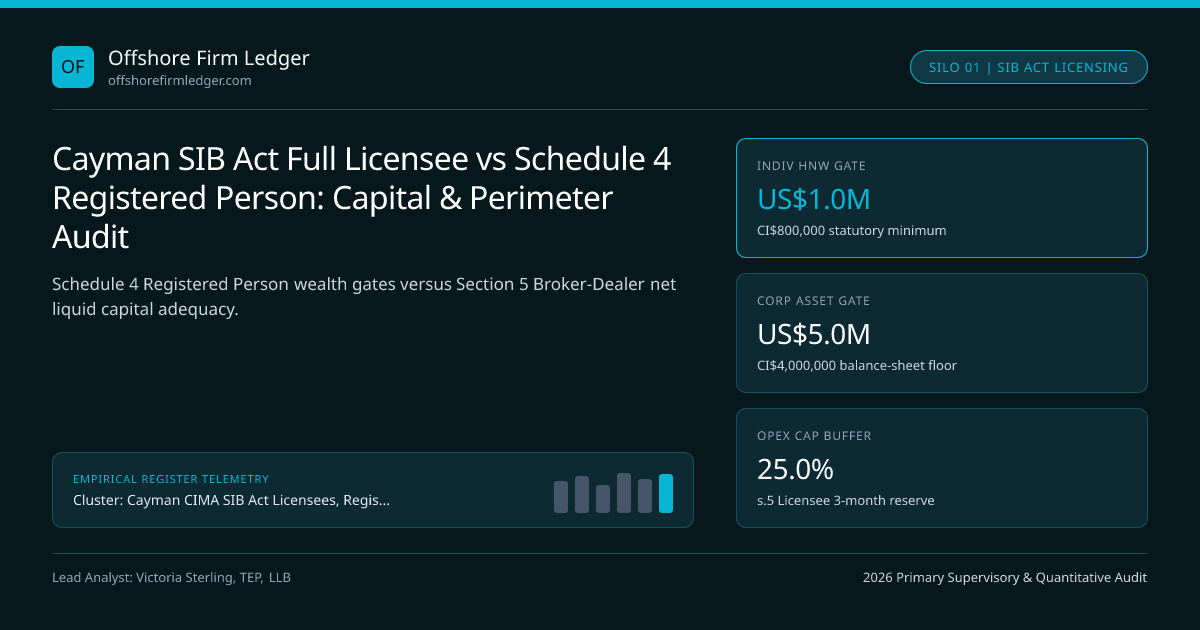
Schedule 4 of the Cayman Islands Securities Investment Business Act establishes a hard statutory cliff: an investment manager, advisor, or broker-dealer registered as a "Registered Person" with CIMA may transact solely for Sophisticated Persons, High Net Worth Persons (minimum CI$800,000 / US$1,000,000 net worth for individuals or CI$4,000,000 / US$5,000,000 total assets for corporate bodies), or investment entities exclusively owned by such persons. Any firm soliciting or executing margin, derivatives, or securities orders for non-qualifying retail clients must obtain a full Section 5 SIB Act Licence, maintain continuous regulatory net liquid capital, and file audited financial statements within six months of fiscal year-end. Within our Cayman CIMA SIB Act & Fund Governance hub, this statutory distinction explains why legitimate Cayman retail broker-dealers number fewer than two dozen globally while over 1,600 institutional fund managers operate as Registered Persons.
Statutory Abolition of Excluded Persons and the 2020 Re-Registration Mandate#
Prior to the Securities Investment Business (Amendment) Act, 2019, thousands of Cayman investment managers and offshore dealing desks operated as "Excluded Persons" by filing a one-page annual notice without undergoing director fitness vetting or regulatory inspection. Following critical peer assessments by the Caribbean Financial Action Task Force (CFATF) and the EU Code of Conduct Group, the Cayman legislature abolished Excluded Person status entirely as of January 15, 2020, compelling every active entity inside the Cayman SIB Act topic cluster to transition into CIMA-vetted Registered Person status or apply for a Section 5 Full Licence.
Transitioning into Schedule 4 Registered Person status did not grant equivalence with a full prudential brokerage charter. Under Section 5(4) and Section 5(5) of the SIB Act, a Registered Person must maintain at least two natural-person directors (or one corporate director duly licensed under the Directors Registration and Licensing Act), submit personal questionnaires and police clearance certificates for all 10%+ beneficial owners and officers, and undergo CIMA AML/CFT thematic inspections—yet CIMA explicitly states on its public register that Registered Persons are not "licensed" for retail conduct-of-business purposes.
Prudential Capital Adequacy: Section 5 Full Licensees Under Financial Requirements Regulations#
Entities holding a Section 5 Licence—Broker-Dealers, Market Makers, Arrangers, or Retail Managers—must obey the SIB Financial Requirements and Conduct of Business Regulations. Whereas Schedule 4 Registered Persons face no CIMA balance-sheet capital floor, a Section 5 Broker-Dealer holding client money must maintain unimpaired net liquid capital equal to the greater of a statutory floor (CI$80,000 to CI$1,000,000+ for principal dealers) or 25% of audited annual relevant expenditure plus position-risk haircuts.
Full Licensees also need prior CIMA written consent before transferring 10%+ voting shares, opening foreign branches, or altering client-money trust accounts. Compliance teams vetting multi-entity brokers in our domiciles directory—such as Axinvest, Axiance, or Aspen Digital—should confirm whether the Cayman entity holds a full Section 5 licence or routes retail clients elsewhere.
Schedule 2A Single Family Offices and Economic Substance Traps#
When Cayman overhauled the SIB Act, family wealth structures lobbied successfully for the Schedule 2A "Non-Registrable Persons" carve-out covering Single Family Offices (SFOs). An SFO managing securities solely for connected family members without soliciting external capital or receiving third-party performance fees is exempt from both Section 5 licensing and Schedule 4 registration, though it remains subject to Cayman's primary AML/CFT Proceeds of Crime Act obligations.
Conversely, any Registered Person or Full Licensee performing discretionary fund management (buying and selling securities on a discretionary mandate rather than pure non-binding investment advice) triggers Core Income Generating Activity (CIGA) requirements under Cayman's Economic Substance Act, requiring adequate Cayman-based investment personnel, local expenditure, and board meetings on Grand Cayman.
| SIB Act Parameter | Schedule 2A Non-Registrable (SFO) | Schedule 4 Registered Person | Section 5 Full Licensee (Advisor/Manager) | Section 5 Full Licensee (Broker-Dealer) |
|---|---|---|---|---|
| Permitted Client Base | Single family bloodline / trusts only | Sophisticated (US$100k ticket) or HNW (US$1M / US$5M) | Retail, HNW, and institutional clients | Retail, HNW, and institutional clients |
| Statutory Capital Floor | None | None prescribed under SIB Act | Min CI$20,000–CI$80,000 + 25% expenditure | Min CI$100,000–CI$1M+ + position-risk haircuts |
| Audited Financial Filing | Not required with CIMA | Not required under SIB Act (unless ES/CIMA directed) | Mandatory within 6 months via local auditor | Mandatory within 6 months + client money opinion |
| PI Insurance Requirement | Voluntary | Recommended under CIMA Governance SOG | Mandatory (min CI$1M claim / CI$1.5M agg.) | Mandatory (risk-scaled PI + fidelity bond) |
| Annual CIMA Renewal Fee | CI$0 | CI$5,000 due by January 15 | CI$4,000–CI$8,000 by licence class | CI$8,000+ plus transaction/branch surcharges |
Net Liquid Capital & Position-Risk Calculation for Section 5 Broker-Dealers#
Before onboarding with a Cayman Section 5 Broker-Dealer, institutional treasurers test the dealer's excess net liquid capital cushion under the SIB (Financial Requirements and Standards) Regulations against concentrated margin-book shocks.
- Where:
- EligibleLiquidAssets = Cash at approved Tier-1 banks + T-bills (0-2% haircut) - illiquid receivables & intercompany loans (100% haircut)
- TotalRankingLiabilities = Unsubordinated liabilities (excluding CIMA-approved subordinated debt >= 2yr maturity)
- Cap_Base = Prescribed statutory base capital (e.g., US$121,951 [CI$100,000] for standard Broker-Dealer)
- PositionRiskRequirement = Notional principal book exposure * statutory volatility haircut (e.g., 8% FX, 15% equities)
- Worked Stress Audit (Cayman s.5 Broker-Dealer with US$3.4M Balance Sheet):
- EligibleLiquidAssets = US$3,400,000 - US$650,000 (unsecured parent loan disallowed) = US$2,750,000
- TotalRankingLiabilities = US$1,120,000
- NetLiquidCapital = US$1,630,000
- AnnualFixedOpex = US$2,400,000 -> 0.25 * Opex = US$600,000
- Position & Counterparty Risk = US$540,000 (on US$6.75M unhedged FX principal book @ 8%)
- RequiredMinimumCapital = max(121,951, 600,000 + 540,000) = US$1,140,000
- ExcessNetLiquid_Capital = 1,630,000 - 1,140,000 = +US$490,000 (143.0% solvency coverage)
Notice how disallowing the US$650,000 unsecured intercompany receivable to a parent holding company compresses the dealer's excess capital cushion from US$1.14 million to US$490,000—demonstrating why CIMA examiners scrutinize related-party receivables during quarterly prudential reviews.
Verification Protocol for Allocators and Prime Counterparties#
Counterparty credit teams reviewing a Cayman entity claiming SIB Act authorization should never accept a Certificate of Incorporation from the Registrar of Companies as evidence of regulatory standing. Cross-check the exact entity name on CIMA's regulated-entities portal, verify whether its category reads "Securities - Licensee" versus "Securities - Registered Person," confirm compliance with the CIMA Rule on Internal Controls, and compare license numbers against the license verification portal—just as cross-border examiners verify BVI permits like SIBA/L/19/1122 before executing prime give-up agreements.
Frequently asked questions
What is the High Net Worth Person threshold for a Cayman SIB Act Registered Person?
Under Section 2 of the Securities Investment Business Act, a High Net Worth Person is an individual whose net worth is at least CI$800,000 (customarily US$1,000,000) or any body corporate, unincorporated association, partnership, or trust that has total assets of not less than CI$4,000,000 (approximately US$5,000,000).
Do Cayman SIB Act Registered Persons submit annual audited financial statements to CIMA?
Unlike Section 5 Full Licensees—which must file local CIMA-approved audited financial statements within six months of financial year-end—Schedule 4 Registered Persons file an annual declaration and pay CI$5,000 by January 15 without a routine statutory audit filing, unless specifically ordered by CIMA inspection.
Does a Cayman SIB Act Registered Person trigger Cayman Economic Substance requirements?
Only if the Registered Person performs discretionary "fund management business"—making binding investment buy/sell decisions on behalf of an investment fund. Entities providing purely non-discretionary investment advice or trade arrangement fall outside the fund-management CIGA perimeter under the Economic Substance Act.
Why does CIMA disallow intercompany loans when calculating a Section 5 Broker-Dealer net liquid capital?
Under the SIB Financial Requirements and Standards Regulations, unsecured receivables and advances to affiliated group companies cannot be liquidated immediately during a margin crisis and therefore receive a 100% illiquidity haircut when computing Eligible Liquid Assets.
Publication record
- Published
- 14 November 2026
- Updated
- 14 November 2026
- Author
- Victoria Sterling, TEP, LLB
- Review
- Review not recorded
- Automated fact check
- Passed in the stored pipeline record
- Source URLs
- 3 recorded
AI assistance recorded: anthropic/claude-opus-4.6. This field does not establish human review or source verification.
Academic & Institutional Attribution
Cite This Research & Embed Live Data Card
Standard academic & institutional research paper citation format.
Victoria Sterling, TEP, LLB. (2026, November 14). Cayman SIB Act Full Licensee vs Schedule 4 Registered Person: Capital & Perimeter Audit. Offshore Firm Ledger. https://offshorefirmledger.com/dossiers/cayman-sib-act-full-licensee-vs-registered-person-transitionRegulatory Directory Cross-Reference
Referenced Institutions & Regulatory Registries
Top Regulated Institutions in This Coverage Slice
Referenced Supervisory Authorities
Related Cayman Cima Sib Mutual Private Funds & Institutional Briefings
Explore Cayman Cima Sib Mutual Private Funds Hub (20) →Cayman Cima Sib Mutual Private Funds
Cayman CIMA SIB Act, SPC Ring-Fencing, Mutual & Private Funds: Institutional Statute GuideCayman Cima Sib Mutual Private Funds
Cayman Segregated Portfolio Company (SPC) Ring-Fencing Under Companies Act Part XIVCayman Cima Sib Mutual Private Funds
Cayman SPC Cross-Cell Contamination & Section 224 Receivership Case Law AuditCayman Cima Sib Mutual Private Funds
CIMA Rule on Corporate Governance for Regulated Entities: Fund Board & Fine AuditCayman Cima Sib Mutual Private Funds
CIMA Rule on Internal Controls: Five COSO Components & Outsourcing AuditsCayman Cima Sib Mutual Private Funds
Cayman Private Funds Act Section 16 Asset Valuation: Level 3 & Manager FirewallsCayman Cima Sib Mutual Private Funds
Cayman Private Funds Act Section 17 Safekeeping & Title Verification AuditCayman Cima Sib Mutual Private Funds
Cayman Private Funds Act Section 18 Cash Monitoring & Bank ReconciliationBvi Fsc Siba Approved Manager Statutes
BVI SIBA Category 2 Arranging Deals in Investments: Introducer & White-Label LimitsBvi Fsc Siba Approved Manager Statutes
BVI SIBA Category 3 Investment Management (Sub-Categories A–E): Capital & CIGA AuditBvi Fsc Siba Approved Manager Statutes
BVI SIBA Categories 4, 5 & 6: Investment Advice, Custody & Fund AdministrationBvi Fsc Siba Approved Manager Statutes
BVI Approved Manager Regime: US$400M Open-Ended & US$1B Closed-Ended AUM Caps
Offshore Firm Ledger Data, Benchmarks & Contributor Records
CC BY 4.0 Open Data
Open Institutional Datasets (CSV / JSON) →
Download desk-compiled quantitative series & schemas.
2026 Reference Matrix
2026 Institutional Benchmarks & Thresholds →
Statutory capital, clearing, margin & rate conventions.
Editorial Records
Authors & Review Records →
View named contributors where those records are available.
Complete Index
Master Research & Dossier Archive →
Browse all published briefings by topic pillar & date.