
Cayman Cima Sib Mutual Private Funds
Cayman SPC Cross-Cell Contamination & Section 224 Receivership Case Law Audit
Cayman Grand Court rulings from ABC Company (SPC) v J & Co. to Performance Insurance confirm that an insolvent cell triggers a targeted Section 224 receivership order rather than winding up solvent sibling hedge fund cells.
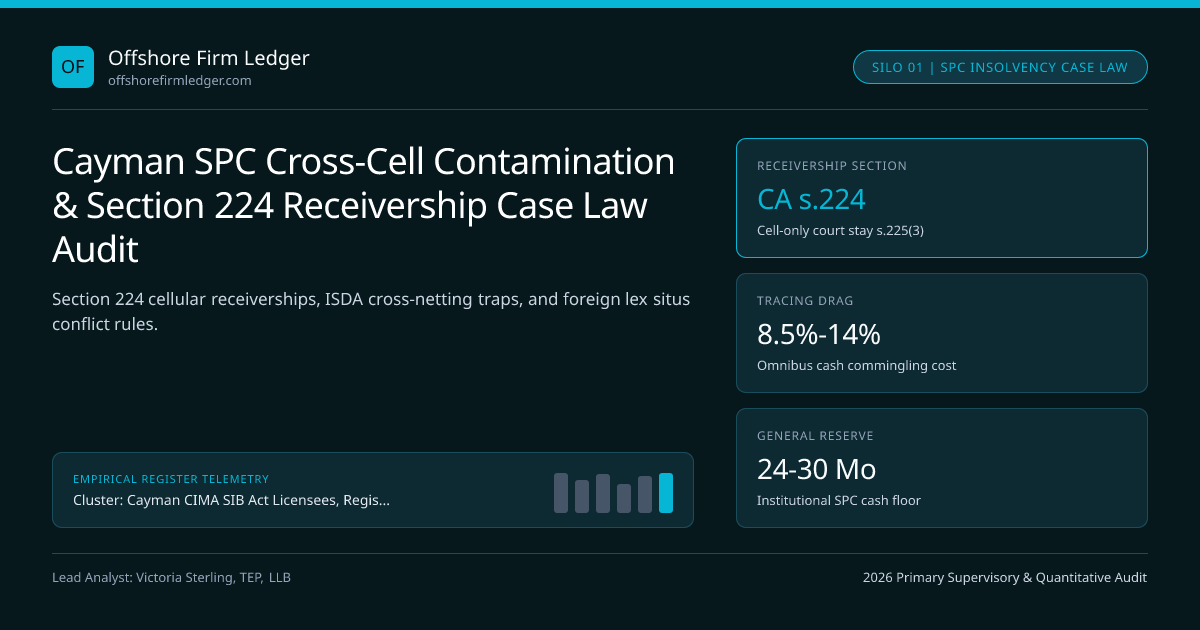
Grand Court Financial Services Division jurisprudence—anchored by ABC Company (SPC) v J & Co. Ltd [2012 (1) CILR 300], In the Matter of Performance Insurance Company SPC [2021], and In the Matter of Obelisk Global Fund SPC—establishes that insolvency inside a single segregated portfolio does not render the parent Segregated Portfolio Company insolvent as a whole, provided general assets remain solvent and cellular accounts were not commingled. Instead of placing the entire umbrella into compulsory winding-up under Section 92 of the Companies Act, the Grand Court appoints a Receiver strictly over the distressed cell under Section 224 while solvent portfolios continue trading uninterrupted under CIMA supervision. Within our Cayman CIMA SIB Act & SPC statute hub, understanding the four operational vectors that breach cellular isolation is mandatory for prime brokerage risk committees and institutional LPs.
Section 224 Receivership Orders Versus Whole-Company Official Liquidation#
Under Section 224(1) of the Cayman Companies Act, if the court is satisfied that the segregated portfolio assets attributable to a particular cell are or are likely to be insufficient to discharge the claims of creditors in respect of that portfolio, the court may issue a Receivership Order specific to that portfolio. Upon entry of a Section 224 order, the directors' powers cease exclusively with respect to the business and assets of that distressed portfolio, an automatic statutory stay bars actions or execution proceedings against that cell's assets without leave of the Grand Court (Section 225(3)), and solvent sibling cells retain uninterrupted board governance.
In ABC Company (SPC) v J & Co. Ltd, the Cayman Islands Court of Appeal rejected an unpaid redeeming investor's petition to wind up an entire multi-cell SPC under the "just and equitable" ground where the dispute concerned solely one illiquid portfolio, holding that Winding-Up Orders destroy the statutory bargain of Part XIV cellular ring-fencing for innocent investors in unrelated cells. Conversely, where every cell is defunct, fraud pervades the entire board, or general assets cannot fund mandatory statutory audit and registered-office fees, Official Liquidators appointed over the SPC as a whole must ring-fence liquidator remuneration cell-by-cell (Re Performance Insurance Company SPC), charging general liquidation overhead pro-rata or only against assets benefiting from specific realization work.
The Four Real-World Vectors of Cross-Cell Contamination#
Even though Cayman domestic statute prohibits cross-cell attachment under Section 220(b), four recurring operational and conflict-of-laws failures routinely trigger real-world cross-cell contamination:
- Omnibus Cash & Unsegregated Margin Accounts: When an emerging platform administrator routes investor wires into a single master USD bank account at an offshore or onshore depository before journal-booking entries to sub-ledgers, an insolvency freeze or third-party garnishment attaches the commingled omnibus balance, forcing solvent cells to fund multi-year tracing litigation under equitable Clayton's Case or pari passu pooling rules.
- Unamended ISDA Master Agreement Section 5(a)(vii) & Cross-Default Clauses: Standard 2002 ISDA Master Agreements define the contracting party by legal entity name. Unless the Schedule contains a bespoke Segregated Portfolio Annex deeming each cell a separate "Party" with independent Events of Default, independent Credit Support Annexes (CSAs), and zero cross-collateralization across cells, a Section 224 Receivership on Cell A triggers automatic early termination and close-out netting across solvent Cell B's derivatives book at the same prime broker.
- *Foreign Lex Situs* Non-Recognition of Statutory Cells*: Under English and New York conflict-of-laws doctrine, while matters of corporate status are governed by the law of incorporation (Cayman), procedural remedies and attachment over assets physically situated onshore (lex situs*) may be tested under local insolvency or contract law if the governing contract is English or New York law and omitted an explicit contractual non-recourse covenant.
- Joint Sovereign Tax or Regulatory Penalties: Withholding tax assessments (such as Indian capital-gains assessments, US IRS Section 1446(f) partnership withholding, or CIMA entity-level administrative fines) assessed against the SPC's single corporate tax ID (TIN/GIIN) attach general assets first and can freeze master custody relationships across the Cayman SIB & Fund Governance cluster.
Comparative Matrix: Cayman SPC Cross-Cell Contamination Vectors & Mitigations#
| Contamination Vector | Underlying Operational Defect | Statutory / Contractual Exposure | Institutional Mitigation Standard |
|---|---|---|---|
| Prime Broker ISDA Cross-Netting | Single umbrella ISDA lacking cell-by-cell separation schedule | Prime broker liquidates SP-B margin to cover SP-A deficit | Separate ISDA Umbrella Schedule + unique sub-LEI & separate CSA per cell |
| Omnibus Bank Subscription Account | Shared USD clearing IBAN across all SPC cells | Garnishment freeze + expensive forensic tracing costs | Dedicated bank IBAN and prime custody account per segregated portfolio |
| Foreign Court Lex Situs Attachment | Onshore real estate or unhedged loan held directly by SPC | Onshore creditor argues non-corporate cell lacks standing | Interpose cell-owned Cayman/Delaware SPV LLC beneath each high-risk cell |
| Unpaid General Overhead Deficit | General assets exhausted; CIMA & Registrar fees unpaid | SPC struck off Companies Register, paralyzing all cells | Maintain 24-month escrowed general-asset expense reserve funded pro-rata |
Modeling Receiver Fee Allocation & General-Asset Reserve Adequacy#
Following Re Performance Insurance Company SPC and Re Premier Assurance Group SPC Ltd., liquidators and court-appointed receivers cannot raid solvent portfolios to fund unrecoverable investigation expenses of a defrauded empty cell. Institutional allocators stress-test an SPC's general-asset reserve runway before subscribing into a low-volatility cell alongside leveraged sibling cells:
- Where:
- GeneralAssetCash_Reserve = Unencumbered cash held in the SPC General Account (distinct from all SP accounts)
- UninsuredEntityPenalty_Exposure = Deductible / uncovered CIMA administrative fine or entity-level tax reserve
- FixedSPCStatutory_Fees = Annual Registrar + CIMA SPC base fees + Registered Office + DRLA board base
- SharedAuditLegal_Retainer = Unallocated entity-level legal & umbrella audit governance cost
- Worked Stress Test (5-Cell SPC where Cell 3 Enters s.224 Receivership & Stops Paying Platform Dues):
- GeneralAssetCash_Reserve = US$185,000
- UninsuredEntityPenalty_Exposure = US$50,000 (D&O / regulatory inquiry retention deductible)
- RemainingFourCells_Contribution = Covers 80% of US$96,000 annual shared SPC governance; 20% shortfall = US$19,200/yr
- AdditionalEntityLegal_Monitor = US$34,800/yr (counsel monitoring Cell 3 s.224 Receiver filings)
- NetAnnualGeneral_Burn = US$19,200 + US$34,800 = US$54,000/yr (US$4,500/month)
- SolventCellContinuity_Runway = (185,000 - 50,000) / 4,500 = 30.0 Months of uninterrupted solvent-cell operation
With US$185,000 escrowed in the SPC's general account, the four solvent portfolios enjoy a 30-month buffer to novate into a standalone vehicle or wind down Cell 3's receivership cleanly without Registrar strike-off.
Counterparty Due Diligence Checklist for Prime Brokers & LP Committees#
Institutional allocators comparing SPC hedge fund cells against multi-entity brokerage groups tracked in the offshore domiciles register—such as Blackbull or Blueberry Markets—must combine structural legal opinions with operational cash verification under Private Funds Act Section 18 cash monitoring and hedge fund redemption suspension case law. Insist on inspecting the prime broker's signed Segregated Portfolio Annex, confirming dedicated cell-specific bank IBANs, and verifying active CIMA registration status on the license verification portal.
Frequently asked questions
Does insolvency in one segregated portfolio force the entire Cayman SPC into liquidation?
No. Provided the SPC general account and other segregated portfolios remain solvent, the Grand Court appoints a Section 224 Receiver solely over the distressed cell. Solvent cells retain their directors, bank accounts, and CIMA trading authority without interruption.
How can an unamended ISDA Master Agreement defeat Cayman SPC cellular ring-fencing?
Standard ISDA Master Agreements treat the corporate entity as a single counterparty. Without a Segregated Portfolio Annex deeming each portfolio a separate Party with separate Credit Support Annexes, a prime broker can cross-net margin posted by solvent Cell B against losses in insolvent Cell A.
Who pays the fees of a Grand Court Receiver appointed over an insolvent Cayman SPC cell?
Under Section 224 and Grand Court decisions including Performance Insurance Company SPC, a cell receiver remuneration and expenses are payable strictly out of the segregated portfolio assets of the specific cell over which the receiver was appointed, not from sibling cells.
Why do institutional Cayman SPCs interpose a subsidiary SPV below cells holding onshore real estate or loans?
Foreign onshore courts in jurisdictions lacking statutory cell legislation may apply local lex situs attachment rules to non-corporate cells. Placing a standalone Cayman or Delaware LLC subsidiary beneath the cell provides universally recognized separate corporate personality onshore.
Publication record
- Published
- 14 November 2026
- Updated
- 14 November 2026
- Author
- Victoria Sterling, TEP, LLB
- Review
- Review not recorded
- Automated fact check
- Passed in the stored pipeline record
- Source URLs
- 3 recorded
AI assistance recorded: anthropic/claude-opus-4.6. This field does not establish human review or source verification.
Academic & Institutional Attribution
Cite This Research & Embed Live Data Card
Standard academic & institutional research paper citation format.
Victoria Sterling, TEP, LLB. (2026, November 14). Cayman SPC Cross-Cell Contamination & Section 224 Receivership Case Law Audit. Offshore Firm Ledger. https://offshorefirmledger.com/dossiers/cayman-spc-cross-cell-contamination-receivership-case-lawRegulatory Directory Cross-Reference
Referenced Institutions & Regulatory Registries
Mentioned Regulated Institutions
Referenced Supervisory Authorities
Related Cayman Cima Sib Mutual Private Funds & Institutional Briefings
Explore Cayman Cima Sib Mutual Private Funds Hub (20) →Cayman Cima Sib Mutual Private Funds
Cayman CIMA SIB Act, SPC Ring-Fencing, Mutual & Private Funds: Institutional Statute GuideCayman Cima Sib Mutual Private Funds
CIMA Rule on Corporate Governance for Regulated Entities: Fund Board & Fine AuditCayman Cima Sib Mutual Private Funds
CIMA Rule on Internal Controls: Five COSO Components & Outsourcing AuditsCayman Cima Sib Mutual Private Funds
Cayman Private Funds Act Section 16 Asset Valuation: Level 3 & Manager FirewallsCayman Cima Sib Mutual Private Funds
Cayman Private Funds Act Section 17 Safekeeping & Title Verification AuditCayman Cima Sib Mutual Private Funds
Cayman Private Funds Act Section 18 Cash Monitoring & Bank ReconciliationCayman Cima Sib Mutual Private Funds
Cayman Mutual Funds Act Section 4(3) Registered vs Administered & Licensed FundsCayman Cima Sib Mutual Private Funds
Cayman-Delaware Master-Feeder & UBTI Blocker Structure: Form 8832 Tax & CIMA AuditBvi Fsc Siba Approved Manager Statutes
BVI SIBA Categories 4, 5 & 6: Investment Advice, Custody & Fund AdministrationBvi Fsc Siba Approved Manager Statutes
BVI Approved Manager Regime: US$400M Open-Ended & US$1B Closed-Ended AUM CapsBvi Fsc Siba Approved Manager Statutes
BVI Incubator Fund (20/20/20 Test) vs Approved Fund (US$100M Cap): Audit & ConversionBvi Fsc Siba Approved Manager Statutes
BVI Professional Fund, Private Fund & Public Fund Recognition vs Registration Tiers
Offshore Firm Ledger Data, Benchmarks & Contributor Records
CC BY 4.0 Open Data
Open Institutional Datasets (CSV / JSON) →
Download desk-compiled quantitative series & schemas.
2026 Reference Matrix
2026 Institutional Benchmarks & Thresholds →
Statutory capital, clearing, margin & rate conventions.
Editorial Records
Authors & Review Records →
View named contributors where those records are available.
Complete Index
Master Research & Dossier Archive →
Browse all published briefings by topic pillar & date.