
Cayman Cima Sib Mutual Private Funds
Cayman Mutual Funds Act Section 4(3) Registered vs Administered & Licensed Funds
Over 70% of open-ended Cayman hedge funds register under Mutual Funds Act Section 4(3) with a US$100,000 minimum initial equity ticket, bypassing retail licensing while accepting full CIMA audit oversight.
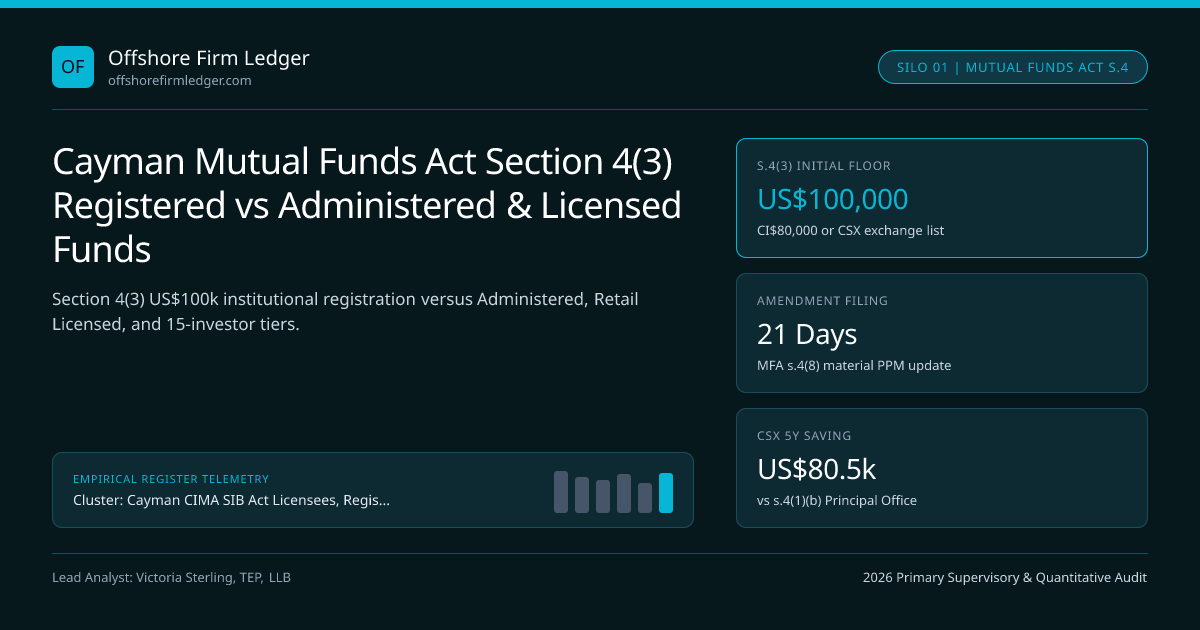
Open-ended collective investment vehicles domiciled in Grand Cayman—defined as any company, unit trust, or partnership issuing equity interests redeemable or repurchasable at the option of investors—must qualify under one of four statutory gateways in Section 4 of the Mutual Funds Act (2025 Revision) supervised by the Cayman Islands Monetary Authority. Institutional hedge funds overwhelmingly choose Section 4(3) Registered Fund status, which commands over 70% of Cayman's open-ended register (plus roughly 2,700 registered Master Funds) by enforcing a hard statutory minimum initial subscription of CI$80,000 (US$100,000) per investor. Within our Cayman CIMA statutory hub, choosing wrongly among Section 4(3), Section 4(1)(b) Administered, Section 4(1)(a) Licensed, and Section 4(4) Limited Investor categories dictates minimum ticket sizes, Cayman administrator tie-ins, and Japanese/retail distribution eligibility.
The Four Statutory Gateways of the Cayman Mutual Funds Act#
Every open-ended Cayman fund pooling more than one investor (single-investor funds of one fall outside the mutual-fund pooling definition, though voluntary registration is available) must fit one of four authorization tracks inside the Cayman SIB & Fund Governance topic hub:
- Section 4(3) Registered Mutual Fund (Institutional Standard): Requires either a minimum initial equity investment of CI$80,000 (universally drafted as US$100,000 or currency equivalent in offering memoranda) per investor or listing of the equity interests on a CIMA-recognized stock exchange (such as CSX, Euronext Dublin, or TISE). CIMA does not pre-approve the commercial merits of a Section 4(3) PPM; registration completes via REEFs within 3 to 5 business days upon filing Form MF1, consent letters from the administrator and local CIMA-approved auditor, and DRLA director credentials.
- Section 4(1)(b) Administered Mutual Fund (Sub-US$100k Affluent Feeder): Permits initial subscriptions below US$100,000 (for instance, US$25,000 minimum tickets for wealth-management feeder platforms) provided a CIMA-licensed Mutual Fund Administrator in the Cayman Islands provides the fund's principal office and assumes statutory vetting liability under Section 16 for the soundness of the promoter and offering.
- Section 4(1)(a) Licensed Mutual Fund (Retail / Japanese Public Offerings): Designed for true retail distribution (notably Japanese Toshin unit trusts distributed through Tokyo securities houses), requiring exhaustive CIMA prior vetting of promoter track record, capitalization, administrator, and prospectus terms before licence issuance.
- Section 4(4) Limited Investor Fund ("15-or-Fewer" Former Exempt Route): Captures open-ended funds whose equity interests are held by not more than 15 investors, a majority in number of whom hold the legal power by ordinary vote to appoint and remove the operator (directors, GP, or trustee). Abolishing the pre-2020 unregulated 15-investor loophole, Section 4(4) funds must now register with CIMA, maintain two natural-person directors, and file audited financials annually.
Master Fund Registration Triggers in Master-Feeder Architectures#
Under Section 4(3)(a)(iii) of the Mutual Funds Act, a Cayman Master Fund must separately register with CIMA whenever it holds investments, conducts trading activities, has one or more regulated feeder funds (investing 51%+ of its assets into the master), and issues redeemable equity interests. Crucially, Master Funds enjoy a streamlined regulatory profile: they have no separate US$100,000 investor minimum beyond their regulated feeder's threshold, need not file a separate offering document if terms sit inside the feeder's PPM, and pay a reduced CI$2,675 (US$3,262) annual CIMA fee—as modeled in our Cayman-Delaware Master-Feeder & Blocker engineering dossier. By contrast, Section 4(4) Master Funds are exempt from standalone master registration if they do not solicit outside the limited feeder group.
Strict Prohibition on Aggregated Nominee Tickets Breaching US$100,000#
A recurring CIMA inspection finding involves wealth platforms or unregulated offshore brokers—such as entities in the offshore domiciles register like Algo Global or Altimatrade—pooling ten US$10,000 retail clients inside an omnibus nominee to subscribe one US$100,000 ticket into a Section 4(3) Registered Fund. Under CIMA policy, where an investor subscribes via a nominee or bare trust formed to bypass the CI$80,000 / US$100,000 floor, each underlying beneficial investor must independently meet the US$100,000 threshold (unless the wrapper is a regulated collective scheme or discretionary manager).
| Mutual Funds Act Gateway | Statutory Citation | Min Initial Subscription | Investor Count Cap | Cayman Licensed Admin Required? | Typical REEFs Timeline & Annual Fee |
|---|---|---|---|---|---|
| Registered Mutual Fund | MFA s.4(3) | US$100,000 (CI$80k) or listed | Unlimited | No (recognized onshore admin permitted, e.g., Citco, SS&C, Apex US/IE) | 3–5 business days; CI$3,675 (US$4,482) |
| Regulated Master Fund | MFA s.4(3)(a)(iii) | Governed by Regulated Feeder | >=1 Regulated Feeder | No (recognized global admin permitted) | 3–5 business days; CI$2,675 (US$3,262) |
| Administered Mutual Fund | MFA s.4(1)(b) | None (set by PPM, e.g., US$25k) | Unlimited | Yes — Cayman-licensed MFA must provide Principal Office | 2–3 weeks (Admin s.16 vetting); CI$3,675 + Principal Office fee |
| Licensed Mutual Fund | MFA s.4(1)(a) | None (retail unit trusts) | Unlimited | Onshore or Cayman CIMA-approved admin | 6–10 weeks full CIMA promoter vetting; CI$3,675 |
| Limited Investor Fund | MFA s.4(4) | None | Max 15 investors (majority remove board) | Optional (local CIMA audit still mandatory) | 5–7 business days; CI$3,675 (US$4,482) |
Break-Even Cost Model: Section 4(1)(b) Sub-$100k Feeder vs Section 4(3) Listed Share Class#
Sponsors targeting US$25,000–US$50,000 affluent private-bank tickets can avoid the US$100,000 Section 4(3) floor via two legal routes: appointing a Cayman-licensed Mutual Fund Administrator to provide a Principal Office under Section 4(1)(b), or executing a technical listing of a Section 4(3) share class on the Cayman Islands Stock Exchange (CSX). Here is the five-year cost comparison:
- Where:
- Route A (Section 4(1)(b) Administered Fund with Cayman Principal Office):
- InitialPrincipalOfficeDueDiligence = US$7,500
- AnnualPrincipalOfficeResponsibilityFee = US$24,000 / year (over & above standard NAV admin fee)
- FiveYearTCORouteA = 7,500 + (5 * 24,000) = US$127,500
- Route B (Section 4(3) Registered Fund Technically Listed on CSX Specialist Fund Segment):
- InitialCSXListingAgent&ExchangeFee = US$14,500 (US$12,000 listing agent + US$2,500 CSX initial)
- AnnualCSXMaintenance&Agent_Retainer = US$6,500 / year (allows non-Cayman US/Irish administrator)
- FiveYearTCORouteB = 14,500 + (5 * 6,500) = US$47,000
- FiveYearNet_Saving (CSX Listed s.4(3) vs s.4(1)(b)) = US$127,500 - US$47,000 = US$80,500 (63.14% saving)
Listing a share class on CSX unlocks Section 4(3) eligibility without the US$100,000 minimum ticket while allowing the fund to retain its existing New York or Dublin administrator—saving US$80,500 over five years relative to a Section 4(1)(b) Principal Office arrangement.
Ongoing Section 4(8) Material Change Filings & Investor Verification#
Every Section 4(3) and Section 4(1)(b) operator must file an amended Offering Document and updated Form MF1/MF2 with CIMA within 21 days of becoming aware of any material change affecting offering information (such as changing prime brokers, modifying redemption gates or side-pocket clauses, or replacing DRLA directors), and LPs can verify current registration status via the license verification portal.
Frequently asked questions
Can an existing investor in a Cayman Section 4(3) hedge fund make top-up subscriptions smaller than US$100,000?
Yes. The statutory CI$80,000 (US$100,000) floor under Section 4(3)(a)(i) applies strictly to the initial equity investment per investor. Once an investor has subscribed at least US$100,000 initially (and has not redeemed below PPM maintenance floors), subsequent top-up tickets may be smaller.
Does a Section 4(3) Cayman Mutual Fund require a Cayman-domiciled fund administrator?
No. Unlike Section 4(1)(b) Administered Funds, a Section 4(3) Registered Fund may appoint a reputable fund administrator domiciled in a recognized onshore or offshore jurisdiction (such as the United States, Ireland, Luxembourg, Singapore, or BVI), although its financial audit still requires local Cayman CIMA-approved auditor sign-off.
Are single-investor Cayman funds ("funds of one") required to register under the Mutual Funds Act?
No. Because the statutory definition of a mutual fund requires the pooling of investor funds across more than one investor, a true single-investor vehicle is exempt from mandatory registration, though institutional mandates can elect voluntary registration.
How quickly must a Cayman Mutual Fund file Offering Memorandum amendments with CIMA?
Under Section 4(8) of the Mutual Funds Act, whenever a continuing offering experiences a material change affecting any information in the filed Offering Document or prescribed particulars, an amended document must be filed with CIMA via REEFs within 21 days.
Publication record
- Published
- 14 November 2026
- Updated
- 14 November 2026
- Author
- Victoria Sterling, TEP, LLB
- Review
- Review not recorded
- Automated fact check
- Passed in the stored pipeline record
- Source URLs
- 3 recorded
AI assistance recorded: anthropic/claude-opus-4.6. This field does not establish human review or source verification.
Academic & Institutional Attribution
Cite This Research & Embed Live Data Card
Standard academic & institutional research paper citation format.
Victoria Sterling, TEP, LLB. (2026, November 14). Cayman Mutual Funds Act Section 4(3) Registered vs Administered & Licensed Funds. Offshore Firm Ledger. https://offshorefirmledger.com/dossiers/cayman-mutual-funds-act-section-4-3-registered-licensed-adminRegulatory Directory Cross-Reference
Referenced Institutions & Regulatory Registries
Top Regulated Institutions in This Coverage Slice
Referenced Supervisory Authorities
Related Cayman Cima Sib Mutual Private Funds & Institutional Briefings
Explore Cayman Cima Sib Mutual Private Funds Hub (20) →Cayman Cima Sib Mutual Private Funds
Cayman CIMA SIB Act, SPC Ring-Fencing, Mutual & Private Funds: Institutional Statute GuideCayman Cima Sib Mutual Private Funds
Cayman-Delaware Master-Feeder & UBTI Blocker Structure: Form 8832 Tax & CIMA AuditCayman Cima Sib Mutual Private Funds
CIMA Directors Registration and Licensing Act (DRLA): Covered Entities & Insurance RulesCayman Cima Sib Mutual Private Funds
Cayman VASP Act Phase 2 Licensing: Custody Segregation, Exchanges & SIB Act OverlapCayman Cima Sib Mutual Private Funds
Cayman Foundation Companies Act (2017): Orphan SPVs, DAO Treasuries & Supervisor LawCayman Cima Sib Mutual Private Funds
Cayman Economic Substance Act: Fund Management CIGA, Investment Fund Carve-Out & DITC FinesCayman Cima Sib Mutual Private Funds
Cayman AMLCO, MLRO & DMLRO Rules: Natural-Person Independence & CIMA FinesCayman Cima Sib Mutual Private Funds
Cayman Exempted Limited Partnership Act (ELPA): LP Safe Harbors, Clawbacks & Side LettersBvi Fsc Siba Approved Manager Statutes
BVI Business Companies Act 2023–2025 Amendments: Annual Financial Returns & Director ListsBvi Fsc Siba Approved Manager Statutes
BVI Strike-Off & Immediate Dissolution Reform: Bona Vacantia & 5-Year RestorationBvi Fsc Siba Approved Manager Statutes
BVI Regulatory Code Part IV Client Assets: Statutory Trust, Reconciliations & TTCA TrapsBvi Fsc Siba Approved Manager Statutes
BVI Economic Substance Act & BOSS Filings: Pure Equity Holding vs Fund Management CIGA
Offshore Firm Ledger Data, Benchmarks & Contributor Records
CC BY 4.0 Open Data
Open Institutional Datasets (CSV / JSON) →
Download desk-compiled quantitative series & schemas.
2026 Reference Matrix
2026 Institutional Benchmarks & Thresholds →
Statutory capital, clearing, margin & rate conventions.
Editorial Records
Authors & Review Records →
View named contributors where those records are available.
Complete Index
Master Research & Dossier Archive →
Browse all published briefings by topic pillar & date.