
Cayman Cima Sib Mutual Private Funds
Cayman Exempted Limited Partnership Act (ELPA): LP Safe Harbors, Clawbacks & Side Letters
Over 85% of closed-ended Cayman private equity and private credit funds organize under the Exempted Limited Partnership Act, pairing Delaware-style contractual freedom with strict Section 31 insolvency clawback rules.
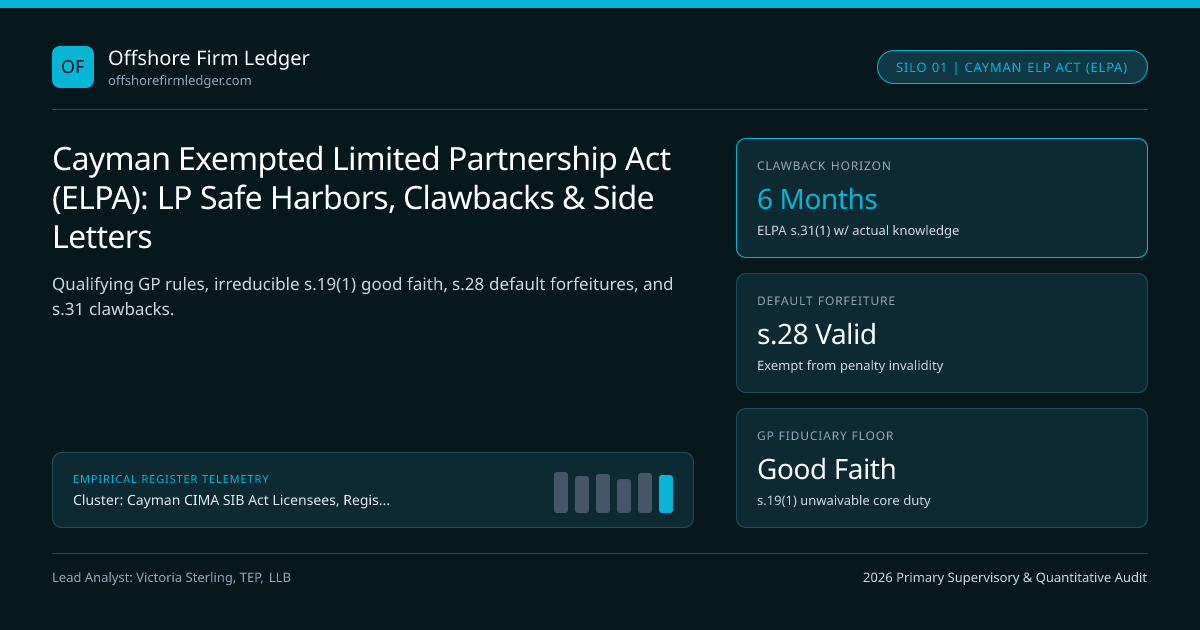
Modeled consciously alongside the Delaware Revised Uniform Limited Partnership Act yet rooted in English/Cayman common law and equity, the Cayman Islands Exempted Limited Partnership Act (ELPA) serves as the flagship legal charter for over 85% of the ~16,900 closed-ended buyout, venture, infrastructure, and private credit vehicles registered with CIMA under the Private Funds Act. Unlike a Cayman Exempted Company, a Cayman Exempted Limited Partnership (ELP) does not possess separate legal personality: under Section 4 and Section 16 of the ELPA, all letters, contracts, deeds, and property titles are entered into and held by the General Partner (GP) upon statutory trust for the partnership. Within our Cayman CIMA SIB Act & Fund Governance hub, mastering the ELPA's Qualifying General Partner rules, LPAC safe-harbor protections, Section 31 distribution clawbacks, and Privy Council side-letter enforceability prevents costly LPA drafting defects.
Qualifying Cayman General Partner Mandate & LPAC Limited-Liability Safe Harbors#
Section 4(4) of the ELPA imposes a strict jurisdictional anchor: at least one General Partner of a Cayman ELP must be a "Qualifying General Partner"—namely, a Cayman-incorporated company, a foreign company (such as a Delaware LLC or LP) formally registered in Cayman as a Foreign Company under Part IX of the Companies Act, a Cayman-resident individual, or another Cayman ELP. Sponsors forming a Delaware LLC to serve as GP frequently overlook that the Delaware LLC must complete Part IX Foreign Company registration in George Town before filing the Section 9 ELP registration statement.
For institutional Limited Partners—such as sovereign wealth funds and public pensions serving on the Limited Partner Advisory Committee (LPAC)—Section 14 and Section 20 of the ELPA codify an expansive statutory Safe Harbor inside the Cayman SIB & Fund Governance cluster. Whereas participating in external business management of the partnership with third parties risks forfeiting limited liability under Section 20(1), Section 14(2) explicitly guarantees that LPs do not take part in conduct of the business merely by sitting on an LPAC, approving or vetoing Section 16 valuation conflicts, consenting to key-person/exclusivity waivers, consulting with the GP, or voting to remove and replace the General Partner! Even more favorably for fiduciary boards, Section 19(2) expressly permits the LPA to modify or exclude fiduciary duties of LPAC members toward the partnership and other LPs altogether.
Section 31 Statutory Insolvency Clawback vs LPA Contractual Recall#
Institutional LPs negotiating LPA giveback caps must distinguish contractual recalls from Section 31(1) of the ELPA. Under Section 31(1), if an LP receives a return of contribution when the ELP is insolvent AND the LP has actual knowledge of that insolvency, then for 6 months post-receipt, the LP is liable to repay that amount plus 10% simple interest to discharge partnership debts incurred while its contribution formed partnership assets.
If the ELP was solvent at payment—or if the LP lacked actual knowledge of insolvency—Section 31(1) imposes zero statutory clawback, leaving only negotiated LPA clauses. Equally vital for GPs enforcing drawdowns, Section 28 of the ELPA abrogates the English common-law rule against penalties, making 50%–100% LPA capital-account forfeitures against defaulting LPs statutorily enforceable in the Cayman Grand Court.
Side Letters & Lansdowne / Mediterra Entire-Agreement Traps#
Anchor LPs routinely negotiate Side Letters for fee discounts, co-investments, or MFN rights. In Cayman litigation (Re Lansdowne and Mediterra), side letters failed where: (a) the LPA lacked an explicit clause authorizing GP side-letter variations, or (b) a subsequent Subscription Agreement contained a boilerplate "Entire Agreement" clause omitting the Side Letter! Unlike informal rebates at offshore brokerages in the offshore domiciles register like Barginex or Bcr, Cayman side letters must be expressly carved into the Subscription Agreement and signed by the GP in its partnership capacity.
| ELPA Statutory Section | Legal Issue Governed | Cayman ELPA Statutory Rule | Delaware RULPA Comparison | Practical Drafting Mandate |
|---|---|---|---|---|
| Section 4(4) | GP Jurisdictional Nexus | >=1 GP must be Cayman entity or Part IX Foreign Co | Any entity (no DE registration of foreign GP required beyond registered agent) | Register Delaware GP LLC under Part IX before ELP formation |
| Section 19(1) & (2) | Fiduciary Duties | GP owes unwaivable statutory duty to act at all times in good faith; LPAC duties can be fully excluded | Delaware permits complete elimination of GP fiduciary duties (save implied contractual good faith) | Cannot draft away Cayman GP core good-faith fiduciary floor |
| Section 22(2) | LP Right to Information / LP List | LPs entitled to true/full info by default, subject to LPA restriction | Similar LPA carve-out permitted | Explicitly restrict LP list disclosure in LPA if confidentiality desired |
| Section 28 | Capital-Call Default Remedies | Expressly exempts default forfeitures from rule against penalties | Similar statutory safe harbor (6 Del. C. § 17-306) | Specify exact notice cure days (e.g., 10 BD) & 50% haircut mechanics |
| Section 31(1) | Return-of-Capital Clawback | 6 months if insolvent at payment AND LP had actual knowledge (+10% interest) | 3-year clawback if LP knew distribution violated § 17-607 (zero statutory 10% rate) | Issue GP solvency certificate with every distribution notice |
Quantitative Model: Section 28 Capital-Call Default Forfeiture Accretion to Non-Defaulting LPs#
When a distressed LP defaults on a mid-lifecycle capital call in a Cayman buyout ELP and fails to cure within the LPA's 10-business-day notice period, Section 28 validates the LPA's capital-account haircut—accreting NAV directly to performing LPs without equitable relief against forfeiture:
- Where:
- TotalFundNAVPreCall = US$180,000,000 across all LPs
- DefaultingLPPaidIn_NAV = US$15,000,000 (single family office LP failing a US$3.0M follow-on call)
- TotalPerformingLP_NAV = US$165,000,000
- Haircut_Pct = 50.0% LPA Section 28 forfeiture penalty upon uncured default
- DefaultLegalAdmin_Costs = US$95,000 (Cayman counsel notice, capital-account re-allocation & secondary cure process)
- Worked Section 28 Enforcement Impact:
- ForfeitedCapitalPool = US$15,000,000 * 0.50 = US$7,500,000
- NetReallocatedAccretion = US$7,500,000 - US$95,000 = US$7,405,000 distributed pro-rata to performing LP capital accounts
- PerformingLPNAV_Accretion = (7,405,000 / 165,000,000) * 100 = +4.488% (+448.8 bps immediate NAV uplift to non-defaulting LPs)
Because Section 28 shields that 50% (US$7.50 million) forfeiture from common-law penalty invalidation, Cayman ELPs enjoy exceptional subscription-line credit ratings from Tier-1 banks underwriting capital-call facilities (frequently reducing borrowing spreads by 15–25 bps).
Essential Cayman LPA Pre-Closing Audit Steps#
Before executing a Cayman LPA and Side Letter, counsel should confirm: (1) the GP's active Cayman incorporation or Part IX Foreign Company certificate; (2) an express LPA Side-Letter authorization clause plus explicit Side-Letter preservation inside the Subscription Agreement's entire-agreement clause; (3) whether Section 19(1) requires the GP to act in the interests of the ELP ("subject to any express provisions of the LPA" allowing multi-fund allocation); and (4) active Private Fund registration under CIMA's Section 16–18 regime on the license verification portal.
Frequently asked questions
Can a Delaware LLC serve directly as the sole General Partner of a Cayman Exempted Limited Partnership?
Only after first registering in the Cayman Islands as a Foreign Company under Part IX of the Cayman Companies Act. Once Part IX registration is issued, the Delaware LLC qualifies as a "Qualifying General Partner" under Section 4(4) of the ELPA.
Can a Cayman LPA completely eliminate all fiduciary duties of the General Partner like a Delaware LP?
No. Section 19(1) of the Cayman ELPA mandates an irreducible statutory duty: the General Partner must act at all times in good faith and, subject to any express provisions of the LPA to the contrary, in the interests of the partnership. Only LP and LPAC fiduciary duties can be fully excluded under Section 19(2).
Do institutional LPs risk losing limited liability by voting on LPAC conflict waivers or removing the GP?
No. Section 14(2) of the ELPA provides a comprehensive statutory safe harbor confirming that serving on an LPAC, advising or approving GP actions, and voting to dissolve the fund or remove/replace the GP does not constitute taking part in conduct of the business.
Why do Cayman Side Letters sometimes fail in litigation if signed before the Subscription Agreement?
If the Subscription Agreement contains a standard "Entire Agreement" clause stating it supersedes all prior agreements and fails to expressly carve in the Side Letter, courts treat the Side Letter as extinguished. Always cross-reference the Side Letter inside the Subscription Agreement.
Publication record
- Published
- 14 November 2026
- Updated
- 14 November 2026
- Author
- Victoria Sterling, TEP, LLB
- Review
- Review not recorded
- Automated fact check
- Passed in the stored pipeline record
- Source URLs
- 3 recorded
AI assistance recorded: anthropic/claude-opus-4.6. This field does not establish human review or source verification.
Academic & Institutional Attribution
Cite This Research & Embed Live Data Card
Standard academic & institutional research paper citation format.
Victoria Sterling, TEP, LLB. (2026, November 14). Cayman Exempted Limited Partnership Act (ELPA): LP Safe Harbors, Clawbacks & Side Letters. Offshore Firm Ledger. https://offshorefirmledger.com/dossiers/cayman-exempted-limited-partnership-act-gp-clawback-side-lettersRegulatory Directory Cross-Reference
Referenced Institutions & Regulatory Registries
Mentioned Regulated Institutions
Referenced Supervisory Authorities
Related Cayman Cima Sib Mutual Private Funds & Institutional Briefings
Explore Cayman Cima Sib Mutual Private Funds Hub (20) →Cayman Cima Sib Mutual Private Funds
Cayman CIMA SIB Act, SPC Ring-Fencing, Mutual & Private Funds: Institutional Statute GuideCayman Cima Sib Mutual Private Funds
CIMA Local Auditor Sign-Off & REEFs Fund Annual Return (FAR): Deadlines & WaiversCayman Cima Sib Mutual Private Funds
Cayman Beneficial Ownership Transparency Act (BOTA): ELP Scope, Fund Route & Access RulesCayman Cima Sib Mutual Private Funds
Cayman Hedge Fund Redemption Gates, NAV Suspensions & Side-Pocket Case Law AuditCayman Cima Sib Mutual Private Funds
Cayman SIB Act Full Licensee vs Schedule 4 Registered Person: Capital & Perimeter AuditCayman Cima Sib Mutual Private Funds
Cayman Segregated Portfolio Company (SPC) Ring-Fencing Under Companies Act Part XIVCayman Cima Sib Mutual Private Funds
Cayman SPC Cross-Cell Contamination & Section 224 Receivership Case Law AuditCayman Cima Sib Mutual Private Funds
CIMA Rule on Corporate Governance for Regulated Entities: Fund Board & Fine AuditBvi Fsc Siba Approved Manager Statutes
BVI FSC Section 34 Compliance Officers, Compliance Manuals & Enforcement FinesBvi Fsc Siba Approved Manager Statutes
BVI Limited Partnership Act 2017: Optional Legal Personality, GP Safe Harbors & SecurityBvi Fsc Siba Approved Manager Statutes
BVI International Arbitration Centre (BVI IAC): 2021 Rules, New York Convention & JoinderMauritius Fsc Seychelles Fsa Dealers
Mauritius FSC Full Service Investment Dealer: Including vs Excluding Underwriting (MUR 10M vs 1M)
Offshore Firm Ledger Data, Benchmarks & Contributor Records
CC BY 4.0 Open Data
Open Institutional Datasets (CSV / JSON) →
Download desk-compiled quantitative series & schemas.
2026 Reference Matrix
2026 Institutional Benchmarks & Thresholds →
Statutory capital, clearing, margin & rate conventions.
Editorial Records
Authors & Review Records →
View named contributors where those records are available.
Complete Index
Master Research & Dossier Archive →
Browse all published briefings by topic pillar & date.