
Cayman Cima Sib Mutual Private Funds
Cayman Economic Substance Act: Fund Management CIGA, Investment Fund Carve-Out & DITC Fines
Under the Cayman Economic Substance Act, regulated Investment Funds are statutorily carved out from Relevant Entity scope, whereas Cayman SIB Act discretionary fund managers must satisfy strict island CIGA tests.
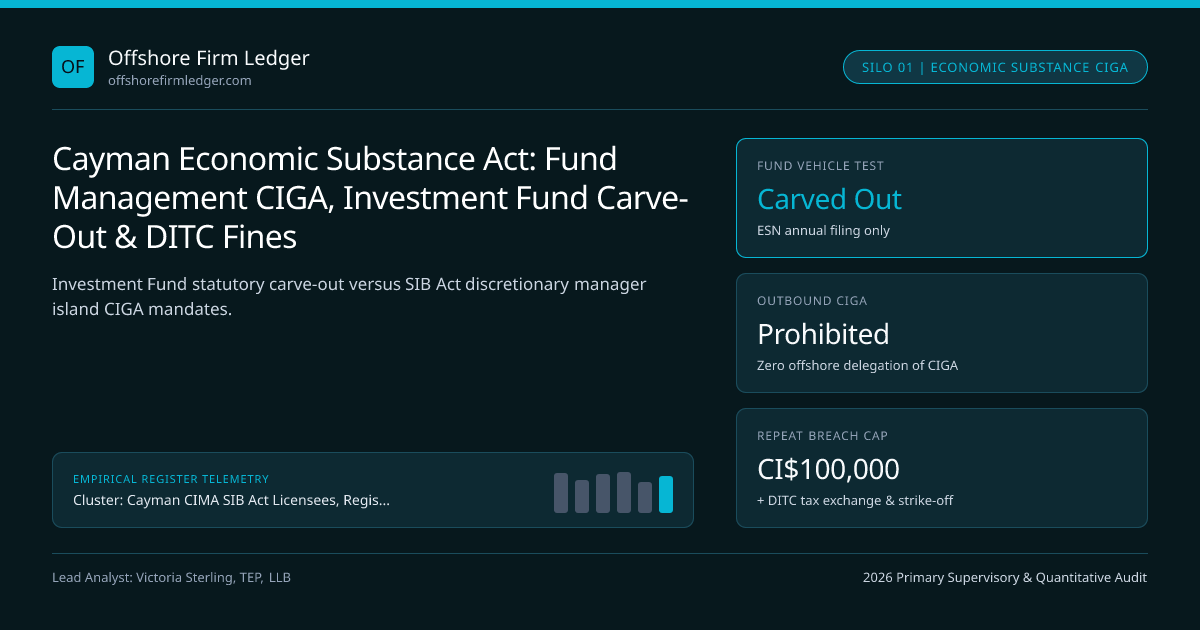
Administered by the Cayman Islands Department for International Tax Cooperation (DITC) to satisfy the OECD Forum on Harmful Tax Practices (FHTP) Substance Standard and EU Code of Conduct Criterion 2.2, the International Tax Co-operation (Economic Substance) Act draws a razor-sharp statutory line across asset-management structures: Investment Funds themselves (including CIMA-registered Mutual Funds, Private Funds, and Master Funds through which investments are made) are expressly excluded from the definition of a "Relevant Entity," whereas a Cayman-incorporated company or LLC registered under the Cayman Islands SIBA Framework that carries on discretionary fund management business must satisfy the full three-limb Cayman Economic Substance Test every financial year. Within our Cayman CIMA SIB Act & Fund Governance hub, confusing an exempt fund with an in-scope Cayman Investment Manager triggers CI$10,000 first-year and CI$100,000 second-year DITC penalties plus automatic spontaneous tax-authority exchange and Grand Court strike-off petitions.
Defining "Fund Management Business" vs Pure Non-Discretionary Investment Advice#
Not every SIB Act Registered Person or Licensee triggers the Economic Substance Test. Under the Schedule to the Economic Substance Act and DITC Guidance v3.2, Fund Management Business means the business of managing securities belonging to another person in circumstances involving the exercise of discretion carried on by a relevant entity licensed or otherwise authorized by CIMA under the SIB Act for an investment fund.
Two critical structuring consequences flow from this statutory wording inside the Cayman SIB & Fund Governance cluster:
- Pure Non-Discretionary Investment Advisors: A Cayman SIB Act Registered Person whose sub-advisory contract grants zero discretionary trade-execution power—merely transmitting non-binding research recommendations to an onshore SEC/FCA-regulated Investment Manager or directly to a Cayman fund board that exercises genuine independent trade discretion—does not conduct "fund management business" (though sponsors must ensure intercompany pricing does not trigger separate "headquarters" or "service centre" relevant activities).
- General Partners of Cayman ELPs: Domestic limited partnerships and Exempted Limited Partnerships without separate legal personality were brought into Economic Substance notification scope via 2021 regulations, yet a corporate General Partner acting purely in its sovereign capacity as constitutional GP of an investment fund—while delegating discretionary securities management directly to a non-Cayman onshore Investment Manager—avoids fund-management CIGA provided the GP earns zero separate discretionary securities-management fee.
The Four Statutory CIGAs of Fund Management and Anti-Circumvention Outsourcing Rules#
When a Cayman corporate Investment Manager retains discretionary trading authority and collects fees in Cayman, Section 4(2) mandates three cumulative tests on island:
- Cayman CIGAs: (i) decisions on holding and selling investments; (ii) calculating risk and reserves; (iii) currency/interest hedging decisions; and (iv) preparing investor/CIMA reports.
- Directed and Managed in Cayman: Board meetings held physically on Grand Cayman with an island quorum and local minutes.
- Adequate Island Opex, Premises & FTEs: Local office lease, resident investment staff, and island spend proportional to fee income.
While Section 4(4) permits outsourcing CIGAs to a supervised provider within the Cayman Islands, CIGAs can NEVER be outsourced outside the Cayman Islands. Delegating buy/sell execution back to London or New York from a zero-staff Cayman company fails the ES Test immediately—unlike shell setups in the offshore domiciles register such as Amrica Fx Trade or A Peak Global that trigger spontaneous OECD notices.
Comparative Matrix: Cayman DITC Economic Substance Scope by Entity Profile#
| Cayman Entity Profile | Annual ES Notification (ESN) via Registrar? | Full DITC ES Return (12m Post-FYE)? | Required Cayman Island Footprint | Failure Consequence |
|---|---|---|---|---|
| CIMA-Regulated Mutual or Private Fund | Yes (mandatory pre-Jan 31 prerequisite for Govt Return) | No (Investment Fund statutory carve-out) | Registered office + CIMA governance/audit compliance | Late Govt annual return surcharges |
| SIB Act Discretionary Fund Manager (Cayman Tax Domiciled) | Yes | Yes (audited financial metrics + FTE/opex breakdown) | Qualified Cayman PM/Risk staff, leased Cayman office & island board quorum | CI$10k Yr 1 -> CI$100k Yr 2 + OECD tax exchange + strike-off |
| SIB Act Pure Non-Discretionary Advisor | Yes | No (unless triggering HQ / Service Centre activity) | Registered office + DRLA board + AML officer suite | Reclassification audit if covert discretion exercised |
| Foreign Tax-Resident Cayman Manager (e.g., UK/HK Tax Resident) | Yes + Foreign Tax Residency Claim | Exempt from ES Test upon filing foreign tax return/TIN proof | Taxed onshore; DITC spontaneously notifies foreign tax authority | Reverts to full Cayman ES Test if foreign proof rejected |
Quantitative Break-Even: Maintaining a Cayman Discretionary IM vs Direct Onshore IM Appointment#
Sponsors historically interposed a Cayman SIB Act Registered Person between the Cayman Master Fund and the onshore sub-advisor purely out of habit. Under the Economic Substance Act, maintaining genuine Grand Cayman CIGA only makes financial sense when principals physically relocate to Grand Cayman:
- Where:
- GrossMgmtPerf_Fees = US$4,000,000 annual management + crystallized performance fee revenue
- OnshoreEffectiveTax_Rate = 25.0% corporate/partnership effective tax rate if principals remain onshore vs 0.0% if principals relocate to Cayman
- CaymanResidentFTE_Payroll = US$360,000 (1 resident CIO/PM + 1 Risk/Compliance analyst physically in Grand Cayman)
- CamanaBayOffice_IT = US$92,000 (dedicated Seven Mile / Camana Bay office lease, Bloomberg/OMS & travel)
- SIBESAudit_Fees = US$28,000 (SIB Act CI$5,000 + DRLA + DITC ES Return filing & accounting)
- Worked Relocation vs Redundant-Layer Audit:
- Scenario 1 (Principals Physically Relocate to Grand Cayman under Residency/Work Permits):
- TaxSaving = US$4,000,000 * 0.25 = US$1,000,000; CaymanSubstance_Cost = US$480,000 -> Net Gain = +US$520,000/yr
- Scenario 2 (Principals Stay in London/NY & Delegate Trading Back Onshore):
- Onshore Transfer-Pricing / CFC Rules tax ~90%+ of fee onshore anyway + Cayman DITC fails outbound CIGA delegation -> -US$480,000 deadweight loss + CI$10k/CI$100k DITC fines!
Where portfolio managers remain physically in New York, London, or Hong Kong, eliminating the redundant Cayman SIB Act manager and contracting the Cayman Fund directly with the onshore regulated manager avoids US$480,000 in deadweight substance overhead and eliminates DITC penalty risk completely.
Annual ESN & DITC Portal Compliance Calendar#
Every Cayman corporate and ELP entity must file its Economic Substance Notification (ESN) via the General Registry CAP portal each January prior to paying annual government fees, and any in-scope SIB Act Fund Manager must submit its audited Economic Substance Return on the DITC portal within 12 months of financial year-end—cross-verifying status alongside the license verification portal.
Frequently asked questions
Are Cayman Section 4(3) Hedge Funds or Private Funds required to have physical offices and staff in Cayman?
No. Investment funds themselves are expressly excluded from the definition of a "Relevant Entity" under the Cayman Economic Substance Act. They must only file an annual Economic Substance Notification confirming their CIMA registration number and Investment Fund classification.
Can a Cayman SIB Act Registered Person outsource its Fund Management CIGAs to an affiliate in London or New York?
No. Under Section 4(4) of the Economic Substance Act, Core Income Generating Activities may only be outsourced to a service provider located physically within the Cayman Islands, and the entity must prove it monitors and controls that Cayman provider.
What if a Cayman SIB Act company is already tax-resident and paying corporate tax in the United Kingdom or Hong Kong?
An entity that proves to the DITC via tax identification numbers, assessments, or residency certificates that it is tax-resident outside the Cayman Islands is excluded from Relevant Entity status, though the DITC automatically exchanges that claim with the foreign tax authority.
Does a Pure Equity Holding Company in a Cayman Private Equity buyout stack face the same CIGA rules as a Fund Manager?
No. A Cayman SPV that solely holds equity participations in other entities and earns only dividends and capital gains faces a "Reduced Economic Substance Test," satisfied largely by maintaining its Cayman registered office and complying with statutory Companies Act filings.
Publication record
- Published
- 14 November 2026
- Updated
- 14 November 2026
- Author
- Victoria Sterling, TEP, LLB
- Review
- Review not recorded
- Automated fact check
- Passed in the stored pipeline record
- Source URLs
- 3 recorded
AI assistance recorded: anthropic/claude-opus-4.6. This field does not establish human review or source verification.
Academic & Institutional Attribution
Cite This Research & Embed Live Data Card
Standard academic & institutional research paper citation format.
Victoria Sterling, TEP, LLB. (2026, November 14). Cayman Economic Substance Act: Fund Management CIGA, Investment Fund Carve-Out & DITC Fines. Offshore Firm Ledger. https://offshorefirmledger.com/dossiers/cayman-economic-substance-act-fund-management-ciga-outsourcingRegulatory Directory Cross-Reference
Referenced Institutions & Regulatory Registries
Top Regulated Institutions in This Coverage Slice
Referenced Supervisory Authorities
Related Cayman Cima Sib Mutual Private Funds & Institutional Briefings
Explore Cayman Cima Sib Mutual Private Funds Hub (20) →Cayman Cima Sib Mutual Private Funds
Cayman CIMA SIB Act, SPC Ring-Fencing, Mutual & Private Funds: Institutional Statute GuideCayman Cima Sib Mutual Private Funds
Cayman AMLCO, MLRO & DMLRO Rules: Natural-Person Independence & CIMA FinesCayman Cima Sib Mutual Private Funds
Cayman Exempted Limited Partnership Act (ELPA): LP Safe Harbors, Clawbacks & Side LettersCayman Cima Sib Mutual Private Funds
CIMA Local Auditor Sign-Off & REEFs Fund Annual Return (FAR): Deadlines & WaiversCayman Cima Sib Mutual Private Funds
Cayman Beneficial Ownership Transparency Act (BOTA): ELP Scope, Fund Route & Access RulesCayman Cima Sib Mutual Private Funds
Cayman Hedge Fund Redemption Gates, NAV Suspensions & Side-Pocket Case Law AuditCayman Cima Sib Mutual Private Funds
Cayman SIB Act Full Licensee vs Schedule 4 Registered Person: Capital & Perimeter AuditCayman Cima Sib Mutual Private Funds
Cayman Segregated Portfolio Company (SPC) Ring-Fencing Under Companies Act Part XIVBvi Fsc Siba Approved Manager Statutes
BVI VISTA Trusts: Disengaged Trustee Duties, Office of Director Rules & Sham DefenseBvi Fsc Siba Approved Manager Statutes
BVI Segregated Portfolio Companies (SPCs): BCA Part VII Eligibility & FSC Cell ApprovalBvi Fsc Siba Approved Manager Statutes
BVI FSC Section 34 Compliance Officers, Compliance Manuals & Enforcement FinesBvi Fsc Siba Approved Manager Statutes
BVI Limited Partnership Act 2017: Optional Legal Personality, GP Safe Harbors & Security
Offshore Firm Ledger Data, Benchmarks & Contributor Records
CC BY 4.0 Open Data
Open Institutional Datasets (CSV / JSON) →
Download desk-compiled quantitative series & schemas.
2026 Reference Matrix
2026 Institutional Benchmarks & Thresholds →
Statutory capital, clearing, margin & rate conventions.
Editorial Records
Authors & Review Records →
View named contributors where those records are available.
Complete Index
Master Research & Dossier Archive →
Browse all published briefings by topic pillar & date.