
Cayman Cima Sib Mutual Private Funds
Cayman Private Funds Act Section 16 Asset Valuation: Level 3 & Manager Firewalls
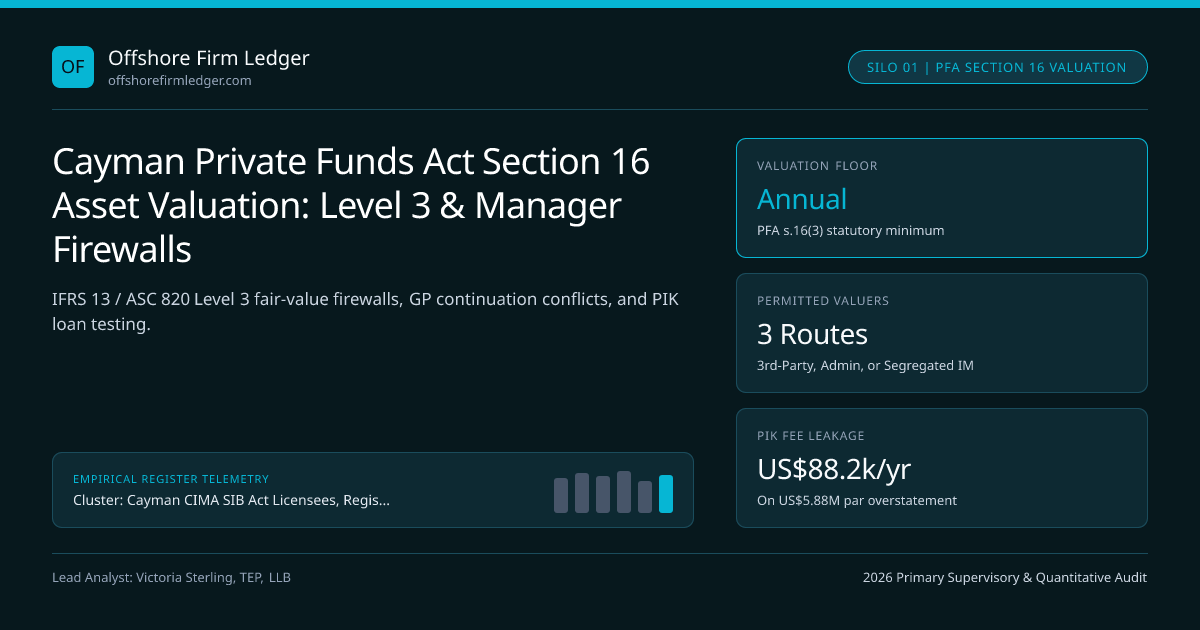
Section 16 of the Cayman Private Funds Act requires annual fair-value valuation of illiquid private equity and private credit assets by an independent third party, administrator, or functionally segregated manager committee.
Section 16 of the Cayman Islands Private Funds Act (2025 Revision), reinforced by the binding CIMA Rule on Calculation of Asset Values – Registered Private Funds, mandates that every closed-ended Cayman private fund perform formal asset valuations at least annually in accordance with IFRS, US/UK/Japanese/Swiss GAAP, or the valuation principles of a non-high-risk jurisdiction. Crucially, Section 16(2) limits who may determine fair value across illiquid buyouts, venture preferred stock, and bilateral private credit loans to three statutorily enumerated actors: (a) an appropriately qualified independent third party in a non-high-risk jurisdiction, (b) the fund's administrator, or (c) the manager or operator of the private fund—provided the valuation function is functionally independent from portfolio management or potential conflicts are formally disclosed, mitigated, and monitored for investors. Within our Cayman CIMA statutory hub, Section 16 represents CIMA's primary defense against stale or inflated Level 3 marks ahead of continuation-fund rollovers and fundraising closes.
Functional Independence Inside Manager-Led Valuation Committees#
Unlike open-ended hedge funds—where independent third-party administrators price liquid exchange-traded books daily or monthly—over 65% of Cayman private equity and venture capital funds rely on Section 16(2)(b) manager-performed valuations because portfolio companies lack observable market quotes. To prevent Deal Partners whose carried interest or next-fund management fee hinges on interim IRR from marking their own homework, CIMA's Rule on Calculation of Asset Values imposes strict functional segregation requirements whenever the manager or General Partner values assets internally.
Specifically, voting members of the Manager's Valuation Committee must exclude portfolio managers and deal-origination principals responsible for transacting those assets; deal teams may supply operational EBITDA forecasts and borrower covenant updates solely in a non-voting advisory capacity. Furthermore, remuneration of Valuation Committee members (typically the CFO, Chief Risk Officer, General Counsel, and independent valuation specialists) cannot be tied directly to unrealized write-ups of specific deal pods. Where a boutique emerging manager inside the Cayman SIB & Fund Governance cluster lacks sufficient headcount for total voting separation, Section 16(2)(b)(ii) requires explicit LPA/PPM conflict disclosure to LPs, LPAC (Limited Partner Advisory Committee) sign-off on valuation methodology changes, and heightened scrutiny by the CIMA-approved local auditor.
Hard-to-Value Assets: Private Credit PIK Loans & GP-Led Continuation Vehicles#
CIMA supervisory circulars and Cayman audit panels focus intensely on two high-risk Level 3 valuation scenarios under ASC 820 / IFRS 13:
- Distressed & Payment-in-Kind (PIK) Private Credit Facilities: Direct-lending funds holding senior or unitranche loans that amend cash-interest covenants into PIK toggles mid-term cannot continue carrying principal at 100 cents on the dollar (par) merely because maturity remains two years out. Section 16 fair-value discipline—paired with Section 17 title verification of loan amendment agreements—requires recalibrating credit-spread discount rates against public BDC/syndicated-loan benchmarks and modeling borrower enterprise-value coverage.
- GP-Led Secondary Continuation Funds: When a Cayman GP transfers a trophy portfolio company from Fund IV into a newly registered Cayman Continuation Private Fund, the GP stands on both sides of the transaction—crystallizing carried interest for selling LPs while resetting management fees for rolling LPs. Under both Section 16 and the CIMA Corporate Governance Rule, institutional practice requires an independent fairness opinion or competitive third-party lead-buyer bid rather than an internal GP valuation mark.
Comparative Matrix: Private Funds Act Section 16 Valuation Agent Routes#
| Valuation Agent Route (PFA s.16(2)) | Statutory Independence Condition | Typical Asset Class Fit | Audit & Fee Impact | Conflict Disclosure Burden |
|---|---|---|---|---|
| Qualified Independent 3rd-Party Valuer (e.g., Houlihan Lokey, Lincoln, Kroll) | Independent of GP/IM; domiciled in non-high-risk jurisdiction | Private credit, infrastructure, real estate & GP-led secondaries | +US$3,500–US$9,000 per Level 3 credit/asset | Minimal; gold-standard LP assurance |
| Licensed Fund Administrator | Contractual NAV & valuation engagement independent of IM | Crossover funds, structured credit & liquid co-investments | Bundled in 6–12 bps admin fee + complex-security surcharge | Low; verify admin pricing-vendor overrides |
| Segregated Manager Valuation Committee (s.16(2)(b)(i)) | Voting members functionally separated from deal/PM staff | Mid/large-cap buyout & growth equity (Blackstone/KKR-scale GPs) | Internal CFO/Risk cost; deeper local audit sample testing | Moderate; disclose VC charter in PPM |
| Small-GP Unsegregated Manager Valuation (s.16(2)(b)(ii)) | Insufficient headcount for full firewall; LPAC + investor disclosure | Sub-US$150M emerging VC & seed partnerships | Highest local auditor substantive re-performance fee | High; mandatory explicit investor conflict notice |
Quantitative Model: Net-Invested-Capital Fee Overcharge From Inflated Level 3 Marks#
Post-investment-period private equity and private credit LPAs commonly charge management fees (e.g., 1.50% per annum) on the Net Asset Value (or impaired cost) of unrealized investments. When a manager fails to record timely Section 16 fair-value write-downs on PIK-amended or covenant-stressed positions, LPs suffer immediate cash management-fee overcharges enforceable via CIMA audit restatements and LPA clawbacks:
- AnnualMgmtFeeOvercharge = (CarryingParValue - FairValueLoan) * rpostperiodmgmt_fee
- Where:
- CarryingParValue = Unadjusted principal + capitalized PIK interest (US$40,000,000 across 3 stressed borrowers)
- s_initial = Origination credit spread (5.50%)
- Deltascredit = Credit deterioration spread widening upon PIK toggle (+4.25% -> total spread 9.75%)
- Lambda_illiquidity = Secondary private-loan illiquidity premium (+1.25%)
- rpostperiodmgmtfee = Post-commitment LPA management fee rate (1.50% per annum)
- Worked Audit Adjustment (3-Year Remaining Maturity Zero-Amortization Stressed Credit Basket):
- Discounted FairValueLoan (incorporating +550 bps combined spread/illiquidity widening) = US$34,120,000 (85.30 cents/dollar)
- Valuation_Overstatement = US$40,000,000 - US$34,120,000 = US$5,880,000 (+17.23% NAV overstatement)
- AnnualMgmtFee_Overcharge = US$5,880,000 * 0.0150 = US$88,200 / year in excess management fees billed to LPs
Independent third-party loan valuation engagement costing US$18,000 (US$6,000 × 3 loans) eliminates US$88,200 per year in excess management-fee leakage while insulating the GP from SEC/CIMA parallel fee-calculation enforcement actions.
LP Due Diligence & Cross-Section Audit Integration#
Institutional LPAC members reviewing a Cayman Private Fund should verify that the written Valuation Policy required by CIMA's Rule on Calculation of Asset Values is annexed to board/GP minutes, confirm that historical cost is never used as a permanent proxy for fair value beyond brief post-closing windows, and integrate Section 16 valuation checks with Section 17 safekeeping/title verification, Section 18 cash monitoring, and entity verification on the license verification portal (contrast unregulated offshore entities such as Aglobe Investment or Agni Finance).
Frequently asked questions
Can an emerging Cayman venture capital GP perform its own Section 16 asset valuations without hiring an external valuer?
Yes, under Section 16(2)(b)(ii) of the Private Funds Act, provided all potential conflicts of interest are clearly identified, disclosed to investors in offering documents, and mitigated—typically through LPAC methodology review and substantive fair-value audit testing by the CIMA-approved local auditor.
How frequently must a Cayman Private Fund value its portfolio assets under CIMA Rules?
Section 16(3) establishes a mandatory statutory minimum of at least once per year, aligned with the annual audited financial statements. However, private credit and semi-liquid funds issuing quarterly capital-account statements customarily run quarterly valuation cycles.
Can CIMA grant an exemption from Section 16 valuation requirements for a Cayman Private Fund?
Section 16(5) empowers CIMA to waive or modify Section 16 requirements conditionally or unconditionally, but in practice CIMA grants waivers only in exceptional scenarios such as terminal liquidation wind-downs with zero remaining realizable assets.
Which accounting standards satisfy the CIMA Rule on Calculation of Asset Values for Registered Private Funds?
Valuations must follow IFRS or the Generally Accepted Accounting Principles (GAAP) of the United States, United Kingdom, Japan, Switzerland, or any other non-high-risk jurisdiction approved under Cayman AML/CFT country-risk assessments.
Publication record
- Published
- 14 November 2026
- Updated
- 14 November 2026
- Author
- Victoria Sterling, TEP, LLB
- Review
- Review not recorded
- Automated fact check
- Passed in the stored pipeline record
- Source URLs
- 3 recorded
AI assistance recorded: anthropic/claude-opus-4.6. This field does not establish human review or source verification.
Academic & Institutional Attribution
Cite This Research & Embed Live Data Card
Standard academic & institutional research paper citation format.
Victoria Sterling, TEP, LLB. (2026, November 14). Cayman Private Funds Act Section 16 Asset Valuation: Level 3 & Manager Firewalls. Offshore Firm Ledger. https://offshorefirmledger.com/dossiers/cayman-private-funds-act-section-16-valuation-hard-to-valueRegulatory Directory Cross-Reference
Referenced Institutions & Regulatory Registries
Mentioned Regulated Institutions
Referenced Supervisory Authorities
Related Cayman Cima Sib Mutual Private Funds & Institutional Briefings
Explore Cayman Cima Sib Mutual Private Funds Hub (20) →Cayman Cima Sib Mutual Private Funds
Cayman CIMA SIB Act, SPC Ring-Fencing, Mutual & Private Funds: Institutional Statute GuideCayman Cima Sib Mutual Private Funds
Cayman Private Funds Act Section 17 Safekeeping & Title Verification AuditCayman Cima Sib Mutual Private Funds
Cayman Private Funds Act Section 18 Cash Monitoring & Bank ReconciliationCayman Cima Sib Mutual Private Funds
Cayman Mutual Funds Act Section 4(3) Registered vs Administered & Licensed FundsCayman Cima Sib Mutual Private Funds
Cayman-Delaware Master-Feeder & UBTI Blocker Structure: Form 8832 Tax & CIMA AuditCayman Cima Sib Mutual Private Funds
CIMA Directors Registration and Licensing Act (DRLA): Covered Entities & Insurance RulesCayman Cima Sib Mutual Private Funds
Cayman VASP Act Phase 2 Licensing: Custody Segregation, Exchanges & SIB Act OverlapCayman Cima Sib Mutual Private Funds
Cayman Foundation Companies Act (2017): Orphan SPVs, DAO Treasuries & Supervisor LawBvi Fsc Siba Approved Manager Statutes
BVI Professional Fund, Private Fund & Public Fund Recognition vs Registration TiersBvi Fsc Siba Approved Manager Statutes
BVI Private Investment Funds (PIF) Under SIBA Part IIIA: Three Appointed Persons AuditBvi Fsc Siba Approved Manager Statutes
BVI VASP Act, 2022: Virtual Asset Exchanges, Custody, Travel Rule & Token Carve-OutsBvi Fsc Siba Approved Manager Statutes
BVI Business Companies Act 2023–2025 Amendments: Annual Financial Returns & Director Lists
Offshore Firm Ledger Data, Benchmarks & Contributor Records
CC BY 4.0 Open Data
Open Institutional Datasets (CSV / JSON) →
Download desk-compiled quantitative series & schemas.
2026 Reference Matrix
2026 Institutional Benchmarks & Thresholds →
Statutory capital, clearing, margin & rate conventions.
Editorial Records
Authors & Review Records →
View named contributors where those records are available.
Complete Index
Master Research & Dossier Archive →
Browse all published briefings by topic pillar & date.