
Cayman Cima Sib Mutual Private Funds
Cayman Foundation Companies Act (2017): Orphan SPVs, DAO Treasuries & Supervisor Law
Under the Cayman Foundation Companies Act, a body corporate can permanently cease to have shareholders while retaining Companies Act limited liability, creating an ideal orphan wrapper for securitizations and protocol treasuries.
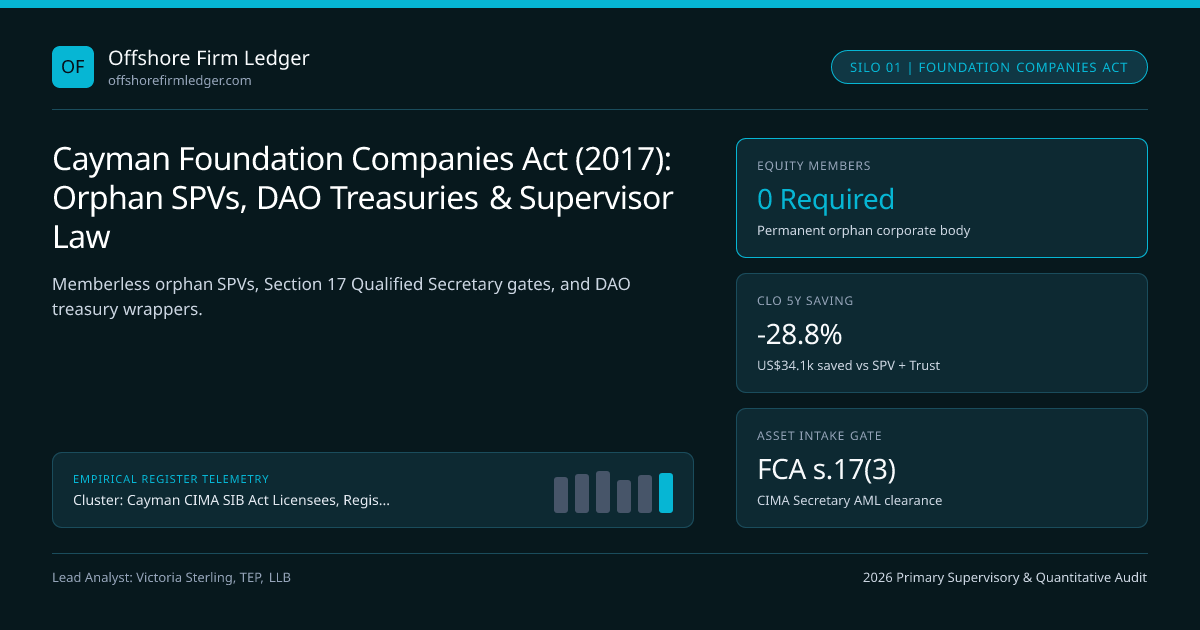
Enacted under the Cayman Islands Foundation Companies Act (2017), a Foundation Company is not a sui generis civil-law stiftung unfamiliar to common-law courts; rather, Section 3(2) incorporates the entire Cayman Islands Companies Act directly into every Foundation Company except where expressly modified. Once its Memorandum of Association prohibits dividend distributions to members and appoints a Qualified Person (a company licensed by CIMA under the Companies Management Act / TCSP Regulatory Standard) as statutory Secretary, the company may redeem or cancel its founding subscriber share and exist permanently with zero shareholders or members. Within our Cayman CIMA SIB Act & Fund Governance hub, this hybrid orphan corporate architecture eliminated the historic need for STAR purpose trusts holding nominal SPV shares across structured-credit CLOs, GP-orphan holding vehicles, and Web3 DAO treasuries.
Statutory Mechanics: Memberless Existence, Supervisors & Beneficiary Bar#
Five statutory pillars distinguish a Cayman Foundation Company inside the Cayman SIB & Fund Governance cluster from a traditional exempted company or trust:
- Permanent Abolition of Shareholders (Section 7 & Section 8): Provided the Foundation Company has at least one Supervisor—a natural or legal person empowered under the Articles to oversee the directors and request books and accounts without owning equity—it may cease to have members entirely and prohibit any future share issuance, preventing hostile equity takeovers or probate freeze of founder shares.
- Mandatory CIMA-Licensed Secretary Gatekeeper (Section 16 & Section 17): Every Foundation Company must at all times have a Qualified Person serving as Secretary at its Cayman registered office. Crucially, under Section 17(3), the Foundation Company cannot legally accept any asset contribution or gift until the Qualified Person Secretary issues a formal regulatory notice confirming there appears to be no AML/CFT, sanctions, or proceeds-of-crime objection to accepting the assets.
- Default Exclusion of Beneficiary Litigation Standing (Section 7(5)): Unless the Memorandum or Articles expressly grant direct enforcement rights, beneficiaries of a Foundation Company owe and hold zero statutory powers or standing to sue directors, demand confidential accounting ledgers, or petition for information—vesting enforcement standing exclusively in the Foundation Company itself and its appointed Supervisors.
- Fiduciary Duty Owed Strictly to the Company (Section 7(4)): Unlike trust law—where trustees owe onerous equitable duties directly to fluctuating classes of beneficiaries vulnerable to Commonwealth Sham Trust Jurisprudence challenges—directors of a Foundation Company owe their duties solely to the Foundation Company itself, enjoying standard corporate business-judgment protection.
- Private Bylaws Outside Public Registry Inspection: Detailed governance mechanics (such as token-holder governance proposal routing, family-council voting quorums, or CLO waterfall triggers) can be housed in private Bylaws under Section 21 that bind directors and officers without being filed publicly with the Registrar of Companies.
Three Institutional Use Cases: CLO Orphan SPVs, Private Trust Companies & DAO Wrappers#
- Orphan Securitization & Private Credit Risk-Retention Conduits: Historically, bankruptcy-remote CLO issuers and off-balance-sheet aircraft/receivables SPVs required a Cayman Exempted Company owned by a Cayman Charitable or STAR Trust (two entities, two fee stacks). A single Foundation Company achieves identical IFRS 10 non-consolidation and bankruptcy-remoteness in one corporate vehicle.
- Ultra-High-Net-Worth Family Office Governance & PTCs: Families uncomfortable ceding control of operating businesses to institutional trustees form a memberless Foundation Company to serve as a Private Trust Company (PTC) or direct holding vehicle, appointing family elders and independent STEP protectors as Supervisors while immunizing assets against foreign forced-heirship claims via Section 23's incorporation of Cayman's Trusts Act Firewall (Sections 90–93).
- Decentralized Protocol (DAO) Legal Wrappers: Over 400 Layer-1, Layer-2, and DeFi governance treasuries (contrast unchartered token projects cataloged in the offshore domiciles register like Aavegotchi, Aergo, or Apro Oracle) wrap unincorporated token-holder governance inside a memberless Cayman Foundation Company so individual multisig signers and governance voters cannot be held jointly and severally liable as general partners under onshore partnership tort/tax law—while evaluating whether treasury swaps cross into Phase 1 or Phase 2 of the Cayman VASP Act.
Comparative Matrix: Cayman Foundation Company vs Peer Orphan & Trust Structures#
| Structural Attribute | Cayman Foundation Company (FCA 2017) | Cayman Exempted Co + STAR Share Trust | Panama / Liechtenstein Civil Foundation | BVI VISTA Trust + BVI IBC |
|---|---|---|---|---|
| Separate Legal Entities Required | 1 (Single corporate body) | 2 (SPV Company + Declaration of Trust) | 1 (Civil-law foundation) | 2 (VISTA Trust + underlying BVI Co) |
| Common-Law Court Predictability | High — Companies Act Ch. 22 case law applies | High — dual corporate + STAR statute | Lower in NY/English commercial courts | High — ECSC & Privy Council precedent |
| Compulsory AML Gate on Contributions | Yes — Section 17 Qualified Secretary notice | Trustee AML onboarding check | Varies by registered agent | Licensed BVI Trustee AML check |
| Beneficiary Information Rights | Zero by default (s.7(5)); Supervisor enforces | Enforcer only under STAR Trust Part VIII | Statutory beneficiary audit rights common | Trust beneficiaries retain court standing |
| Winding-Up & Insolvency Regime | Standard Cayman Companies Act Part V | Split corporate liquidation + trust termination | Civil foundation dissolution code | Split trust + BVI BCA liquidation |
Quantitative Cost Model: 5-Year CLO / Securitization Orphan Conduit Comparison#
Structured-credit arrangers launching a 5-year CLO warehouse-to-term vehicle compare the total Cayman corporate-services cost of a single Foundation Company against the traditional two-tier Exempted Company + Share Trustee orphan structure:
- Where:
- Setup_Dual = US$9,800 (Exempted SPV formation + Charitable/STAR Share Trust deed)
- AnnualDualSPV_Trust = US$4,200 (SPV RO & Govt) + US$5,500 (Licensed Share Trustee fee) + US$12,000 (2 SPV Directors) = US$21,700/yr
- Setup_Foundation = US$7,200 (Foundation Co Memorandum, Articles & private Bylaws)
- AnnualFoundationQualified_Sec = US$4,900 (Qualified Person Secretary, RO, Govt & Supervisor) + US$10,500 (Director suite) = US$15,400/yr
- Worked 5-Year CLO Lifecycle Calculation:
- LegacyDual5Y_Total = US$9,800 + (5 * US$21,700) = US$118,300
- FoundationCo5Y_Total = US$7,200 + (5 * US$15,400) = US$84,200
- FiveYearOrphan_Savings = US$118,300 - US$84,200 = US$34,100 per CLO conduit (28.83% structural saving across 10 deals = US$341,000)
Across a 10-CLO private-credit shelf, migrating from share-trust SPVs to Foundation Companies eliminates US$341,000 in duplicate trustee overhead while consolidating governance into a single statutory register entry.
Beneficial Ownership & AML Compliance Anchors#
Even though a Foundation Company has zero shareholders, it is not exempt from the Cayman Beneficial Ownership Transparency Act (BOTA) or Cayman AML officer staffing mandates where conducting relevant financial business: under BOTA cascading rules, any Supervisor, Founder, or Director exercising ultimate effective control—or a Senior Managing Official where control is dispersed across thousands of DAO token holders—must be recorded with the Qualified Person Secretary and cross-verified via the license verification portal.
Frequently asked questions
Who is eligible to act as the mandatory Secretary of a Cayman Foundation Company?
Under Section 2 and Section 16 of the Foundation Companies Act, only a "Qualified Person"—defined as a person licensed or permitted under the Cayman Companies Management Act to provide company management services—may serve as Secretary of a Foundation Company.
Can token holders of a DAO sue the directors of a Cayman Foundation Company directly?
No, unless the Memorandum or Articles explicitly grant token holders direct standing. Under Section 7(5), interested persons and beneficiaries have no powers or rights against the company, its directors, or its assets; token-holder votes typically direct action via private Bylaws enforced by an independent Supervisor.
What happens if a Cayman Foundation Company transfers tokens into its wallet without a Section 17 Secretary notice?
Accepting an asset disposition without a Section 17(3) no-objection notice from the Qualified Person Secretary commits a statutory offense exposing the Foundation Company, its directors, and any knowing manager to fines of CI$15,000 and five years imprisonment under Section 17(5).
Who is listed on the Beneficial Ownership Register of a memberless Cayman Foundation Company?
Under the Beneficial Ownership Transparency Act 2023, because there are no 25% equity holders, the Qualified Person identifies any natural person exercising ultimate effective control (such as a dominant Founder or Supervisor), or records a Senior Managing Official if control is genuinely decentralized.
Publication record
- Published
- 14 November 2026
- Updated
- 14 November 2026
- Author
- Victoria Sterling, TEP, LLB
- Review
- Review not recorded
- Automated fact check
- Passed in the stored pipeline record
- Source URLs
- 3 recorded
AI assistance recorded: anthropic/claude-opus-4.6. This field does not establish human review or source verification.
Academic & Institutional Attribution
Cite This Research & Embed Live Data Card
Standard academic & institutional research paper citation format.
Victoria Sterling, TEP, LLB. (2026, November 14). Cayman Foundation Companies Act (2017): Orphan SPVs, DAO Treasuries & Supervisor Law. Offshore Firm Ledger. https://offshorefirmledger.com/dossiers/cayman-foundation-companies-act-dao-treasury-orphan-spv-chartersRegulatory Directory Cross-Reference
Referenced Institutions & Regulatory Registries
Top Regulated Institutions in This Coverage Slice
Referenced Supervisory Authorities
Related Cayman Cima Sib Mutual Private Funds & Institutional Briefings
Explore Cayman Cima Sib Mutual Private Funds Hub (20) →Cayman Cima Sib Mutual Private Funds
Cayman CIMA SIB Act, SPC Ring-Fencing, Mutual & Private Funds: Institutional Statute GuideCayman Cima Sib Mutual Private Funds
Cayman Economic Substance Act: Fund Management CIGA, Investment Fund Carve-Out & DITC FinesCayman Cima Sib Mutual Private Funds
Cayman AMLCO, MLRO & DMLRO Rules: Natural-Person Independence & CIMA FinesCayman Cima Sib Mutual Private Funds
Cayman Exempted Limited Partnership Act (ELPA): LP Safe Harbors, Clawbacks & Side LettersCayman Cima Sib Mutual Private Funds
CIMA Local Auditor Sign-Off & REEFs Fund Annual Return (FAR): Deadlines & WaiversCayman Cima Sib Mutual Private Funds
Cayman Beneficial Ownership Transparency Act (BOTA): ELP Scope, Fund Route & Access RulesCayman Cima Sib Mutual Private Funds
Cayman Hedge Fund Redemption Gates, NAV Suspensions & Side-Pocket Case Law AuditCayman Cima Sib Mutual Private Funds
Cayman SIB Act Full Licensee vs Schedule 4 Registered Person: Capital & Perimeter AuditBvi Fsc Siba Approved Manager Statutes
BVI Commercial Court Section 24A Black Swan Orders & Worldwide Freezing InjunctionsBvi Fsc Siba Approved Manager Statutes
BVI VISTA Trusts: Disengaged Trustee Duties, Office of Director Rules & Sham DefenseBvi Fsc Siba Approved Manager Statutes
BVI Segregated Portfolio Companies (SPCs): BCA Part VII Eligibility & FSC Cell ApprovalBvi Fsc Siba Approved Manager Statutes
BVI FSC Section 34 Compliance Officers, Compliance Manuals & Enforcement Fines
Offshore Firm Ledger Data, Benchmarks & Contributor Records
CC BY 4.0 Open Data
Open Institutional Datasets (CSV / JSON) →
Download desk-compiled quantitative series & schemas.
2026 Reference Matrix
2026 Institutional Benchmarks & Thresholds →
Statutory capital, clearing, margin & rate conventions.
Editorial Records
Authors & Review Records →
View named contributors where those records are available.
Complete Index
Master Research & Dossier Archive →
Browse all published briefings by topic pillar & date.