
Cayman Cima Sib Mutual Private Funds
CIMA Rule on Internal Controls: Five COSO Components & Outsourcing Audits
Enforced alongside the Corporate Governance Rule, CIMA Rule on Internal Controls mandates five COSO-aligned control pillars across Cayman hedge funds, private equity GPs, and SIB Act offshore brokerages.
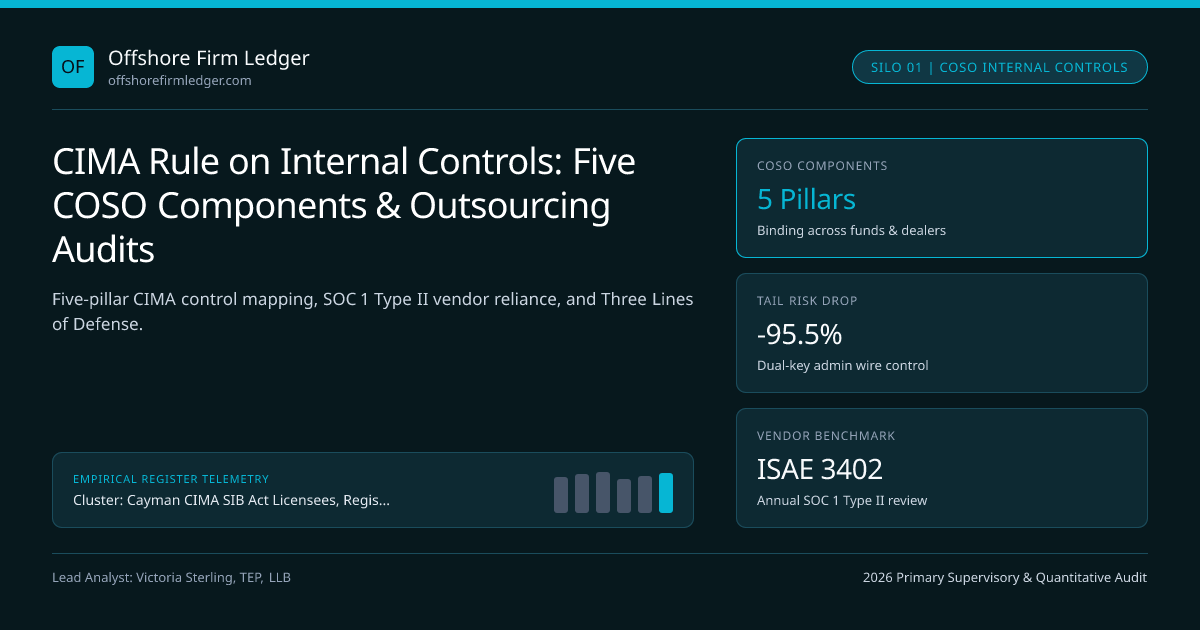
Taking effect simultaneously on October 14, 2023, the CIMA Rule and Statement of Guidance on Internal Controls for Regulated Entities replaced CIMA's legacy 2007 framework and extended mandatory internal-control architecture to all regulated Mutual Funds, Private Funds, SIB Act Full Licensees, and virtual asset service providers. Built explicitly around the five internationally recognized COSO pillars—Control Environment, Risk Assessment, Control Activities, Information and Communication, and Monitoring Activities—the Rule empowers the Cayman Islands Monetary Authority to examine not only an entity's own Cayman books, but also how its Governing Body verifies controls inside outsourced onshore administrators, prime brokers, and investment managers. Within our Cayman CIMA SIB Act & Fund Governance hub, mastering the proportionality carve-out for investment funds is essential to passing CIMA inspections without duplicating onshore back-office infrastructure.
Five Mandatory COSO Control Pillars Adapted to Offshore Vehicles#
Part I of the Rule requires every regulated entity to establish, document, and maintain an internal-control system comprising five interrelated components:
- Control Environment: Tone at the top set by the Governing Body under the Corporate Governance Rule, segregating incompatible duties so no single officer can initiate a wire transfer, override a Level 3 valuation mark, and approve the resulting NAV release.
- Risk Identification & Assessment: Dynamic mapping of financial, operational, liquidity, counterparty, cybersecurity, and AML/sanctions risks—recalibrated whenever a fund launches a new leverage facility, adds digital-asset exposure, or migrates prime brokers.
- Control Activities & Segregation of Duties: Dual-signature payment release matrices, automated pre-trade investment-guideline blocks, daily cash and position reconciliations, and independent physical/digital asset verification.
- Information Systems & Reliable Communication: Tamper-evident audit trails across OMS/EMS terminals, NAV accounting ledgers, and investor registry portals, paired with escalation channels that route material NAV errors (>=50 bps) or cyber breaches rapidly to the Cayman board and CIMA.
- Monitoring & Deficiency Remediation: Periodic independent evaluations—via internal audit at operating SIB Act brokerages or ISAE 3402 / SOC 1 Type II assurance reports reviewed by fund directors—tracking management remediation deadlines to closure.
Proportionality & Group/Service-Provider Reliance for Investment Funds#
Because a typical Cayman hedge fund or closed-ended LP employs zero clerical staff on Grand Cayman—delegating trading to an SEC/FCA manager and accounting to a licensed administrator—Part II of the SOG permits regulated funds to rely on outsourced service-provider or group internal controls, subject to strict conditions inside the Cayman SIB & Fund Governance cluster.
Blind reliance violates the Rule. Fund operators must document: (a) pre-appointment vendor due diligence; (b) annual board review of the administrator's SOC 1 Type II / ISAE 3402 report, specifically checking "Complementary User Entity Controls" (CUECs) and exceptions; (c) quarterly administrator compliance certificates confirming zero unescalated pricing overrides or Section 18 cash-monitoring breaks; and (d) contractual audit-access rights for CIMA and the Cayman local auditor.
Three Lines of Defense Inside SIB Act Full Licensees & Offshore Brokerages#
Operating intermediaries—such as SIB Act Section 5 Broker-Dealers, Market Makers, Trust Companies, and VASP trading venues—cannot rely solely on external fund administrators; they must embed a genuine Three Lines of Defense model internally. Line 1 (front-office dealing, treasury, and client onboarding) owns day-to-day execution controls; Line 2 (independent Risk Management and Compliance led by a CIMA-approved Compliance Officer and natural-person MLRO) monitors margin limits, best execution, and suspicious activity; and Line 3 (Internal Audit or an independent external control-assurance engagement) tests both Line 1 and Line 2 annually, reporting directly to the board or Audit Committee rather than the CEO. This structural separation distinguishes Tier-1 offshore charters from lightly supervised entities cataloged in the offshore domiciles register such as Accentforex or Acg Markets.
| Regulated Entity Type | Internal Audit Requirement | Outsourced Control Reliance | Dual-Control Cash & Pricing Gate | Primary CIMA Inspection Evidence |
|---|---|---|---|---|
| SIB Act s.5 Broker-Dealer / VASP | Mandatory independent Line 3 (in-house or co-sourced internal audit) | Permitted for IT/cloud only with SLA & right-to-audit clauses | Dual treasury release + automated margin-liquidation logs | Annual Internal Audit report + quarterly compliance packs |
| Section 4(3) Registered Mutual Fund | Satisfied via annual CIMA local financial audit + admin SOC 1 review | Expressly permitted over Fund Admin, IM & Prime Broker | Admin independent wire release + manager price-challenge wall | Board minutes reviewing Admin SOC 1 Type II & quarterly KPIs |
| Registered Private Fund (PE / Credit) | Satisfied via annual CIMA local audit + s.16–18 verification logs | Expressly permitted over GP/IM & third-party fund admin | s.18 Cash Monitoring dual-signoff on capital calls/waterfalls | Annual GP Operator Control Matrix + SOC 1 gap review |
| SIB Act Schedule 4 Registered Person | Proportional independent compliance testing (annual AML audit mandatory) | Group parent reliance allowed if documented & mapped to Cayman risks | Segregated advisory mandate authorities; zero unauthorized custody | Written Internal Control Manual + Independent AML Audit |
Quantitative Residual Control-Risk & Sampling Model for Fund Operators#
Before signing off the annual internal-control attestation in board minutes, Cayman fund directors and SIB Act Audit Committees evaluate residual operational risk exposure across cash wires, OTC valuation marks, and outsourced vendor CUECs:
- Where:
- GrossProcessVolume_i = Annual USD notional passing through process i (wires, NAV marks, margin calls)
- InherentErrorRate_i = Unmitigated baseline operational/fraud error probability
- ControlEffectivenessScore_i = Verified mitigation factor (0.00 = single-party unchecked; 0.98 = dual-party + SOC 1 Type II tested)
- Worked Control-Upgrade Comparison (US$120M Cayman Credit Fund Executing US$85M Annual Loan Wires):
- Regime 1 (GP Single-Portal Wire Release without Admin Maker-Checker):
- GrossProcessVolume = US$85,000,000; InherentErrorRate = 0.0040 (40 bps wire/BEC/waterfall error risk)
- Control_Effectiveness = 0.45 (post-trade monthly bank review only)
- ResidualExposure1 = 85,000,000 * 0.0040 * (1 - 0.45) = US$187,000 expected annual operational loss tail
- Regime 2 (Independent Administrator Dual-Key Release + Verified Counterparty Callback + SOC 1 Type II):
- Control_Effectiveness = 0.975
- ResidualExposure2 = 85,000,000 * 0.0040 * (1 - 0.975) = US$8,500 expected tail (95.45% risk reduction)
Transitioning wire release from unilateral GP treasury access to independent administrator dual-control reduces modeled expected operational tail exposure by 95.45% while simultaneously satisfying both the Internal Controls Rule and Private Funds Act Section 18.
Actionable Audit Checklist for Cayman Operators and SIB Act Compliance Teams#
Every Cayman fund board and SIB Act intermediary should maintain a concise Internal Controls Mapping Matrix linking each of the five COSO pillars to named service-provider policies, minute a dedicated annual review of the administrator's SOC 1 Type II report (explicitly addressing all CUECs), enforce independent AML/CFT testing separate from the MLRO who authored the AML manual, and cross-verify regulatory counterparty credentials via the license verification portal.
Frequently asked questions
Must a Cayman Section 4(3) hedge fund hire its own internal auditor to comply with the CIMA Rule on Internal Controls?
No. Under the proportionality provisions of Part II of the Statement of Guidance for Regulated Mutual Funds and Private Funds, a fund with no employees may rely on the internal controls of its outsourced administrator and investment manager, provided the board documents annual oversight such as reviewing SOC 1 Type II reports.
What are Complementary User Entity Controls (CUECs) in a fund administrator SOC 1 Type II report?
CUECs are specific control responsibilities that the administrator audit assumes the client fund or investment manager performs—such as authorized-signatory list updates or dual approval of non-standard fee payments. CIMA expects fund boards to verify that every CUEC is actively assigned and operating.
Can a SIB Act Licensee Compliance Officer also conduct the entity Line 3 independent AML and internal control audit?
No. Under both the CIMA Rule on Internal Controls and the Cayman Anti-Money Laundering Regulations, Line 3 independent testing must be performed by an internal audit function or qualified external specialist completely independent of the Line 2 Compliance Officer/MLRO who manages daily compliance.
When must a Cayman regulated entity notify CIMA of an internal control deficiency?
Regulated entities must notify CIMA promptly in writing whenever a material internal control breakdown occurs that threatens investor assets, impairs accurate NAV calculation beyond materiality thresholds, involves suspected fraud, or breaches statutory capital or solvency rules.
Publication record
- Published
- 14 November 2026
- Updated
- 14 November 2026
- Author
- Victoria Sterling, TEP, LLB
- Review
- Review not recorded
- Automated fact check
- Passed in the stored pipeline record
- Source URLs
- 3 recorded
AI assistance recorded: anthropic/claude-opus-4.6. This field does not establish human review or source verification.
Academic & Institutional Attribution
Cite This Research & Embed Live Data Card
Standard academic & institutional research paper citation format.
Victoria Sterling, TEP, LLB. (2026, November 14). CIMA Rule on Internal Controls: Five COSO Components & Outsourcing Audits. Offshore Firm Ledger. https://offshorefirmledger.com/dossiers/cima-rule-internal-controls-three-lines-defense-frameworkRelated Cayman Cima Sib Mutual Private Funds & Institutional Briefings
Explore Cayman Cima Sib Mutual Private Funds Hub (20) →Cayman Cima Sib Mutual Private Funds
Cayman CIMA SIB Act, SPC Ring-Fencing, Mutual & Private Funds: Institutional Statute GuideCayman Cima Sib Mutual Private Funds
Cayman Private Funds Act Section 16 Asset Valuation: Level 3 & Manager FirewallsCayman Cima Sib Mutual Private Funds
Cayman Private Funds Act Section 17 Safekeeping & Title Verification AuditCayman Cima Sib Mutual Private Funds
Cayman Private Funds Act Section 18 Cash Monitoring & Bank ReconciliationCayman Cima Sib Mutual Private Funds
Cayman Mutual Funds Act Section 4(3) Registered vs Administered & Licensed FundsCayman Cima Sib Mutual Private Funds
Cayman-Delaware Master-Feeder & UBTI Blocker Structure: Form 8832 Tax & CIMA AuditCayman Cima Sib Mutual Private Funds
CIMA Directors Registration and Licensing Act (DRLA): Covered Entities & Insurance RulesCayman Cima Sib Mutual Private Funds
Cayman VASP Act Phase 2 Licensing: Custody Segregation, Exchanges & SIB Act OverlapBvi Fsc Siba Approved Manager Statutes
BVI Incubator Fund (20/20/20 Test) vs Approved Fund (US$100M Cap): Audit & ConversionBvi Fsc Siba Approved Manager Statutes
BVI Professional Fund, Private Fund & Public Fund Recognition vs Registration TiersBvi Fsc Siba Approved Manager Statutes
BVI Private Investment Funds (PIF) Under SIBA Part IIIA: Three Appointed Persons AuditBvi Fsc Siba Approved Manager Statutes
BVI VASP Act, 2022: Virtual Asset Exchanges, Custody, Travel Rule & Token Carve-Outs
Offshore Firm Ledger Data, Benchmarks & Contributor Records
CC BY 4.0 Open Data
Open Institutional Datasets (CSV / JSON) →
Download desk-compiled quantitative series & schemas.
2026 Reference Matrix
2026 Institutional Benchmarks & Thresholds →
Statutory capital, clearing, margin & rate conventions.
Editorial Records
Authors & Review Records →
View named contributors where those records are available.
Complete Index
Master Research & Dossier Archive →
Browse all published briefings by topic pillar & date.