
Multi Entity Group Onboarding Arbitrage
OECD BEPS Actions 8–10 Transfer Pricing: Splitting Spreads Between Onshore Tech & Offshore Hubs
Booking 90% of global brokerage profit inside a 0%-tax BVI or Bahamas subsidiary while 120 engineers, quants, and marketers sit in London or Limassol triggers devastating OECD BEPS Actions 8–10 tax reallocations.
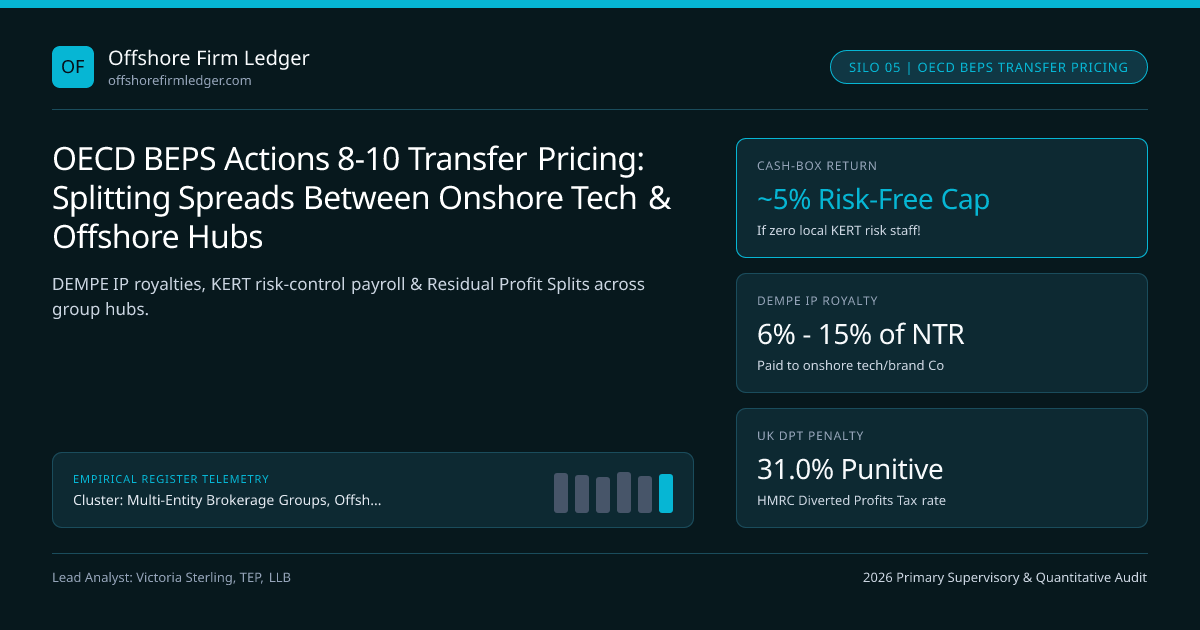
Ten years ago, aggressive CFOs set up a simple tax play: employ 150 software developers, quantitative pricing analysts, and performance marketers inside a London, Limassol, Tel Aviv, or Sydney "Cost-Plus 8% Service Company," while booking 92% of global FX/CFD spread revenue inside a 0%-tax BVI or Bahamas contracting entity staffed by two part-time administrators! Try that structure in 2026 and UK HMRC, Cyprus Tax Department, or the Australian Taxation Office (ATO) will tear it to shreds! Under the OECD Base Erosion and Profit Shifting (BEPS) Actions 8–10 Transfer Pricing Guidelines, DEMPE Intangible Rules, and OECD FHTP Economic Substance Standards, contractual risk allocation on an intra-group ISDA is disregarded for tax purposes unless the offshore entity employs the actual people performing the Key Entrepreneurial Risk-Taking (KERT) functions AND possesses the financial equity to absorb losses! Within our Multi-Entity Group & Client Recourse hub, aligning transfer pricing with real offshore substance prevents eight-figure retroactive tax assessments.
Three OECD BEPS Pillars Governing Multi-Entity Brokerage Profit Allocation#
Inside the Multi-Entity Group & Client Recourse cluster, Big-Four financial-services transfer-pricing practices test every intra-group agreement (hedging ISDAs, CRM software licences, brand royalties, and marketing-service contracts) against three OECD Transfer Pricing Guidelines chapters:
- Control Over Risk & KERT Functions (OECD TPG Chapter I, Section D.1.2):
- Putting US$5,000,000 of cash inside a Tortola or Nassau bank account only earns a risk-free / credit-adjusted treasury return (~4.5%–6.5% per annum!) if the human beings deciding VaR limits, skewing B-Book quotes, and approving hedge thresholds sit in London or Limassol! To retain residual market-making trading profits offshore, qualified dealing/risk officers physically situated in Nassau (SCB), Ebène (Mauritius FSC), or Labuan must exercise real day-to-day Risk Control!
- DEMPE Functions for Proprietary Trading Platforms & Brand IP (OECD TPG Chapter VI):
- Tax authorities look past legal trademark registration in Cayman or BVI to audit who performs Development, Enhancement, Maintenance, Protection, and Exploitation (DEMPE) of the trading app, quantitative execution engine, and global brand—requiring arms-length technology and brand royalty streams (typically 6%–18% of net trading revenue) back to the onshore R&D hub!
- OECD Pillar Two 15% Global Minimum Tax (
GloBE Rules>= EUR 750M Revenue):
- For mega-brokerage groups exceeding EUR 750,000,000 in consolidated revenue, Income Inclusion Rules (IIR) and Domestic Minimum Top-up Taxes (DMTT) in Bermuda, Bahamas, Guernsey, Jersey, and UK/EU impose a 15% effective tax floor per jurisdiction—shifting group strategy away from pure 0% tax arbitrage toward operational capital efficiency!
Comparative Transfer-Pricing Methods Across Intra-Group Brokerage Transactions#
| Intra-Group Transaction | Parties Involved | Preferred OECD TP Method | Typical Arms-Length Benchmark Range | Audit Failure Trigger |
|---|---|---|---|---|
| Back-to-Back STP Liquidity | Offshore Sub -> UK/CySEC Hub | CUP (Comparable Uncontrolled Price) | Institutional PoP spread + $2–$5/million clearing | Charging 10x market spread to strip offshore profit (or 0 spread!) |
| Shared Hybrid Risk Pool | Offshore Principal <-> Onshore Hub | Residual Profit Split Method (RPSM) | Split weighted by KERT Risk Payroll + Regulatory Capital | Giving 90% profit to entity with 0 risk staff |
| Proprietary App & Brand Licence | Onshore IP Co -> Offshore Sub | CUT / Royalty % of NTR | 6% – 15% of Net Trading Revenue | 0% royalty ("free brand use" by offshore sister!) |
| Customer Support & KYC Ops | Cyprus / Manila / KL Hub -> Offshore | TNMM (Cost-Plus Markup) | Full Loaded Cost + 6% to 10% | Marking up strategic sales acquisition as "routine admin" |
| Intra-Group Payment Agent | EU/UK Payment Co -> Offshore Sub | TNMM / Basis-Point Fee | Cost + 5%–8% (or 15–35 bps volume) | Zero fee despite EU AML/chargeback staff load |
Quantitative Residual Profit-Split Formula (OECD TPG Chapter II)#
Let's walk through the exact Two-Stage Residual Profit Split Method (RPSM) used by Big-Four tax advisers to allocate US$50,000,000 in combined multi-entity operating profit between a London FCA Liquidity/Tech Hub and a Mauritius FSC / Bahamas SCB Principal Contracting Subsidiary that genuinely employs 8 resident risk & dealing specialists:
- Where (Group Combined Pre-Split Operating Profit = US$50,000,000):
- Stage 1 — Routine Returns & DEMPE IP:
- OnshoreTechSupportRoutineAndIPReturn = US$18,000,000 (Cost + 8% on admin + 10% NTR platform/brand IP royalty)
- OffshoreRoutineOnboarding_Return = US$2,000,000
- GroupResidualNonRoutineProfitUSD = 50,000,000 - 18,000,000 - 2,000,000 = US$30,000,000
- Stage 2 — Residual KERT Risk & Capital Allocation Key (50% Weighted KERT Risk-Desk Payroll + 50% Unencumbered VaR Equity):
- OffshoreShareOfGlobalKERTRiskPayroll = 34.0% (experienced resident Nassau / Ebène dealing & risk directors)
- OffshoreShareOfGroupVaRRiskCapital = 46.0%
- OffshoreKERTAndCapitalAllocation_Key = (0.50 * 0.34) + (0.50 * 0.46) = 40.0%
- Worked Sustainable Split:
- OffshoreSustainableTaxableProfitUSD = 2,000,000 + (30,000,000 * 0.40) = US$14,000,000 (taxed at 0%–3% = $0–$420k!)
- OnshoreUKTaxableProfitUSD = 18,000,000 + (30,000,000 * 0.60) = US$36,000,000 (taxed at 25% UK CIT = $9.0M)
- BlendedAuditProofGroupEffectiveTax_Rate = ~18.0%–18.8% (zero HMRC Diverted Profits Tax 31% penalty!)
Investor Takeaway: Why BEPS Compliance Signals Counterparty Safety!#
Notice how tax compliance helps traders and institutional depositors too: a brokerage group that stations real risk officers, real unencumbered capital, and Big-Four transfer-pricing audits inside its Mauritius, Bahamas, or Labuan subsidiary (unlike hollow names in the offshore domiciles register like Albabrokers or Alpho) actually holds real cash on-island if creditors ever need recourse!
Master File & Local File Contemporaneous Documentation Gates#
Under OECD BEPS Action 13, multi-entity brokerages maintain annual Master Files and jurisdiction-specific Local Files benchmarking every intra-group spread, IT royalty, and marketing SLA against third-party database comparables prior to statutory tax-return filing—reinforcing genuine offshore COMI standing during cross-border Chapter 15 insolvency reviews.
Frequently asked questions
Can an offshore BVI or Seychelles subsidiary legally use its London parent's brand name for free?
No! Under OECD Transfer Pricing Guidelines Chapter VI (DEMPE intangibles), allowing an offshore sister entity to onboard clients under a valuable group trademark and proprietary platform without paying an arms-length royalty triggers upward tax adjustments in the IP owner's onshore jurisdiction.
What is a KERT function in financial-services transfer pricing?
Key Entrepreneurial Risk-Taking (KERT) functions in securities/derivatives dealing are the high-value human decisions creating and managing balance-sheet risk: setting pricing skews, configuring A-Book/B-Book routing algorithms, establishing VaR limits, and executing directional hedges.
When does OECD BEPS Action 13 Country-by-Country Reporting (CbCR) become mandatory?
Multinational brokerage and fintech groups with consolidated annual group revenue of EUR 750,000,000 or more must file annual Country-by-Country Reports disclosing revenue, pre-tax profit, tax paid, stated capital, headcount, and tangible assets per tax jurisdiction—automatically shared across tax authorities.
Which offshore hubs make it easiest to hire genuine local KERT risk and dealing staff?
Nassau (The Bahamas), Hamilton (Bermuda), Ebène Cybercity (Mauritius), and Labuan/Malaysia offer deep pools of university-educated finance, actuarial, and treasury professionals—making genuine KERT substance far more practical than tiny micro-islands.
Publication record
- Published
- 13 November 2026
- Updated
- 14 November 2026
- Author
- Victoria Sterling, TEP, LLB
- Review
- Review not recorded
- Automated fact check
- Passed in the stored pipeline record
- Source URLs
- 3 recorded
AI assistance recorded: anthropic/claude-opus-4.6. This field does not establish human review or source verification.
Academic & Institutional Attribution
Cite This Research & Embed Live Data Card
Standard academic & institutional research paper citation format.
Victoria Sterling, TEP, LLB. (2026, November 14). OECD BEPS Actions 8–10 Transfer Pricing: Splitting Spreads Between Onshore Tech & Offshore Hubs. Offshore Firm Ledger. https://offshorefirmledger.com/dossiers/oecd-beps-transfer-pricing-profit-splits-multi-entity-brokeragesRegulatory Directory Cross-Reference
Referenced Institutions & Regulatory Registries
Top Regulated Institutions in This Coverage Slice
Referenced Supervisory Authorities
Related Multi Entity Group Onboarding Arbitrage & Institutional Briefings
Explore Multi Entity Group Onboarding Arbitrage Hub (20) →Multi Entity Group Onboarding Arbitrage
Multi-Entity Brokerage Groups: Offshore Contracting Entities, Risk Routing & Client RecourseMulti Entity Group Onboarding Arbitrage
Omnibus Prime-of-Prime Margin & TTCAs: Why Offshore Client Segregation Fails on LP DefaultMulti Entity Group Onboarding Arbitrage
Statutory vs Contractual Negative Balance Protection: Auditing Retroactive Voidance ClausesMulti Entity Group Onboarding Arbitrage
Governing-Law & Exclusive Offshore Arbitration Clauses: Litigating Tortola, Mahé & Port LouisMulti Entity Group Onboarding Arbitrage
Intra-Group EU & UK Payment-Agent Subsidiaries: Billing Descriptors & Visa/MC Chargeback LawMulti Entity Group Onboarding Arbitrage
USDT & USDC Brokerage Deposit Rails: Tether/Circle Blacklist Freezes & Omnibus Wallet AuditsMulti Entity Group Onboarding Arbitrage
Shared Global Broker Brands & Corporate Veil Law: Why UK FCA Parents Owe Zero Duty to OffshoreMulti Entity Group Onboarding Arbitrage
MiFID II / FCA Elective Professional Reclassification vs Migrating to an Offshore SubsidiaryRetirement Planning
Why Private Equity Might Be a Threat to Your 401(k) - MorningstarRegulatory and Market Glossary
Goldman, Fortress and HBSC Back Rare Private Credit Deal in Saudi Arabia - Bloomberg.comMarket Insights
Data Insights: Technology reshapes hedge fund positioning in October - Securities Finance TimesPrivate Equity
Taproot Capital Launches Emerging Private Equity Manager Network - Chief Investment Officer
Offshore Firm Ledger Data, Benchmarks & Contributor Records
CC BY 4.0 Open Data
Open Institutional Datasets (CSV / JSON) →
Download desk-compiled quantitative series & schemas.
2026 Reference Matrix
2026 Institutional Benchmarks & Thresholds →
Statutory capital, clearing, margin & rate conventions.
Editorial Records
Authors & Review Records →
View named contributors where those records are available.
Complete Index
Master Research & Dossier Archive →
Browse all published briefings by topic pillar & date.