
Multi Entity Group Onboarding Arbitrage
Intra-Group Back-to-Back ISDA Hedging: How Offshore Subsidiaries Route B-Book & A-Book Delta
Tier-1 G-SIB prime brokers in London and New York rarely extend direct credit lines to standalone US$50,000 Seychelles or Vanuatu subsidiaries—so global groups bridge risk through intra-group ISDA/CSA master agreements.
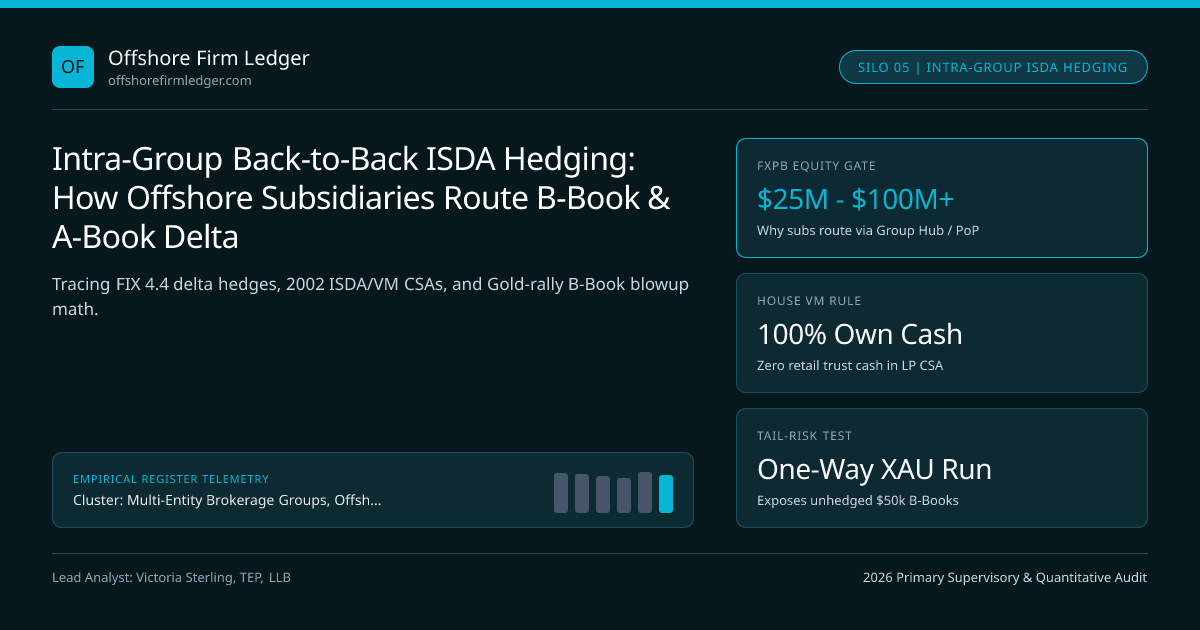
Ever wondered how a Seychelles FSA `SD` or Mauritius FSC subsidiary capitalized at US$50,000–$250,000 streams institutional sub-millisecond pricing from J.P. Morgan, UBS, Goldman Sachs, XTX Markets, and Citadel Securities on FIX API and MT5? Walk into a G-SIB Foreign Exchange Prime Broker (FXPB) onboarding committee in Canary Wharf and ask for a direct credit line for a standalone US$50,000 island company: you will be rejected in 30 seconds (G-SIB FXPB balance-sheet minimums sit at US$25M–$100M+ tangible net equity)! Instead, multi-entity brokerage groups connect their offshore contracting subsidiaries to Tier-1 liquidity via Intra-Group Back-to-Back 2002 ISDA Master Agreements & Credit Support Annexes (CSAs) routed through their UK FCA, Cyprus CySEC, or Australian ASIC Principal Liquidity Hub! Within our Multi-Entity Group & Client Recourse hub, tracing where net B-Book warehouse profit and tail risk actually sit explains both group profitability and intra-group contagion risk.
Three Intra-Group Execution & Risk-Transfer Topologies#
Inside the Multi-Entity Group & Client Recourse cluster, inspecting statutory footnote disclosures ("Related Party Transactions") in publicly listed brokerage annual reports (IG, Plus500, CMC, Swissquote, XTB, and major multi-entity CFD groups compared on /compare, such as BlackBull vs Blueberry Markets) reveals three distinct execution models:
- Model A — 100% Back-to-Back STP Mirror to Onshore Group Liquidity Hub (Offshore Risk-Neutral):
- Every millisecond a client clicks Buy
10.00 lots XAU/USDat the Bahamas, Labuan, or Seychelles subsidiary, an automated FIX 4.4 bridge fires an identical offsetting10.00 lothedge under an Intra-Group ISDA against the group's London FCA Matched-Principal / Market-Maker Hub—leaving the offshore subsidiary earning a clean, low-volatility commission/spread markup while centralizing quantitative B-Book/A-Book risk management in London/Sydney! (Mandatory by statute for Labuan LFSA `MB/` Money-Brokers!)
- Model B — Offshore Principal B-Book Warehousing + Tail-Delta ISDA Stop-Loss:
- The BVI Cat 1B, Bahamas SIA Principal, Belize $500k, or Mauritius Full-Service Dealer acts as Principal Counterparty, internalizing ("B-Booking") uncorrelated retail flow locally (capturing net spread + overnight swap + net retail trading losses in a 0%–3% tax hub!), and only sends residual net exposure exceeding pre-set Value-at-Risk (VaR) limits (e.g.,
>US$2M net Gold delta) upstream via ISDA to the London/Prime-of-Prime hub!
- Model C — External Prime-of-Prime (PoP) Direct Feed:
- Mid-sized groups without a US$30M FCA flagship connect their Mauritius/Seychelles/BVI dealer to an FCA/ASIC/BMA-regulated Prime-of-Prime (e.g., Finalto, CFH/TradeTech, Sucden, LMAX, Swissquote), posting house Variation Margin in an omnibus margin account.
The Regulatory Trap: UK EMIR Margin Rules & Offshore CIGA Substance!#
Look at two non-negotiable legal guardrails when structuring intra-group ISDA hedging:
- UK EMIR / EU EMIR Intra-Group Variation Margin (VM) Rules: When a UK FCA or EU CySEC entity faces an offshore non-equivalent third-country sister entity (such as Seychelles, BVI, or Vanuatu) on OTC uncleared derivatives, bilateral daily Variation Margin (VM) exchange under a 2016 VM CSA (and EMIR trade reporting to a Trade Repository like UnaVista/DTCC/REGIS-TR!) applies unless a specific regulatory intra-group exemption has been formally granted by the NCA!
- Offshore Economic Substance & Transfer-Pricing Reality: If an offshore BVI or Bahamas subsidiary claims US$40,000,000 in annual B-Book market-making profit at 0% tax while employing zero quantitative risk managers locally (because 100% of pricing algorithms and VaR limits are controlled by 18 quants in London or Limassol!), HMRC/ATO/Cyprus tax auditors will reallocate 85%+ of that profit onshore under OECD BEPS DEMPE & risk-control rules!
Comparative Matrix: Three Brokerage Execution Models & Counterparty Conflict Profiles#
| Execution Dimension | Model 1: Pure STP / Agency (Labuan MB/ / ECN) | Model 2: Hybrid A/B-Book w/ Group ISDA Hub | Model 3: Unhedged Standalone Offshore B-Book |
|---|---|---|---|
| Broker Revenue Source | Fixed per-lot commission + transparent markup | Spread + swap + internalized uncorrelated flow | 100% dependent on net client losses! |
| Profitable Trader Conflict? | Zero — More client volume = more broker rev! | Low-Moderate — Sharp flow auto-routed to A-Book | Extreme — Profitable whale threatens solvency! |
| Black-Swan Tail Survival | High (provided client NBP gap hedged/capped) | High (Group VaR caps + Tier-1 FXPB lines) | Fatal (One unhedged Gold/JPY trend wipes firm!) |
| Client Cash Used as LP Margin? | Forbidden unless explicit TTCA | Strictly House Capital ONLY in CSA! | High risk of illegal client-trust commingling |
| Verifiable Audit Trail | LP FIX 35=8 Execution Reports match 1:1 | Audited related-party ISDA + daily VM CSA | Opaque internal dealing-desk plugin |
Quantitative Hybrid Book Netting & Tail-Hedge Margin Formula#
Let's model how a disciplined multi-entity group's Mauritius / Bahamas Principal Dealer naturally offsets 78% of gross client long/short volume internally while dynamically hedging 100% of excess directional delta above US$3,000,000 via its London FCA group ISDA:
- Where (Active Gold XAU/USD Book on Offshore Subsidiary):
- GrossClientLongNotionalUSD = US$42,000,000
- GrossClientShortNotionalUSD = US$31,000,000 (73.8% natural two-way client netting!)
- NetDirectionalClientLongDelta = US$11,000,000 (clients net long $11M Gold -> broker is net SHORT $11M Gold!)
- LocalVaRRetentionCapUSD = US$2,500,000 (max unhedged risk approved by local Board)
- HedgedViaGroupISDANotional = 11,000,000 - 2,500,000 = US$8,500,000 hedged long upstream!
- UpstreamIMPlus3SigmaBuffer = 5.0% + 4.5% = 9.5%
- Worked House Treasury Requirement:
- RequiredHouseISDABufferUSD = 8,500,000 * 0.095 = US$807,500 in OWN UNENCUMBERED HOUSE EQUITY (0% client trust cash touched!)
Look at that US$807,500 house-equity requirement: if an under-capitalized standalone broker on the offshore domiciles register (like Agni Finance or Alain Fx) starts with only US$50,000 in total capital and clients go net long US$11,000,000 during a 6% Gold rally, the broker cannot afford the US$807,500 upstream hedge margin—which is precisely why tiny unhedged B-Books freeze withdrawals after parabolic Gold rallies!
Reading Related-Party Footnotes in Consolidated Parent Accounts#
Whenever evaluating an offshore subsidiary of a listed London, Sydney, or Warsaw financial group, inspect the "Related Party Derivatives & Liquidity Balances" footnote in the group's annual IFRS report to confirm active bilateral ISDA netting and daily CSA collateral settlement.
Frequently asked questions
Is B-Book execution automatically illegal or a scam at an offshore subsidiary?
No—except in pure agency classes like Labuan Money-Broking or Mauritius Discount Broking, Principal dealing (market making) is completely legal when properly capitalized, audited, and governed by automated VaR delta-hedging limits; danger arises only at under-capitalized standalone B-Books with zero upstream hedge lines.
Why did several small offshore brokers freeze withdrawals during the 2024–2026 Gold (XAU/USD) bull run?
Retail traders overwhelmingly bought Gold call/long positions; under-capitalized standalone B-Book brokers lacked the US$500k–$2M+ house cash needed to post Variation Margin on upstream hedges, leaving them naked short against client paper profits they could not pay.
Can my offshore broker legally send my segregated deposit to its London parent as hedge margin?
Not for retail segregated accounts! Under statutory client-money rules in Bahamas, Mauritius, Seychelles, and BVI, segregated retail client funds cannot be used to margin the broker's own house hedging positions—upstream ISDA CSAs must be funded strictly from corporate shareholder/house cash (unless an institutional client signed an explicit TTCA).
How do regulators verify whether a broker claiming "100% ECN / STP" actually hedged my trade?
Examiners (and EDR auditors like FinaCom) match the client's platform Order ID and millisecond fill timestamp against outbound FIX 4.4 Execution Reports (MsgType 35=8) and monthly clearing statements from the external Liquidity Provider.
Publication record
- Published
- 13 November 2026
- Updated
- 14 November 2026
- Author
- Victoria Sterling, TEP, LLB
- Review
- Review not recorded
- Automated fact check
- Passed in the stored pipeline record
- Source URLs
- 3 recorded
AI assistance recorded: anthropic/claude-opus-4.6. This field does not establish human review or source verification.
Academic & Institutional Attribution
Cite This Research & Embed Live Data Card
Standard academic & institutional research paper citation format.
Victoria Sterling, TEP, LLB. (2026, November 14). Intra-Group Back-to-Back ISDA Hedging: How Offshore Subsidiaries Route B-Book & A-Book Delta. Offshore Firm Ledger. https://offshorefirmledger.com/dossiers/intra-group-back-to-back-isda-hedging-b-book-risk-booking-hubsRegulatory Directory Cross-Reference
Referenced Institutions & Regulatory Registries
Mentioned Regulated Institutions
Referenced Supervisory Authorities
Related Multi Entity Group Onboarding Arbitrage & Institutional Briefings
Explore Multi Entity Group Onboarding Arbitrage Hub (20) →Multi Entity Group Onboarding Arbitrage
Multi-Entity Brokerage Groups: Offshore Contracting Entities, Risk Routing & Client RecourseMulti Entity Group Onboarding Arbitrage
OECD BEPS Actions 8–10 Transfer Pricing: Splitting Spreads Between Onshore Tech & Offshore HubsMulti Entity Group Onboarding Arbitrage
Omnibus Prime-of-Prime Margin & TTCAs: Why Offshore Client Segregation Fails on LP DefaultMulti Entity Group Onboarding Arbitrage
Statutory vs Contractual Negative Balance Protection: Auditing Retroactive Voidance ClausesMulti Entity Group Onboarding Arbitrage
Governing-Law & Exclusive Offshore Arbitration Clauses: Litigating Tortola, Mahé & Port LouisMulti Entity Group Onboarding Arbitrage
Intra-Group EU & UK Payment-Agent Subsidiaries: Billing Descriptors & Visa/MC Chargeback LawMulti Entity Group Onboarding Arbitrage
USDT & USDC Brokerage Deposit Rails: Tether/Circle Blacklist Freezes & Omnibus Wallet AuditsMulti Entity Group Onboarding Arbitrage
Shared Global Broker Brands & Corporate Veil Law: Why UK FCA Parents Owe Zero Duty to OffshoreHealthcare Financing
Lower resident board pass rates in private-equity backed emergency physician groups - 2 Minute MedicineRetirement Planning
Why Private Equity Might Be a Threat to Your 401(k) - MorningstarRegulatory and Market Glossary
Goldman, Fortress and HBSC Back Rare Private Credit Deal in Saudi Arabia - Bloomberg.comMarket Insights
Data Insights: Technology reshapes hedge fund positioning in October - Securities Finance Times
Offshore Firm Ledger Data, Benchmarks & Contributor Records
CC BY 4.0 Open Data
Open Institutional Datasets (CSV / JSON) →
Download desk-compiled quantitative series & schemas.
2026 Reference Matrix
2026 Institutional Benchmarks & Thresholds →
Statutory capital, clearing, margin & rate conventions.
Editorial Records
Authors & Review Records →
View named contributors where those records are available.
Complete Index
Master Research & Dossier Archive →
Browse all published briefings by topic pillar & date.