
Multi Entity Group Onboarding Arbitrage
USDT & USDC Brokerage Deposit Rails: Tether/Circle Blacklist Freezes & Omnibus Wallet Audits
Over 60% of emerging-market offshore CFD margin now moves via TRC-20 and ERC-20 USDT or USDC—introducing smart-contract blacklist freezes, omnibus hot-wallet commingling, and irreversible FATF Travel Rule holds.
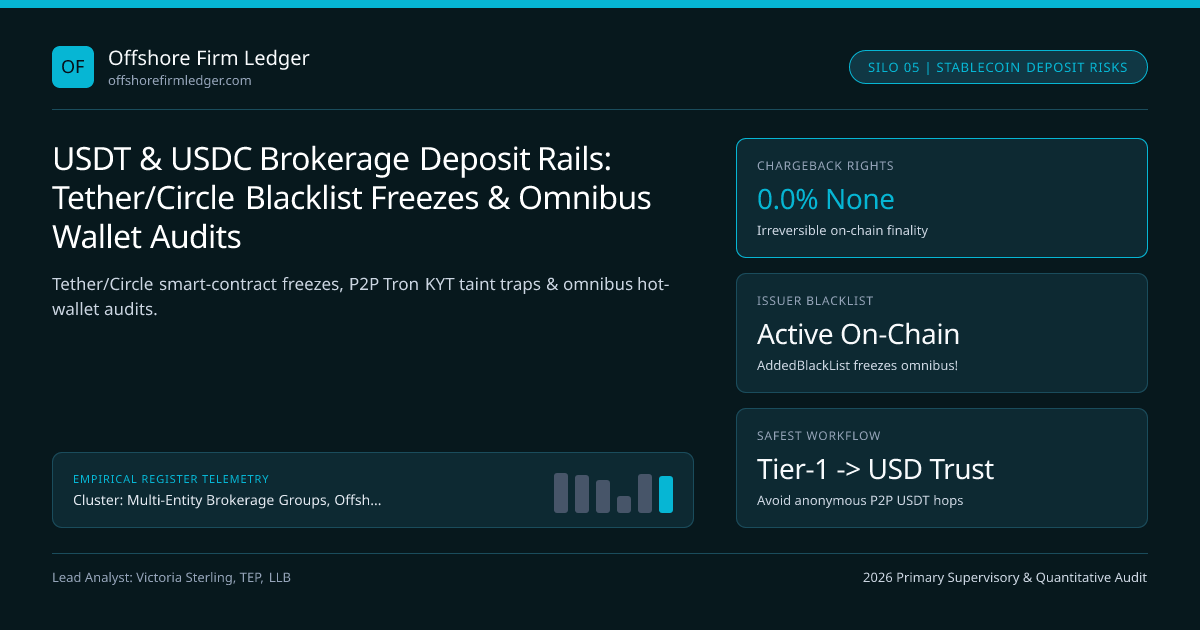
Between 2021 and 2026, USDT (TRC-20 on Tron & ERC-20 on Ethereum) and USDC overtook SWIFT wires across Latin America, MENA, and Southeast Asia as the fastest way to fund offshore trading margin—settling in 45 seconds with near-zero wire fees! Yet traders who treat stablecoin brokerage deposits like "censorship-resistant digital cash" ignore three institutional legal and technical realities: (1) zero card/SWIFT recall recourse once broadcast, (2) centralized issuer smart-contract freeze functions (AddedBlackList in Tether & blacklist in Circle) that can paralyze an entire offshore broker's omnibus deposit hot wallet overnight if tainted funds touch it, and (3) strict FATF Recommendation 15 Travel Rule ( KYT ) source-of-funds freezes! Within our Multi-Entity Group & Client Recourse hub, auditing how your offshore broker architects its VASP / payment-processor wallet segregation prevents catastrophic contagion freezes.
How One Tainted Deposit Can Freeze a Poorly Architected Broker's Entire Omnibus Hot Wallet!#
Inside the Multi-Entity Group & Client Recourse cluster, contrast how institutional crypto-custody gateways (Bermuda DABA, Bahamas DARE, BVI VASP, or licensed payment processors like Alfacoins) handle inbound USDT vs how sloppy offshore brokers (compare unverified names in the offshore domiciles register like Bitget Wallet clones or Bitrage Markets) manage wallets:
- Bad Architecture (Direct Sweep Into Single Unscreened Omnibus Hot Wallet): Every user gets a deposit address that auto-sweeps within 2 blocks into one central
TRC-20hot wallet holding US$18,000,000 of all clients' USDT. A single rogue user deposits US$40,000 of USDT 2-hops away from a DPRK Lazarus or sanctioned darknet exploit; 48 hours later, law enforcement serves a freeze request on Tether Operations Limited (now domiciled in El Salvador, formerly BVI)—triggeringAddedBlackList(Broker_Omnibus_Address)on-chain and freezing ALL US$18,000,000 of innocent traders' withdrawals indefinitely! - Institutional Architecture (Pre-Sweep KYT Quarantine Vault + Fireblocks/Chainalysis Real-Time Scoring): Every inbound deposit lands first in an isolated per-client per-tx quarantine address; real-time Chainalysis KYT / TRM Labs / Elliptic screens hop exposure (
sanctions,ransomware,mixer,high-risk no-KYC exchange); ONLY clean deposits (risk score < threshold) sweep into segregated multi-sig cold/warm treasury vaults, while flagged deposits stay isolated in their single-address sandbox!
The "P2P OTC Tainted USDT" Trap Catching Honest Emerging-Market Traders!#
Here is a real-world nightmare hitting honest traders in Vietnam, Nigeria, Turkey, Argentina, and Pakistan every single week: you buy US$20,000 USDT from an anonymous high-volume merchant on a P2P marketplace, withdraw it to your personal TronLink/MetaMask wallet, and immediately send it to a strictly compliant Bahamas SCB or Mauritius FSC broker. Suddenly, the broker's KYT engine locks your deposit! Why? Because that P2P merchant sourced USDT from an illicit pig-butchering or sanctioned gambling cluster 2 hops back—giving your wallet indirect severe taint (>15% illicit exposure)!
Comparative Matrix: Brokerage Funding Rails Ranked by Recourse, Speed & Freeze Exposure#
| Funding Rail | Settlement Speed | Total Round-Trip Fee | Payment-Network Dispute Recourse? | Smart-Contract / Taint Freeze Risk | Statutory Trust Protection |
|---|---|---|---|---|---|
| Tier-1 Bank SWIFT Wire (USD/EUR) | 4 – 36 hours | $25 – $60 flat | Bank recall only pre-credit; strong audit trail | Zero smart-contract risk (AML Nostro check) | Highest (Direct into Bank Trust A/C) |
| SEPA Instant / UK Faster Payments | 5 – 30 seconds | €0 – €2 | Strong banking ombudsman paper trail | Zero smart-contract risk | Highest (Via EEA/UK regulated rail) |
Visa / Mastercard (MCC 6211) | Instant | 0% – 2.5% | Yes — 120-day Reason 13.1 protection! | Zero smart-contract risk | High (Swept to trust; Return-to-Source) |
USDC (ERC-20 / Regulated VASP) | 15 – 60 seconds | $0.50 – $5.00 | Zero | Medium (Circle blacklist; audited reserves) | Medium-High if converted to fiat trust |
USDT (TRC-20 via P2P Wallet) | 30 – 90 seconds | $1.00 – $3.00 | Zero | High (Heavy P2P Tron taint + Tether freeze!) | Zero if left in unregulated omnibus hot wallet! |
Quantitative Taint-Exposure Dilution & Pre-Deposit Screening Rule#
Compliance engines (Chainalysis Reactor / Elliptic Lens) compute Proportional Hop Taint Exposure across incoming UTXOs / account-model token flows. Whenever an inbound deposit breaches the broker's Direct (>0.1% Sanctions / >5% High-Risk) or Indirect (>10%–15%) threshold, compliance must freeze and file an STR with the local FIU:
- Where (Trader Wallet Receiving $15,000 Clean Exchange USDT + $5,000 Unvetted Telegram/P2P USDT Carrying 60% Scam Taint):
- TaintedDollarEquivalent = 5,000 * 0.60 = US$3,000 illicit attribution
- TotalWalletInflow_USD = 15,000 + 5,000 = US$20,000
- WalletIndirectIllicitExposurePct = (3,000 / 20,000) * 100 = 15.0% -> TRIGGERS AUTOMATED BROKER COMPLIANCE FREEZE & EDD HOLD!
Three Ironclad Rules for Institutional & HNW Stablecoin Brokerage Funding#
- Source USDT/USDC Strictly From Regulated Tier-1 Exchanges (Coinbase, Kraken, Regulated Local VASPs)—never directly from anonymous P2P OTC desks into a regulated brokerage account!
- Choose a Fiat
USDBase Account Over aUSDTBase Account where the regulated offshore subsidiary converts inbound stablecoins via an institutional OTC liquidity partner straight into segregated bank USD trust cash! - Verify VASP Authorization: Confirm whether the offshore broker holds an explicit digital-asset custody permission (Bahamas DARE, Bermuda DABA, BVI VASP, or Mauritius VAITOS) rather than holding client crypto in an unhedged ledger!
Frequently asked questions
Can Tether or Circle really freeze USDT or USDC sitting inside a private non-custodial wallet or offshore broker wallet?
Yes! Because USDT and USDC are centralized smart contracts on Ethereum, Tron, Solana, and Layer-2s, Tether Operations Ltd and Circle Internet Financial hold administrative master keys (AddedBlackList / blacklist) that freeze token transfers at any blockchain address upon law-enforcement or court order.
Why did my regulated offshore broker freeze my USDT deposit and demand 6 months of exchange trade history?
Under FATF Recommendation 15 and local FIU AML statutes, regulated brokers run automated blockchain analytics (Chainalysis, TRM Labs, Elliptic) on every inbound txhash; if your sending wallet interacted with a mixer, high-risk P2P desk, or unhosted cluster, compliance is legally prohibited from releasing funds until source-of-wealth is cleared.
Is holding a "USDT-denominated MT5 account" covered by traditional bank client-money segregation?
Carefully check your Client Agreement! Traditional bank trust letters cover fiat currency deposits (USD, EUR, GBP); unless the broker also holds a statutory VASP/DARE/DABA custody licence segregating on-chain vault assets in trust, an internal "USDT account" may sit in an unregulated third-party exchange sub-account.
What is the FATF Travel Rule threshold for crypto transfers to and from brokers?
Under FATF Recommendation 15, the baseline international de minimis threshold for transmitting verified originator and beneficiary identity data between VASPs is USD/EUR 1,000 (while the EU Transfer of Funds Regulation enforces a €0 threshold plus mandatory wallet-ownership verification for self-hosted wallets over €1,000).
Publication record
- Published
- 13 November 2026
- Updated
- 14 November 2026
- Author
- Victoria Sterling, TEP, LLB
- Review
- Review not recorded
- Automated fact check
- Passed in the stored pipeline record
- Source URLs
- 3 recorded
AI assistance recorded: anthropic/claude-opus-4.6. This field does not establish human review or source verification.
Academic & Institutional Attribution
Cite This Research & Embed Live Data Card
Standard academic & institutional research paper citation format.
Victoria Sterling, TEP, LLB. (2026, November 14). USDT & USDC Brokerage Deposit Rails: Tether/Circle Blacklist Freezes & Omnibus Wallet Audits. Offshore Firm Ledger. https://offshorefirmledger.com/dossiers/stablecoin-usdt-usdc-brokerage-deposit-rails-omnibus-freeze-riskRegulatory Directory Cross-Reference
Referenced Institutions & Regulatory Registries
Mentioned Regulated Institutions
Related Multi Entity Group Onboarding Arbitrage & Institutional Briefings
Explore Multi Entity Group Onboarding Arbitrage Hub (20) →Multi Entity Group Onboarding Arbitrage
Multi-Entity Brokerage Groups: Offshore Contracting Entities, Risk Routing & Client RecourseMulti Entity Group Onboarding Arbitrage
Shared Global Broker Brands & Corporate Veil Law: Why UK FCA Parents Owe Zero Duty to OffshoreMulti Entity Group Onboarding Arbitrage
MiFID II / FCA Elective Professional Reclassification vs Migrating to an Offshore SubsidiaryMulti Entity Group Onboarding Arbitrage
MT4, MT5 & cTrader Server Certificate Forensics: Matching Trading Servers to Contracting EntitiesMulti Entity Group Onboarding Arbitrage
Offshore Introducing Broker 'Revenue Share' (Client Loss Splits) vs Per-Lot Rebates & CPAMulti Entity Group Onboarding Arbitrage
Offshore Prop-Trading Challenge Firms (DMCC, St. Lucia & SVG): Simulated Accounts & Zero CustodyMulti Entity Group Onboarding Arbitrage
Cross-Border Brokerage Insolvency: US Chapter 15, UNCITRAL Model Law & Offshore JOL BattlesMulti Entity Group Onboarding Arbitrage
CRS 2.0, OECD CARF & FATCA Tax Exchange on Offshore Brokerage, Margin & Crypto Custody AccountsPrivate Equity
The PE Money Tree with Andrew Granato and Pranjal Drall | Private Credit Crisis - The Capitol ForumMergers and Acquisitions
Folding carton maker MM Packaging being sold to private equity - Packaging DiveMarket Insights
2026 Private Credit Survey: LP & GP Views - Goldman Sachs Asset ManagementMarket Insights
Anthropic's IPO will be a positive catalyst for tech, says New York Angels' Bob Peck
Offshore Firm Ledger Data, Benchmarks & Contributor Records
CC BY 4.0 Open Data
Open Institutional Datasets (CSV / JSON) →
Download desk-compiled quantitative series & schemas.
2026 Reference Matrix
2026 Institutional Benchmarks & Thresholds →
Statutory capital, clearing, margin & rate conventions.
Editorial Records
Authors & Review Records →
View named contributors where those records are available.
Complete Index
Master Research & Dossier Archive →
Browse all published briefings by topic pillar & date.