
Multi Entity Group Onboarding Arbitrage
Shared Global Broker Brands & Corporate Veil Law: Why UK FCA Parents Owe Zero Duty to Offshore
Under English Supreme Court corporate-veil doctrine from Salomon (1897) to Prest v Petrodel (2013), sharing a famous London brand logo, website, and CEO never makes an FCA parent automatically liable for an insolvent offshore subsidiary.
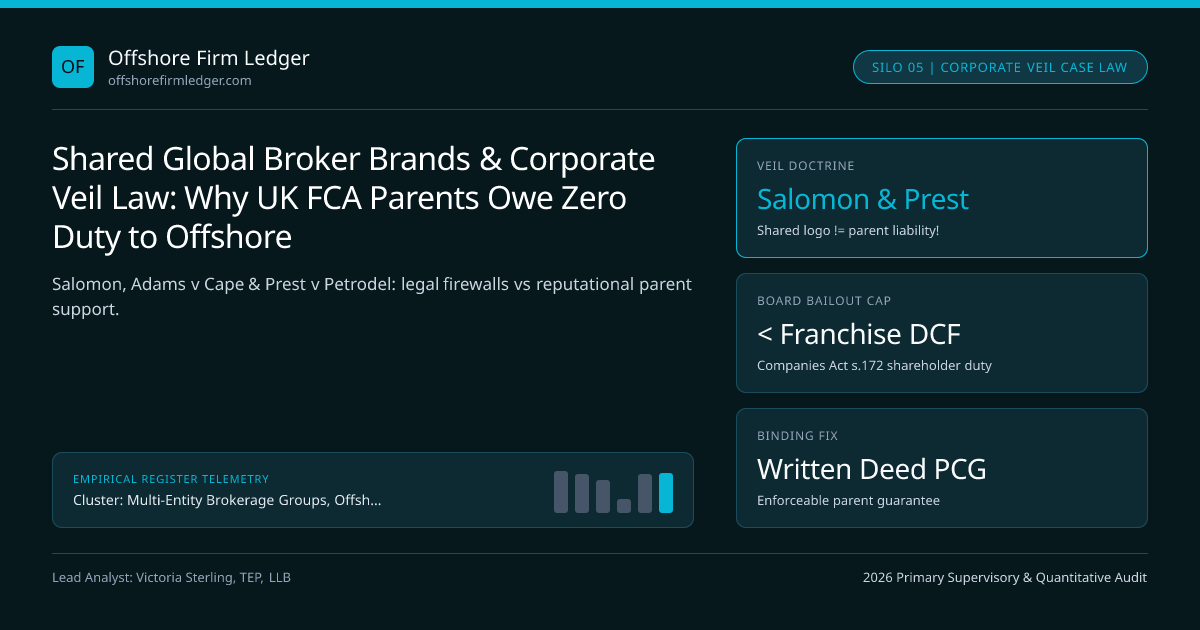
Listen to how retail influencers pitch offshore subsidiaries of famous brokerages: "Don't worry that your account is with Brand X Seychelles or Brand X Bahamas—their parent company is listed on the London Stock Exchange and regulated by the UK FCA, so London HAS to back your funds!" Walk into the Commercial Court in the Rolls Building, London, with that argument and your claim will be struck out before lunch! Under 129 years of unbroken English and Commonwealth Supreme Court precedent, the whole legal purpose of incorporating separate limited-liability subsidiaries across BVI, Cayman, Mauritius, Seychelles, and Bahamas is precisely to ring-fence balance-sheet liabilities inside each distinct corporate body! Within our Multi-Entity Group & Client Recourse hub (complementing our Commonwealth sham-trust & veil doctrine), mastering four landmark UK judgments shows exactly when a parent company walks away clean—and the rare narrow tort exceptions where parent liability attaches.
Four Landmark English Cases Governing Multi-Entity Corporate Groups#
Inside the Multi-Entity Group & Client Recourse cluster, every general counsel of a multi-entity brokerage group builds corporate governance around four foundational House of Lords / UK Supreme Court / Court of Appeal authorities:
- **Salomon v A Salomon & Co Ltd [1897] AC 22 (Separate Legal Personality)**:
- Even if Parent Co PLC owns 100% of the shares of Offshore Sub Ltd, shares the exact same brand logo, and appoints common directors,
Offshore Sub Ltdis at law an entirely separate person—its debts are NOT the debts ofParent Co PLC!
- **Adams v Cape Industries plc [1990] Ch 433 (Right to Use Group Structure to Isolate Future Risk!)**:
- The English Court of Appeal held explicitly: we do NOT accept that the court is entitled to lift the corporate veil against a defendant company which is the member of a corporate group merely because the corporate structure has been used so as to ensure that the legal liability in respect of particular future activities of the group will fall on another member of the group rather than the defendant company! Read that again: setting up a BVI or Vanuatu subsidiary specifically so overseas high-leverage tail risk cannot bankrupt the UK FCA parent is 100% lawful under English law!
- **Prest v Petrodel Resources Ltd [2013] UKSC 34 (Lord Sumption's Ultra-Narrow "Evasion Principle")**:
- The UK Supreme Court restricted true "piercing the corporate veil" to the Evasion Principle ONLY—where a controller interposes a company to evade an already existing legal obligation, NOT the Concealment Principle or normal forward-looking subsidiary risk allocation!
- **Vedanta v Lungowe [2019] UKSC 20 & Okpabi v Royal Dutch Shell [2021] UKSC 3 (Direct Parent Tortious Duty of Care?)**:
- The ONLY narrow modern route plaintiffs attempt against a UK parent is alleging the UK parent directly assumed operational control and defective group-wide risk/custody management over the subsidiary's specific failing—a multi-year High Court battle costing millions in KC fees and fiercely resisted by brokerage Client Agreements containing explicit Non-Reliance on Group Affiliates Clauses!
Commercial Reputational Support vs Enforceable Legal Right: Know the Difference!#
Now let's be nuanced and fair: why IS an offshore subsidiary of a FTSE-250, Warsaw, or Swiss-listed group still 50x safer than a standalone anonymous offshore company (like Axemarks / Axeinvest or Banex Capital in the offshore domiciles register) even without a legal Parent Guarantee?
- Reputational Franchise Value (Up to a Point!): If a listed group worth US$2.5 billion suffers a US$8 million liquidity shortfall inside its Bahamas or Mauritius subsidiary, the PLC board will almost always inject US$8M voluntarily because letting a branded subsidiary default would crash the parent's stock price by US$400M!
- Where Voluntary Support Breaks Down (Catastrophic Tail Events!): If an offshore subsidiary suffers a US$600 million existential black-swan liability (exceeding the value of the offshore franchise—think Alpari UK 2015 or FTX International vs FTX US/Japan!), the parent's directors actually owe a fiduciary duty under UK Companies Act 2006 s.172 to their OWN shareholders NOT to bankrupt the healthy onshore PLC to bail out an unguaranteed offshore subsidiary!
Comparative Matrix: Cross-Entity Recourse Instruments Ranked by Legal Enforceability#
| Group Support Mechanism | Legal Enforceability | Typical Availability | Survives Catastrophic Subsidiary Bust? |
|---|---|---|---|
| Irrevocable Bank Letter of Credit (SBLC) | 100% Autonomous Bank Obligation | Sovereign / $25M+ Institutional Prime | Yes — 100% |
| Executed Deed of Parent Company Guarantee (PCG) | 100% Binding Contract on Parent PLC | $5M+ Hedge Fund ISDA / Institutional DMA | Yes (Up to Parent PLC net worth) |
| Keepwell Agreement / Comfort Letter | Weak / Moral or Qualified Covenant | Mid-tier institutional / banking lines | Uncertain (Litigated heavily in bond defaults!) |
| Listed Tier-1 Parent Brand (No PCG) | 0% Legal Right (Pure Reputation!) | Retail & HNW Offshore Accounts | Yes for small (<$20M) hits; NO for existential wipeouts! |
| Private Unaudited Group w/ Shared Logo | 0% Legal Right + Low Franchise Stake | Mass Offshore Retail | No — Founders walk away & rebrand! |
Quantitative "Franchise-Abandonment Tipping Point" Formula for Group Risk Analysts#
Credit committees at institutional funds model the exact Franchise-Abandonment Threshold—the dollar deficit above which a rational unguaranteed parent PLC board will sever the umbilical cord and place its offshore subsidiary into liquidation rather than recapitalize it:
- Where (Publicly Listed Brokerage Group Worth US$800M Facing a Sudden Deficit in Its Offshore Subsidiary):
- OffshoreSub5YrDCFFranchiseValueUSD = US$45,000,000
- EstimatedParentBrandContagionMarketCap_Hit = US$75,000,000
- ParentAvailableFreeCashRatio = 0.65 (board caps cash drain at 65% of combined franchise/reputation value)
- Worked Rational Board Bailout Ceiling:
- ParentVoluntaryRecapitalizationCeilingUSD = (45,000,000 + 75,000,000) * 0.65 = US$78,000,000!
- > Deficit = US$12M? Parent injects cash quietly over the weekend!
- > Deficit = US$190M? Parent invokes Adams v Cape corporate veil and hands keys to Tortola/Nassau Liquidators!
Institutional Takeaway: For Allocations Over US$2M, Ask for a Written PCG or Onshore Prime!#
If your family office or systematic fund is allocating US$2,000,000+ to an offshore subsidiary of a regulated group, don't guess about reputational bailouts: ask the group's institutional desk for an executed Deed of Parent Company Guarantee, run our 14-Point Counterparty Due-Diligence Scorecard, or clear through the onshore FCA/ASIC/BMA balance sheet via Elective Professional reclassification!
Frequently asked questions
Does sharing the exact same website URL, brand logo, and CEO allow courts to pierce the corporate veil between a UK FCA parent and its Seychelles subsidiary?
No. Under English law (Salomon, Adams v Cape Industries, and Prest v Petrodel), common branding, 100% shareholding, and overlapping directors do not merge separate corporate personalities so long as the Client Agreement clearly identifies the offshore company as your contracting party.
Why is an offshore subsidiary of a publicly listed FCA/ASIC broker still much safer than an independent offshore broker?
Two practical reasons: (1) Group-wide Big-Four audit controls, institutional risk hedging, and compliance oversight prevent insider rug-pulls; and (2) up to its franchise-value ceiling, a listed PLC has a massive stock-market incentive to cure moderate subsidiary deficits voluntarily.
What is a Parent Company Guarantee (PCG) in institutional brokerage?
A Deed of Parent Company Guarantee is a formal legally binding contract signed by the onshore parent holding company irrevocably guaranteeing payment of the offshore subsidiary's net financial obligations to a named institutional client upon subsidiary default.
When could a UK parent company face direct tort liability for an offshore subsidiary under Vedanta / Okpabi?
Only in exceptional, heavily litigated tort claims where plaintiffs prove the parent actively promulgated defective group-wide policies or took direct operational takeover of the specific system causing harm—and even in pure economic/contract disputes, non-reliance clauses create steep barriers.
Publication record
- Published
- 12 November 2026
- Updated
- 14 November 2026
- Author
- Victoria Sterling, TEP, LLB
- Review
- Review not recorded
- Automated fact check
- Passed in the stored pipeline record
- Source URLs
- 3 recorded
AI assistance recorded: anthropic/claude-opus-4.6. This field does not establish human review or source verification.
Academic & Institutional Attribution
Cite This Research & Embed Live Data Card
Standard academic & institutional research paper citation format.
Victoria Sterling, TEP, LLB. (2026, November 14). Shared Global Broker Brands & Corporate Veil Law: Why UK FCA Parents Owe Zero Duty to Offshore. Offshore Firm Ledger. https://offshorefirmledger.com/dossiers/shared-global-broker-brands-corporate-veil-piercing-uk-case-lawRegulatory Directory Cross-Reference
Referenced Institutions & Regulatory Registries
Top Regulated Institutions in This Coverage Slice
Related Multi Entity Group Onboarding Arbitrage & Institutional Briefings
Explore Multi Entity Group Onboarding Arbitrage Hub (20) →Multi Entity Group Onboarding Arbitrage
Multi-Entity Brokerage Groups: Offshore Contracting Entities, Risk Routing & Client RecourseMulti Entity Group Onboarding Arbitrage
MiFID II / FCA Elective Professional Reclassification vs Migrating to an Offshore SubsidiaryMulti Entity Group Onboarding Arbitrage
MT4, MT5 & cTrader Server Certificate Forensics: Matching Trading Servers to Contracting EntitiesMulti Entity Group Onboarding Arbitrage
Offshore Introducing Broker 'Revenue Share' (Client Loss Splits) vs Per-Lot Rebates & CPAMulti Entity Group Onboarding Arbitrage
Offshore Prop-Trading Challenge Firms (DMCC, St. Lucia & SVG): Simulated Accounts & Zero CustodyMulti Entity Group Onboarding Arbitrage
Cross-Border Brokerage Insolvency: US Chapter 15, UNCITRAL Model Law & Offshore JOL BattlesMulti Entity Group Onboarding Arbitrage
CRS 2.0, OECD CARF & FATCA Tax Exchange on Offshore Brokerage, Margin & Crypto Custody AccountsMulti Entity Group Onboarding Arbitrage
14-Point Institutional Counterparty Due-Diligence Scorecard for Multi-Entity Offshore BrokeragesMergers and Acquisitions
Folding carton maker MM Packaging being sold to private equity - Packaging DiveMarket Insights
2026 Private Credit Survey: LP & GP Views - Goldman Sachs Asset ManagementMarket Insights
Anthropic's IPO will be a positive catalyst for tech, says New York Angels' Bob PeckMarket Insights
Capitol Hill’s Bark Is Worse Than Its Bite for Bank Stocks
Offshore Firm Ledger Data, Benchmarks & Contributor Records
CC BY 4.0 Open Data
Open Institutional Datasets (CSV / JSON) →
Download desk-compiled quantitative series & schemas.
2026 Reference Matrix
2026 Institutional Benchmarks & Thresholds →
Statutory capital, clearing, margin & rate conventions.
Editorial Records
Authors & Review Records →
View named contributors where those records are available.
Complete Index
Master Research & Dossier Archive →
Browse all published briefings by topic pillar & date.