
Multi Entity Group Onboarding Arbitrage
Statutory vs Contractual Negative Balance Protection: Auditing Retroactive Voidance Clauses
Outside UK FCA, EU ESMA, Australia ASIC, and Bahamas SCB Rule 9, offshore "Negative Balance Protection" is purely contractual—meaning six lines of "scalping, news-gap, or cross-account abuse" fine print can leave you owing six figures!
Flash back to January 15, 2015, when the Swiss National Bank abruptly abandoned the EUR/CHF 1.2000 floor: EUR/CHF plunged 2,800 pips in twelve minutes with zero intermediate liquidity, blowing straight past 50% automated stop-outs and plunging tens of thousands of leveraged 100:1–500:1 accounts into deep six-figure negative debt balances—followed shortly by debt-collection letters from brokers whose websites had casually promised "automated stop-outs prevent you losing more than your deposit"! Within our Multi-Entity Group & Client Recourse hub, every trader operating above 30:1 leverage must know the razor-sharp legal divide between Unconditional Statutory Negative Balance Protection (NBP) and Conditional Contractual Offshore NBP!
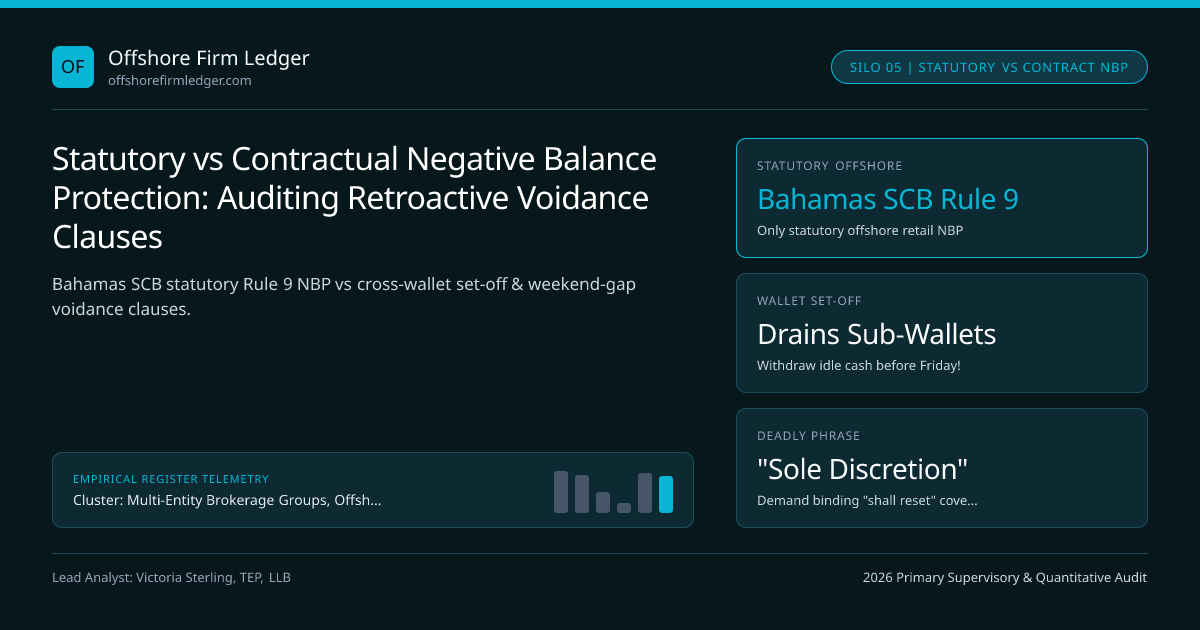
Only ONE Major Offshore Hub Makes Retail NBP Mandatory by Statute: Bahamas SCB!#
Inside the Multi-Entity Group & Client Recourse cluster, check the primary legislation across every offshore domicile we audit:
- Unconditional Statutory NBP (Unwaivable for Retail Clients!):
- UK FCA (
COBS 22.5.17R), EU ESMA / CySEC, & Australia ASIC (CFD Product Intervention Order): By binding law, a retail client's aggregate liability for all CFDs connected to a CFD trading account is strictly limited to the funds in that CFD trading account—the broker CANNOT sue a retail client for a negative gap balance under any market circumstance! - Securities Commission of The Bahamas (SCB) — Rule 9 of the Securities Industry (Contracts for Differences) Rules, 2020: As detailed in our Bahamas SCB CFD statute analysis, The Bahamas is the ONLY major offshore retail CFD jurisdiction where per-account retail Negative Balance Protection is enshrined in binding statutory law!
- Purely Contractual / Discretionary NBP (BVI, Cayman, Mauritius, Seychelles, Labuan, Belize, Vanuatu):
- Neither BVI SIBA, Mauritius Securities Act, Seychelles Securities Act, nor Vanuatu FDLA mandates NBP by statute! If a Mauritius, Seychelles, or Vanuatu broker advertises "Negative Balance Protection," your protection exists ONLY to the extent written inside Clause 14 of its Terms of Business—subject to every carve-out the broker's lawyers drafted!
Five Contractual Booby-Traps Hidden Inside Offshore "Negative Balance Protection" Clauses#
Open your offshore broker's Client Agreement right now and audit these five exact contractual NBP loopholes (especially prevalent on aggressive high-leverage platforms in the offshore domiciles register like Amrica Fx Trade or Argotrade Com):
- Cross-Sub-Account Set-Off ("Per-Client" vs "Per-Account" NBP!): Suppose you hold $85,000 in Safe Sub-Account #1 and $5,000 in 500:1 News-Trading Sub-Account #2. Sub-Account #2 gaps to -$48,000. Under ESMA / Bahamas per-account NBP, Sub-Account #2 resets to $0 and Sub-Account #1 keeps $85,000. Under 90% of offshore contractual clauses ("Right of Set-Off Across All Client Accounts"), the broker drains $48,000 straight out of Sub-Account #1 before applying NBP!
- The "Pre-Weekend / Pre-CPI Intentional High-Leverage Abuse" Voidance Clause: Many offshore NBP policies state that NBP is null and void if the broker "in its sole and absolute discretion determines the Negative Balance resulted from heavy margin utilization opened shortly prior to market close, macroeconomic announcements, or cross-broker opposing-leg arbitrage"!
- Discretionary "Goodwill Basis Only" Wording: Watch for deadly phrasing: "The Company may, as a gesture of goodwill and at its sole discretion, credit a negative balance to zero..."—legally, "may at its sole discretion" equals ZERO enforceable obligation when a $20M black-swan event hits the broker!
- Dollar Cap on Contractual NBP (e.g., "Capped at US$10,000 or US$50,000 Per Client"): Several offshore T&Cs cap lifetime contractual NBP resets at US$20,000–$50,000—leaving HNW traders exposed above the cap!
- Retroactive "Manifest Error / Latency Arbitrage" Trade Cancellation on Winning Legs: If you hedged long at Broker A and short at Broker B, and Broker B voids your +$90,000 winning short leg for "off-market gap quote" while Broker A refuses to reset your -$90,000 losing leg!
Comparative Matrix: Negative Balance Protection Strength Across 6 Jurisdictions#
| Jurisdiction & Licence | NBP Legal Basis | Applies Per Sub-Account? | Can Broker Void for "High Friday Leverage"? | Applies to Elective Pro / Corporate? |
|---|---|---|---|---|
| UK FCA / EU CySEC / AU ASIC | Unconditional Statute | Yes (Per CFD trading account) | No (Unless criminal fraud) | No (Lost on Pro opt-up unless contractual!) |
Bahamas SCB (CFD Rules Rule 9) | Unconditional Statute | Yes (Retail CFD accounts) | No (Statutory mandate + 200:1 cap) | Retail guaranteed; check Pro contract |
Labuan LFSA (MB/ STP) | Contractual + 100:1 cap | Usually Per-Client (sets off sub-A/Cs!) | Check T&Cs (STP passes LP fill!) | Contractual |
| Tier-1 Parented MU / SC / BVI Sub | Contractual Binding Covenant | Usually Per-Client (sets off sub-A/Cs!) | Often carves out two-broker hedge abuse | Contractual (check dollar cap!) |
| Standalone Offshore 1000:1 Dealer | "Sole Discretion Goodwill" | Full cross-account seizure | Yes — Broad unilateral voidance! | None |
| Direct Institutional FXPB / PoP | NONE — Full Deficit Recourse | Full ISDA cross-netting | N/A — Client owes 100% of deficit! | Client owes 100% of negative debt |
Quantitative Tail-Gap Option Value of True Unconditional NBP#
In quantitative finance, unconditional Negative Balance Protection is literally a free out-of-the-money (OTM) Gap Put Option written by the broker to the trader with a strike at Account Equity = $0! Let's calculate why brokers offering 500:1–1000:1 leverage have to insert "pre-weekend gap abuse" voidance clauses—and how HNW traders structure Corporate SPV Ring-Fencing when trading institutional no-NBP accounts:
- Where (US$30,000 Active Account + US$120,000 Internal Broker "Wallet" Holding 200:1 = US$6,000,000 Notional Across a 4.5% Weekend Gap):
- GrossWeekendGap_Loss = 6,000,000 * 0.045 = US$270,000
- Under Per-Account Statutory NBP (SCB / FCA):
- Loss = US$30,000 (Broker absorbs US$240,000 gap; US$120,000 separate account protected if non-set-off!)
- Under Offshore Cross-Wallet Set-Off + $50k NBP Cap:
- Broker seizes US$30,000 + US$120,000 Wallet (= US$150,000), applies $50k NBP cap, and bills client US$70,000 deficit!
Pro-Level Structural Rule: NEVER park idle cash inside an offshore broker's "Internal e-Wallet / Vault Sub-Account" thinking it is insulated from trading sub-account gaps—keep idle cash in your own onshore bank account (or isolate high-leverage strategies inside a dedicated limited-liability SPV)!
Pre-Weekend Margin De-Leveraging & Corporate SPV Isolation#
Institutional systematic desks trading 200:1+ offshore accounts automate Friday 20:45 GMT position reductions ahead of weekend G7/OPEC announcements and house each high-leverage account inside a standalone ring-fenced SPV holding zero excess treasury cash—applying corporate veil ring-fencing principles.
Frequently asked questions
If I keep $50,000 in my offshore broker's "Internal Wallet" and only put $2,000 in my 500:1 MT5 sub-account, is my $50,000 safe from a negative balance?
Read the "Right of Set-Off" clause in your Client Agreement! Almost every offshore broker treats all sub-accounts and internal wallets under your profile as one combined net legal balance—meaning a -$35,000 weekend gap in your MT5 sub-account will immediately deduct $33,000 from your $50,000 Internal Wallet!
Which offshore regulator legally guarantees Negative Balance Protection for retail CFD traders?
The Securities Commission of The Bahamas (SCB), under Rule 9 of the Securities Industry (Contracts for Differences) Rules 2020, statutorily requires licensees to ensure a retail client cannot lose more than the funds dedicated to their CFD trading account.
Why do brokers void Negative Balance Protection for "opposing-leg cross-broker gap arbitrage"?
Fraud rings intentionally open maximum 500:1 long positions at Broker A and 500:1 short positions at Broker B five minutes before Friday market close ahead of major weekend OPEC or election gaps—attempting to pocket +$100k on the winning broker while walking away from -$100k via NBP on the losing broker, which is universally banned as market abuse.
Do Institutional FIX API or Elective Professional accounts include Negative Balance Protection?
Rarely. Both onshore (FCA/CySEC Elective Pro) and institutional Prime-of-Prime accounts generally waive statutory Negative Balance Protection—which is why professional prop desks house high-leverage accounts inside standalone limited-liability corporate SPVs.
Publication record
- Published
- 13 November 2026
- Updated
- 14 November 2026
- Author
- Victoria Sterling, TEP, LLB
- Review
- Review not recorded
- Automated fact check
- Passed in the stored pipeline record
- Source URLs
- 3 recorded
AI assistance recorded: anthropic/claude-opus-4.6. This field does not establish human review or source verification.
Academic & Institutional Attribution
Cite This Research & Embed Live Data Card
Standard academic & institutional research paper citation format.
Victoria Sterling, TEP, LLB. (2026, November 15). Statutory vs Contractual Negative Balance Protection: Auditing Retroactive Voidance Clauses. Offshore Firm Ledger. https://offshorefirmledger.com/dossiers/statutory-vs-contractual-negative-balance-protection-void-clausesRegulatory Directory Cross-Reference
Referenced Institutions & Regulatory Registries
Top Regulated Institutions in This Coverage Slice
Related Multi Entity Group Onboarding Arbitrage & Institutional Briefings
Explore Multi Entity Group Onboarding Arbitrage Hub (20) →Multi Entity Group Onboarding Arbitrage
Multi-Entity Brokerage Groups: Offshore Contracting Entities, Risk Routing & Client RecourseMulti Entity Group Onboarding Arbitrage
Governing-Law & Exclusive Offshore Arbitration Clauses: Litigating Tortola, Mahé & Port LouisMulti Entity Group Onboarding Arbitrage
Intra-Group EU & UK Payment-Agent Subsidiaries: Billing Descriptors & Visa/MC Chargeback LawMulti Entity Group Onboarding Arbitrage
USDT & USDC Brokerage Deposit Rails: Tether/Circle Blacklist Freezes & Omnibus Wallet AuditsMulti Entity Group Onboarding Arbitrage
Shared Global Broker Brands & Corporate Veil Law: Why UK FCA Parents Owe Zero Duty to OffshoreMulti Entity Group Onboarding Arbitrage
MiFID II / FCA Elective Professional Reclassification vs Migrating to an Offshore SubsidiaryMulti Entity Group Onboarding Arbitrage
MT4, MT5 & cTrader Server Certificate Forensics: Matching Trading Servers to Contracting EntitiesMulti Entity Group Onboarding Arbitrage
Offshore Introducing Broker 'Revenue Share' (Client Loss Splits) vs Per-Lot Rebates & CPAMarket Insights
Data Insights: Technology reshapes hedge fund positioning in October - Securities Finance TimesPrivate Equity
Taproot Capital Launches Emerging Private Equity Manager Network - Chief Investment OfficerPrivate Equity
Private Equity’s Take-It-Or-Leave-It Continuation Deals Frustrate Investors - WSJPrivate Equity
The PE Money Tree with Andrew Granato and Pranjal Drall | Private Credit Crisis - The Capitol Forum
Offshore Firm Ledger Data, Benchmarks & Contributor Records
CC BY 4.0 Open Data
Open Institutional Datasets (CSV / JSON) →
Download desk-compiled quantitative series & schemas.
2026 Reference Matrix
2026 Institutional Benchmarks & Thresholds →
Statutory capital, clearing, margin & rate conventions.
Editorial Records
Authors & Review Records →
View named contributors where those records are available.
Complete Index
Master Research & Dossier Archive →
Browse all published briefings by topic pillar & date.