
Multi Entity Group Onboarding Arbitrage
CRS 2.0, OECD CARF & FATCA Tax Exchange on Offshore Brokerage, Margin & Crypto Custody Accounts
Opening an offshore trading or digital-asset account in Cayman, BVI, Bahamas, Bermuda, Mauritius, Seychelles, or Labuan confers zero tax secrecy—automated XML transmissions under CRS 2.0, CARF, and FATCA report balances annually!
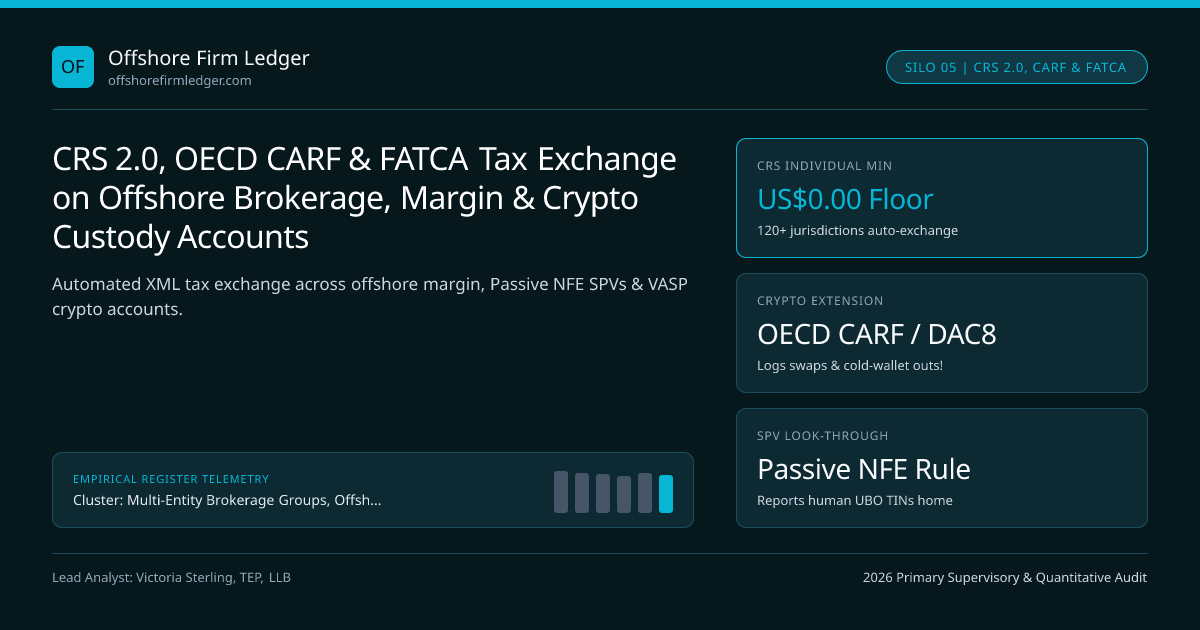
Let's bust the most dangerous 1990s Hollywood myth in offshore finance before it lands an investor in a criminal tax-evasion audit: opening a brokerage, fund, or crypto custody account in the Cayman Islands, BVI, Bahamas, Bermuda, Mauritius, Seychelles, Jersey, Guernsey, or Labuan IBFC provides ZERO tax-authority invisibility! Every single legitimate offshore financial centre is an active signatory to the OECD Common Reporting Standard (`CRS` — Automatic Exchange of Information `AEOI`) across 120+ participating jurisdictions AND US FATCA Model 1 / Model 2 Intergovernmental Agreements (IGAs)—and starting 2026–2027, CRS 2.0 and the OECD Crypto-Asset Reporting Framework (CARF) close every remaining e-money, derivatives, and crypto-VASP reporting gap! Within our Multi-Entity Group & Client Recourse hub (expanding our CRS & FATCA fund briefing), understanding what exact XML fields your offshore broker transmits every May–September keeps global portfolios 100% tax-compliant.
What CRS, CRS 2.0 & OECD CARF Actually Transmit to Your Home Tax Authority!#
Inside the Multi-Entity Group & Client Recourse cluster, when you sign a CRS Self-Certification Form (Individual or Entity—identifying Passive NFE Controlling Persons / UBOs) at a regulated Cayman CIMA, BVI FSC, Bahamas SCB, Bermuda BMA, Mauritius FSC, Seychelles FSA, or Labuan LFSA institution, here is the exact annual XML packet transmitted via the local Tax Information Authority (DITC in Cayman, ITA in BVI, MRA in Mauritius) straight to your country of tax residence:
- Standard CRS (
Custodial & Depository Financial Institutions):
- Full Legal Name, Residential Address, Date & Place of Birth, Taxpayer Identification Number (
TIN), Account Number, Year-End Dec 31 Account Balance / Equity Value, plus Gross Interest, Dividends, and Gross Proceeds/Credits!
- CRS 2.0 Amendments (Effective 2026 Onboarding / 2027 Exchanges):
- Explicitly pulls in Specified Electronic Money Products (EMIs / multi-currency fintech wallets), Central Bank Digital Currencies (
CBDCs), and indirect crypto derivatives / CFD / tracker exposures held at traditional Financial Institutions—while requiring reporting whether the Self-Certification was validly verified and whether an entity account is a joint/controlling-person role!
- OECD Crypto-Asset Reporting Framework —
CARF(60+ Jurisdictions Including Cayman, BVI, Bahamas, Bermuda, Gibraltar, Jersey, Guernsey, UK, EUDAC8, SG!):
- Previously, spot crypto held at a standalone VASP or exchange fell outside traditional CRS "Financial Assets." CARF ends that permanently: Reporting Crypto-Asset Service Providers (
RCASPs) report aggregate annual crypto-to-fiat acquisitions/disposals, crypto-to-crypto swaps, AND outbound transfers to unhosted self-custody cold wallets (total value + unit count!)!
The "Passive NFE" Look-Through Rule: Incorporating a BVI Holding Company Does NOT Stop CRS!#
Some ill-advised traders think: "Instead of opening an offshore brokerage account in my personal name, I'll incorporate a BVI Business Company for $1,500 and open a corporate trading account so CRS reports to BVI instead of my home country!" Wrong! Under CRS Section VIII (Entity Classification), an unregulated investment-holding SPV whose income is >=50% passive/trading gains is classified as a Passive Non-Financial Entity (Passive NFE)—forcing the offshore broker by law to look straight through the BVI company and report the personal TIN, home address, and full account balance directly to the home tax authority of every Controlling Person (UBO)!
Comparative Matrix: International Tax Reporting Frameworks Across Account Types#
| Reporting Regime | Covered Institutions | Key Data Fields Transmitted Annually | De Minimis Individual Floor? | Looks Through Passive SPVs? |
|---|---|---|---|---|
| OECD CRS 1.0 & 2.0 | Banks, Custodial Brokers, Funds, EMIs (CRS 2.0), CFD/Deriv FIs | Name, TIN, Dec 31 Balance, Gross Income/Proceeds, Joint/Role | $0 (NO minimum threshold for new individual accounts!) | Yes — Reports Passive NFE UBOs |
OECD CARF / EU DAC8 | VASPs, Crypto Exchanges (DABA/DARE), Crypto Brokers/ATMs | Crypto-Fiat buys/sells, Crypto-Crypto swaps, Unhosted Wallet outs | $0 (Retail merchant payment threshold $50k only) | Yes — Controlling Persons |
US FATCA (26 U.S.C. §§ 1471–1474) | All Foreign Financial Institutions (FFIs) w/ GIIN | US Persons' Name, SSN/EIN, Peak/Year-End Balance, Gross Receipts | $50,000 individual depository waiver (often waived—firms report $0+!) | Yes — Substantial US Owners (>10%) |
US FBAR (FinCEN Form 114) | Self-filed by US Citizens/Residents | Aggregate peak value of ALL foreign accounts | > US$10,000 aggregate at ANY moment in year! | Yes (>50% owned foreign entities) |
(Notice Row 1's critical detail: unlike US FBAR's $10,000 threshold, OECD CRS has a US$0.00 de minimis floor for individual accounts—even a US$250 active offshore brokerage account gets swept into the automated annual XML batch! Meanwhile, avoid unregulated scam sites in the offshore domiciles register like Blocknom or Brainwavefortune claiming "No KYC, No CRS"—because "No KYC" simply means they steal your deposit with zero audit trail!)
Quantitative Expected Penalty Model: Why Undeclared Offshore Accounts Are Financial Suicide#
Onshore legislatures (such as UK HMRC's Failure to Correct / Offshore Penalties up to 200% of tax due, Australia ATO's 75%–90% intentional disregard uplift, and US IRS willful FBAR penalties of MAX($100k+, 50% of account balance per year!)) impose draconian multipliers specifically on offshore non-disclosure:
- Where (Onshore Taxpayer Hiding US$300,000 Trading Gains = US$75,000 Tax Due for 4 Years Until CRS 2.0 / CARF Auto-Match):
- UnpaidPrincipalTax_USD = US$75,000
- StatutoryOffshorePenalty_Multiplier = 1.50 (150% aggravated offshore non-disclosure penalty)
- StatutoryLateInterest_Rate = 7.5% per annum * 4 years = 30.0%
- Worked Audit Liability:
- Statutory_Fine = 75,000 * 1.50 = US$112,500
- Accrued_Interest = 75,000 * 0.30 = US$22,500
- TotalAssessmentUSD = 75,000 + 112,500 + 22,500 = US$210,000 (70% of the entire trading profit wiped out!)
How Institutional Investors Use Offshore Hubs Lawfully: Tax Neutrality, Not Tax Secrecy!#
Why then do sovereign funds, pensions, and billionaires put US$8+ trillion into Cayman, BVI, Bermuda, Luxembourg, and Mauritius? Tax neutrality (preventing DOUBLE taxation at the fund/vehicle layer, paired with OECD BEPS substance)—where investors declare gains cleanly in their home country (or relocate physically to a territorial/0%-tax residency like UAE, Bahamas, Cayman, Monaco, or Singapore with a valid Tax Residency Certificate)!
Frequently asked questions
Does placing trading funds inside a personal BVI or Cayman company stop my home tax authority from receiving a CRS report?
No! Under CRS Entity Classification rules, a personal investment or trading SPV is a Passive Non-Financial Entity (Passive NFE)—requiring the brokerage or bank to collect and transmit CRS XML data on every individual Controlling Person (UBO) directly to each UBO's country of tax residence.
Is there a $10,000 minimum balance below which offshore brokers do not report under OECD CRS?
No. Unlike the US FinCEN FBAR ($10,000 aggregate threshold), OECD CRS imposes zero de minimis threshold on new individual financial accounts—even a $100 active account is included in the institution's annual CRS XML submission.
Are offshore crypto exchanges in Bahamas, Bermuda, Cayman, and BVI covered by OECD CARF?
Yes! Over 60 financial centres—explicitly including the Cayman Islands, BVI, Bermuda, The Bahamas, Gibraltar, Jersey, Guernsey, Singapore, the UK, and all 27 EU Member States (via DAC8)—committed to implementing the OECD Crypto-Asset Reporting Framework (CARF) across 2026–2028.
What happens if I genuinely move to Dubai (UAE) or Nassau and update my residency with my offshore broker?
Once you establish genuine statutory tax residency (backed by physical day-count compliance, residential lease, local Tax Residency Certificate, and formal tax exit from your former country where required) and file an updated CRS Self-Certification, future CRS reports route lawfully to your new jurisdiction.
Publication record
- Published
- 12 November 2026
- Updated
- 15 November 2026
- Author
- Victoria Sterling, TEP, LLB
- Review
- Review not recorded
- Automated fact check
- Passed in the stored pipeline record
- Source URLs
- 3 recorded
AI assistance recorded: anthropic/claude-opus-4.6. This field does not establish human review or source verification.
Academic & Institutional Attribution
Cite This Research & Embed Live Data Card
Standard academic & institutional research paper citation format.
Victoria Sterling, TEP, LLB. (2026, November 15). CRS 2.0, OECD CARF & FATCA Tax Exchange on Offshore Brokerage, Margin & Crypto Custody Accounts. Offshore Firm Ledger. https://offshorefirmledger.com/dossiers/crs-2-0-carf-fatca-tax-reporting-offshore-margin-custody-accountsRegulatory Directory Cross-Reference
Referenced Institutions & Regulatory Registries
Top Regulated Institutions in This Coverage Slice
Related Multi Entity Group Onboarding Arbitrage & Institutional Briefings
Explore Multi Entity Group Onboarding Arbitrage Hub (20) →Multi Entity Group Onboarding Arbitrage
Multi-Entity Brokerage Groups: Offshore Contracting Entities, Risk Routing & Client RecourseMulti Entity Group Onboarding Arbitrage
14-Point Institutional Counterparty Due-Diligence Scorecard for Multi-Entity Offshore BrokeragesMulti Entity Group Onboarding Arbitrage
Geo-IP Onboarding Routers, ESMA Article 42 Reverse Solicitation & Offshore Dropdown AuditsMulti Entity Group Onboarding Arbitrage
Statutory Investor Compensation (UK FSCS £85k & CySEC ICF €20k) vs Offshore Zero-Cover RealityMulti Entity Group Onboarding Arbitrage
Contractual 'Up to US$1M' Excess-of-Loss Client Insurance: Aggregate Caps & Deductible AuditsMulti Entity Group Onboarding Arbitrage
Private EDR (Financial Commission €20k Fund) vs Statutory Ombudsmen (UK FOS, AFCA & CIFO)Multi Entity Group Onboarding Arbitrage
Intra-Group Back-to-Back ISDA Hedging: How Offshore Subsidiaries Route B-Book & A-Book DeltaMulti Entity Group Onboarding Arbitrage
OECD BEPS Actions 8–10 Transfer Pricing: Splitting Spreads Between Onshore Tech & Offshore HubsMarket Insights
Amid Market Chaos, Stick With Your Investing PlaybookMergers and Acquisitions
Welsh aviation firm AerFin bought in £475m dealRegulatory Compliance
US Sanctions 45 More Targets Tied to Alleged Crypto Scam Empire Prince GroupOffshore Structuring
Cross-Border Exchange Domiciles (ADGM, VARA, Cayman) & Reserve Solvency Audits Following the $6.3B Breach
Offshore Firm Ledger Data, Benchmarks & Contributor Records
CC BY 4.0 Open Data
Open Institutional Datasets (CSV / JSON) →
Download desk-compiled quantitative series & schemas.
2026 Reference Matrix
2026 Institutional Benchmarks & Thresholds →
Statutory capital, clearing, margin & rate conventions.
Editorial Records
Authors & Review Records →
View named contributors where those records are available.
Complete Index
Master Research & Dossier Archive →
Browse all published briefings by topic pillar & date.