
Multi Entity Group Onboarding Arbitrage
Contractual 'Up to US$1M' Excess-of-Loss Client Insurance: Aggregate Caps & Deductible Audits
Bold homepage badges advertising "Client Funds Insured Up to US$1,000,000 at Lloyd's of London" conceal three contractual catches: $20,000 per-claim deductibles, $5M–$10M company-wide aggregate caps, and strict insolvency preconditions.
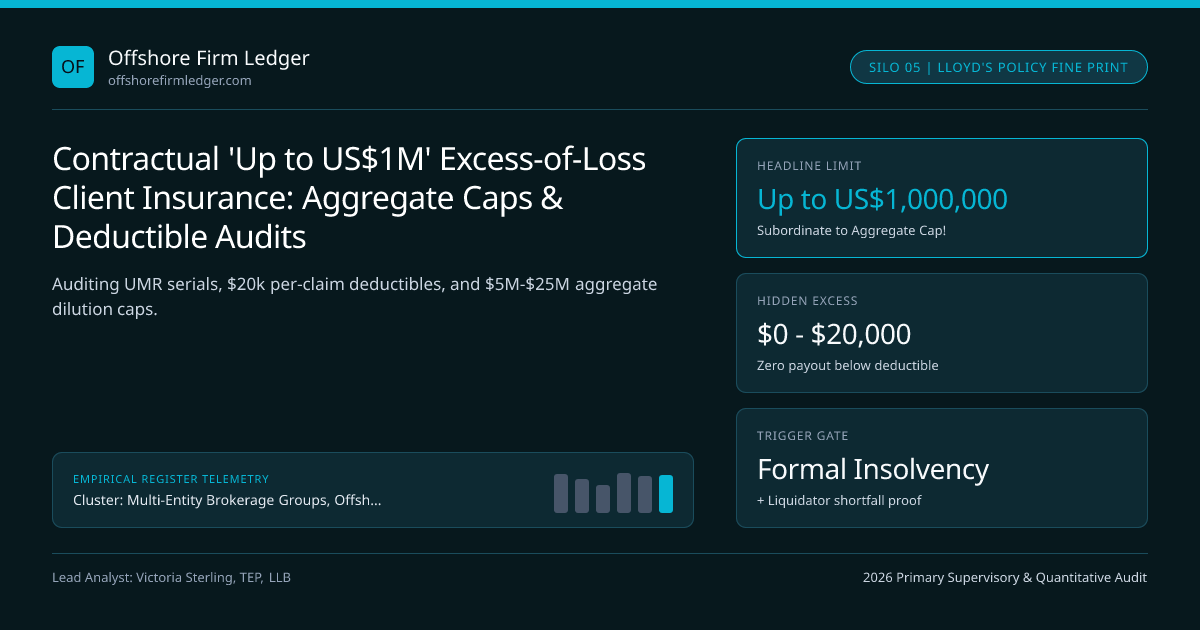
Scroll down the homepage of twenty leading Bahamas, BVI, Mauritius, or Seychelles multi-entity brokerages and fifteen will flash a gleaming gold shield proclaiming "Client Funds Insured Up to US$1,000,000 (or €1,000,000) Underwritten by Syndicates at Lloyd's of London"—crafted specifically to reassure depositors worried about the absence of UK FSCS or CySEC ICF statutory cover! Stop and download the actual 14-page Evidence of Cover & Policy Wording PDF! Within our Multi-Entity Group & Client Recourse hub, reading the Policy Schedule, Aggregate Limit of Liability, Per-Claimant Excess (Deductible), and Insolvency Trigger separates genuine institutional protection from pure marketing theatre.
Four Fine-Print Clauses Every HNW Depositor Must Check in an Excess-of-Loss Policy#
Inside the Multi-Entity Group & Client Recourse cluster, private Client Money Excess-of-Loss Insurance (arranged via specialist London market brokers like Willis Towers Watson / Marsh / Aon with Lloyd's syndicates) is a real, legitimate insurance product—unlike fake PDFs pasted by rogue sites in the offshore domiciles register such as Adam Fx Capitals or Advanced Trade. However, four structural policy terms radically alter how much you actually collect:
- Per-Claimant Deductible ("Threshold / Excess" — Commonly US$20,000!): Because these policies were originally designed as "Excess of ICF (€20,000)" policies for Cyprus brokers and then extended to offshore group subsidiaries, many offshore policies retain a US$20,000 (or €20,000) per-claimant deductible! Translation: if your entire offshore trading account holds US$15,000, your payout under a $20,000-deductible policy is literally US$0!
- Policy-Wide Aggregate Limit of Liability (Often US$5,000,000 to US$25,000,000 Total!): "Up to US$1,000,000 per claimant" is always subject to the Policy Aggregate Cap across ALL claimants combined! If an offshore subsidiary holding US$120,000,000 in client equity collapses with a 50% ($60M) shortfall, and the Lloyd's policy carries a US$10,000,000 Total Aggregate Cap, the syndicate pays at most US$10,000,000 total—just 16.7 cents per missing dollar!
- Strict Formal Insolvency & Exhaustion Trigger: Underwriters do NOT pay out because your withdrawal has been "pending review for 3 weeks" or because you dispute a stop-out! Payment triggers ONLY after: (a) a court or regulator declares the specific Insured Entity formally insolvent / in liquidation, AND (b) the court-appointed Liquidator certifies an actual shortfall in segregated client assets after preliminary estate recovery!
- Exclusions: Crypto Cold-Wallet Hacks, Sanctions, Sovereign Freeze & Intentional Owner Fraud: Standard financial-institutions wordings exclude losses from war/sanctions freezes, market trading drawdowns, unapproved third-party crypto exchange collapses (e.g., if the broker parked client USDT on FTX!), and—unless a specific Innocent Insured / Fidelity extension applies—collusive fraud by the controlling 100% UBOs!
Named Insured Verification: Is YOUR Offshore Subsidiary Actually on the Schedule?#
Watch out for a classic multi-entity sleight of hand: a group buys Excess-of-Loss cover naming its Mauritius FSC (GB...) and Bahamas SCB (SIA-...) subsidiaries on the Policy Schedule, while onboarding retail clients into an uninsured St. Vincent or Vanuatu sister entity under the same website header! Always verify three exact strings on the Evidence of Insurance Certificate:
- Insured Entity Legal Name & Domicile (must match Clause 1 of your Client Agreement verbatim!);
- Policy Period Start & Expiry Dates (policies renew every 12 months—check that the PDF on the broker's website didn't expire 14 months ago!);
- Unique Market Reference (UMR) (standard Lloyd's format starting with
B...., e.g.,B0509..., verifiable through the placing Lloyd's broker).
Comparative Matrix: UK FSCS vs Private Lloyd's Excess-of-Loss vs FinaCom Compensation Fund#
| Protection Parameter | UK FSCS (Statutory) | Private Lloyd's Excess-of-Loss Policy | Financial Commission (FinaCom) | Bare Offshore Segregation Only |
|---|---|---|---|---|
| Legal Basis | UK Act of Parliament (FSMA 2000) | Private annual commercial contract | Private EDR trade-association fund | Local Securities Act trust law |
| Per-Client Headline Cap | £85,000 (~US$108,000) | US$250,000 – US$1,000,000 | Up to €20,000 per complaint | $0 shortfall insurance |
| Per-Client Deductible | £0 (Zero deductible!) | $0, $10,000, or $20,000 (check PDF!) | €0 | N/A |
| Firm-Wide Aggregate Cap? | NO — Unlimited per-firm aggregate! | YES — $5M to $25M policy cap! | Capped by FinaCom fund reserves | N/A |
| Trigger Event | Firm in default / Special Admin | Formal Insolvency + Trust Shortfall | Member refuses binding EDR award | Liquidator distributes trust cash |
| Can Policy Lapse / Cancel? | No (While FCA-authorized) | Yes (Annual renewal / non-payment) | Yes (If broker expelled/resigns) | N/A |
Quantitative Aggregate-Cap Dilution Formula for HNW Treasury Audits#
Before relying on a "US$1,000,000 Insured" badge to justify wiring US$400,000 to an offshore subsidiary, run this 60-second Aggregate-Cap Dilution Equation comparing the policy's Aggregate Limit against the subsidiary's estimated total client deposits:
- Where (HNW Client with US$400,000 Balance Suffering a 50% = US$200,000 Trust Shortfall):
- PerClaimantCap_USD = US$1,000,000
- PolicyDeductibleUSD = US$20,000
- ClaimantExcessLoss = 200,000 - 20,000 = US$180,000
- Case A — Boutique Broker ($30M Total Client Equity -> $15M Total Shortfall; $15M Policy Aggregate Cap):
- Dilution_Factor = MIN(1.0, 15,000,000 / 15,000,000) = 1.00 -> Payout = US$180,000 (+ $200k trust = 95.0% total recovery!)
- Case B — Mega Offshore Broker ($500M Total Client Equity -> $250M Total Shortfall; $10M Policy Aggregate Cap!):
- Dilution_Factor = MIN(1.0, 10,000,000 / 250,000,000) = 0.04 (4%!) -> Payout = 180,000 * 0.04 = US$7,200 (only 1.8% extra recovery!)
Look at Case B: a US$10M aggregate policy on a US$500M offshore broker is a drop in the ocean during a systemic insolvency—whereas the exact same US$10M–$20M policy on a US$25M boutique subsidiary provides meaningful HNW protection!
Annual Policy Renewal Calendar Check Before Wiring HNW Margin#
Because private Excess-of-Loss policies run on strict 12-month underwriting cycles, institutional allocators diary the exact policy expiry date printed on the Evidence of Cover PDF, verify zero-TTCA segregated bank custody, and request the renewed London Market certificate within 15 days of each anniversary.
Frequently asked questions
Can I file a claim directly with Lloyd's of London if my offshore broker refuses to process my withdrawal while still operating?
No. Excess-of-Loss client-money policies respond strictly upon formal insolvency/liquidation of the Insured Broker and certification by the court-appointed Liquidator of a shortfall in segregated client assets—for live operational or execution disputes, you need an External Dispute Resolution (EDR) body.
Why do so many offshore Excess-of-Loss policies have a $20,000 or €20,000 deductible?
London syndicates originally structured the product as "Excess of ICF" insurance sitting above the €20,000 Cyprus Investor Compensation Fund; when multi-entity groups extended those policies to offshore subsidiaries lacking an ICF base layer, the first $20,000 excess layer often remained uninsured.
How do I verify if a broker's Lloyd's insurance certificate is genuine and active?
Download the Evidence of Insurance PDF issued by an FCA-regulated Lloyd's placing broker (such as Willis Towers Watson, Marsh, or Aon), verify the 12-month Policy Period covers today's date, check the Unique Market Reference (UMR B...), and confirm your exact contracting subsidiary is listed as Insured.
Does Excess-of-Loss client insurance cover slippage or market losses during a flash crash?
Never. Like statutory compensation schemes, private Excess-of-Loss policies cover solely eligible custody shortfalls upon formal firm insolvency—never trading losses, stop-out slippage, or market volatility.
Publication record
- Published
- 13 November 2026
- Updated
- 14 November 2026
- Author
- Victoria Sterling, TEP, LLB
- Review
- Review not recorded
- Automated fact check
- Passed in the stored pipeline record
- Source URLs
- 3 recorded
AI assistance recorded: anthropic/claude-opus-4.6. This field does not establish human review or source verification.
Academic & Institutional Attribution
Cite This Research & Embed Live Data Card
Standard academic & institutional research paper citation format.
Victoria Sterling, TEP, LLB. (2026, November 14). Contractual 'Up to US$1M' Excess-of-Loss Client Insurance: Aggregate Caps & Deductible Audits. Offshore Firm Ledger. https://offshorefirmledger.com/dossiers/contractual-lloyds-excess-of-loss-client-funds-insurance-auditsRegulatory Directory Cross-Reference
Referenced Institutions & Regulatory Registries
Top Regulated Institutions in This Coverage Slice
Referenced Supervisory Authorities
Related Multi Entity Group Onboarding Arbitrage & Institutional Briefings
Explore Multi Entity Group Onboarding Arbitrage Hub (20) →Multi Entity Group Onboarding Arbitrage
Multi-Entity Brokerage Groups: Offshore Contracting Entities, Risk Routing & Client RecourseMulti Entity Group Onboarding Arbitrage
Private EDR (Financial Commission €20k Fund) vs Statutory Ombudsmen (UK FOS, AFCA & CIFO)Multi Entity Group Onboarding Arbitrage
Intra-Group Back-to-Back ISDA Hedging: How Offshore Subsidiaries Route B-Book & A-Book DeltaMulti Entity Group Onboarding Arbitrage
OECD BEPS Actions 8–10 Transfer Pricing: Splitting Spreads Between Onshore Tech & Offshore HubsMulti Entity Group Onboarding Arbitrage
Omnibus Prime-of-Prime Margin & TTCAs: Why Offshore Client Segregation Fails on LP DefaultMulti Entity Group Onboarding Arbitrage
Statutory vs Contractual Negative Balance Protection: Auditing Retroactive Voidance ClausesMulti Entity Group Onboarding Arbitrage
Governing-Law & Exclusive Offshore Arbitration Clauses: Litigating Tortola, Mahé & Port LouisMulti Entity Group Onboarding Arbitrage
Intra-Group EU & UK Payment-Agent Subsidiaries: Billing Descriptors & Visa/MC Chargeback LawPrivate Equity
McGuireWoods Appoints Murielle Dawdy as Managing Director, Private Equity - McGuireWoodsPrivate Equity
Private Equity Quarterly Report | Third Quarter 2026 Update - Holland & KnightHealthcare Financing
Lower resident board pass rates in private-equity backed emergency physician groups - 2 Minute MedicineRetirement Planning
Why Private Equity Might Be a Threat to Your 401(k) - Morningstar
Offshore Firm Ledger Data, Benchmarks & Contributor Records
CC BY 4.0 Open Data
Open Institutional Datasets (CSV / JSON) →
Download desk-compiled quantitative series & schemas.
2026 Reference Matrix
2026 Institutional Benchmarks & Thresholds →
Statutory capital, clearing, margin & rate conventions.
Editorial Records
Authors & Review Records →
View named contributors where those records are available.
Complete Index
Master Research & Dossier Archive →
Browse all published briefings by topic pillar & date.